My conscious gaze towards the cosmos began not with a telescope, but with the serendipitous arrival of a book – perhaps by Carl Sagan, perhaps by Carlo Rovelli – into my hands, a decade or more ago. Before this celestial spark, my encounters with the stars, the moon, the vast theatre of the night sky, were confined to fleeting, poetic whispers within literature. These were beautiful, yet ultimately unfulfilling; like glimpsing starlight reflected in a shallow pool, they offered a shimmer but no depth, vanishing almost as soon as they appeared. The scientific texts themselves presented a formidable frontier. I confess, their intricate terminology, equations and theories often eluded my grasp, yet their narrative grandeur proved utterly captivating. Sagan’s own words resonate: “The cosmos is within us. We are made of star-stuff. We are a way for the universe to know itself.” This profound truth, even partially grasped, instilled a sense of hypnotic magnetism. The books painted not just facts, but a visceral panorama: the staggering, almost incomprehensible enormity of the observable universe, a realm where billions of galaxies spin in the dark; the intricate, near-miraculous complexity of matter itself, from the quantum foam to swirling nebulae; the timeless enigma of time, stretching beyond human comprehension; the fundamental intrigue of gravity, the invisible sculptor shaping the dance of celestial bodies. They revealed the agonising insignificance of light-years, mere scratches on the surface of an endless, silent abyss –distances so vast they render even light a slow traveller. And above all, they laid bare our profound cosmic ignorance. As Carlo Rovelli might frame it, peering into this immensity forced a humbling confrontation with the limits of our understanding, a sentiment echoing Socrates: “I know that I know nothing.” This initial encounter was less about mastery and more about awakening to the awe-inspiring, humbling scale of the mystery itself.
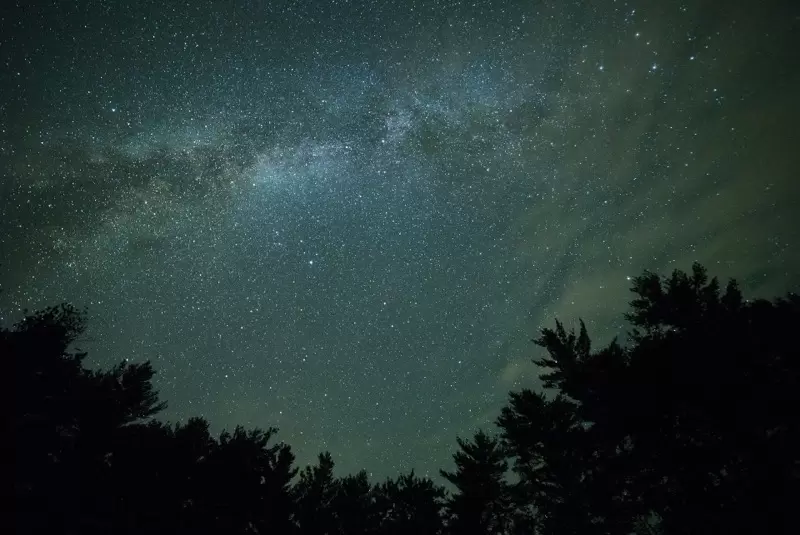
So, when I grasped the staggering truth – that the glittering multitude I beheld from my small lawn in a remote Kashmir hamlet was but a vanishing fraction of the observable universe, a mere handful of diamonds scattered near the doorstep of infinity – my fascination ignited into something fiercer, more profound. Thank God, I often think, for this high-altitude sanctuary where the Himalayan air, thin and unpolluted, renders the cosmos painterly clear, night after crystalline night. As my celestial hunger grew, my engagement deepened: I exchanged the chair for a swing, and finally, surrendered to the earth itself upon a humble charpoy. This horizontal posture felt less like observation and more like yielding to the sublime, an act of cosmic receptivity. Yet this communion was rarely peaceful. Gazing upward frequently plunged me into the exquisite agony of a paradoxical realisation, echoing Pascal’s timeless Pensées: “Man is but a reed, the feeblest thing in nature; but he is a thinking reed… If the universe were to crush him, man would still be more noble than that which killed him, because he knows that he dies…” How crushing is our physical insignificance against such cosmic immensity? And yet, how utterly transcendent is the human capacity to perceive, to feel, that very immensity – to hold the abyss within the compass of a conscious mind? This vertiginous duality mirrors the sensation experienced reclining at sunset amidst endless green plains: the landscape dwarfs you, pressing your smallness upon your soul. But in that crushing awareness, a miraculous inversion occurs. As the poet Rainer Maria Rilke might suggest, “The purpose of life is to be defeated by greater and greater things.” The feeling doesn’t merely diminish; it compresses the vastness, forging an intimate, almost unbearable intimacy with the infinite. The boundless sky, the measureless plain – they cease to be merely outside; they become interior landscapes, mapping the soul’s own capacity for awe. We are small, yes, but within us burns a spark capable of illuminating and containing the universe.
They hang suspended in the velvet dark, dense clusters of frozen fire, their thin, ancient light traversing great voids. From my earthly vantage, their twinkling rays seem to tremble on the brink of connection, almost kissing across the abyss; yet the reality, as astrophysics coldly reveals, is a cruel illusion of perspective. The true distances between them are unfathomable gulfs, voids so vast they put light-years to shame, isolating each stellar furnace in a solitude as deep as eternity. They have burned for aeons beyond human comprehension, their nuclear hearts beating since before Earth coalesced from stellar dust. Watching them, I sometimes sense a cosmic weariness in their patient gleam—as if they are tired witnesses to the unfolding drama of existence itself. What have they not seen? They have beheld the birth and death of worlds, the slow drift of galaxies, the flickering emergence of life on one tiny, blue orb—and upon it, countless eyes turned upwards in wonder. Our eyes meet across the light-years. I gaze, and in that act, join an unbroken chain of consciousness stretching back to the first human who dared to look up in awe, and forward to those yet unborn who will inherit the same star-strewn mystery. Across the globe, in this very moment, another gazer lies upon their charpoy or stands on a distant shore, their upturned face bathed in the same ancient photons. The poets who spun verses to Orion’s belt, the scientists who charted celestial mechanics, the lovers who traced constellations in each other’s palms—for millennia, we have all looked up. As Whitman proclaimed, “I believe a leaf of grass is no less than the journey-work of the stars…”—acknowledging the shared cosmic thread. And Johannes Kepler, centuries ago, captured the essence: “We do not ask for what useful purpose the birds do sing, for song is their pleasure since they were created for singing. Similarly, we ought not to ask why the human mind troubles to fathom the secrets of the heavens.” In that shared, upward glance, across cultures and epochs, we touch the same profound mystery. The stars become more than distant suns; they are silent bridges, connecting soul to soul through the shared language of awe, whispering the same eternal question into the darkness of every human heart that dares to look.
When a star suddenly scampers across the vault of night, a transient miracle of light, my breath catches, and instinct takes hold. In the thin mountain air of Kashmir, under a sky so clear it feels like cracked obsidian, I whisper prayers for those dear to me. It is an old reflex, echoing childhood teachings: “When stars scuttle,” they said, “entreat the heavens, for in that fleeting moment, the cosmos leans close, and God attends.” There is a profound vulnerability in this act—casting human hopes into the infinite on the back of a burning speck of dust. Yet, alongside this tenderness coils a darker, more primal fragment of memory. Vaguely, like half-remembered lore from a schoolroom shadowed by ancient fears, I recall a teacher’s voice: These are no falling stars, but celestial artillery, debris hurled by angels at retreating devils, celebrating their dark triumphs after leading the sons of Adam astray. As Carl Sagan observed in Pale Blue Dot, we are prone to project our dramas onto the cosmos: “We are like butterflies who flutter for a day and think it is forever.” This myth, too, is a projection—a human attempt to narrate chaos, to cast the impersonal violence of cosmic debris entering our atmosphere as a grand, moral battleground between light and shadow. The scientific reality, that these running stars are mere meteors, fragments no larger than pebbles, vaporising in a fiery death, collides with the weight of these stories. As Annie Dillard wrote in Pilgrim at Tinker Creek, “Beauty and grace are performed whether or not we will or sense them. The least we can do is try to be there.” Whether seen as divine intercession or demonic pursuit, the meteor’s streak remains a silent, indifferent spectacle of physics. Yet in that indifference lies a deeper truth: our prayers, our myths, our trembling awe—these are the sparks we strike against the dark, asserting meaning in a universe governed by laws far older than gods or devils. In the end, the shooting star is a mirror: we see in its brief fire our own longing for connection, our terror of insignificance, and the stories we must tell to bridge the abyss.
Gazing into the firmament for a long, unbroken stretch works a subtle alchemy. The static field of stars begins to breathe. Constellations dissolve; new patterns emerge as if etched by an invisible hand. Pareidolia of the cosmos takes hold: stars pulse with vitality, some flaring sharper in the rarefied air, others retreating into velvety oblivion. Celestial geometries materialise, lines arc between points, forming transient triangles, spirals, sigils written in ancient light. The sky ceases to be a passive backdrop; it becomes a living, shifting tapestry, thrumming with silent stories. In this liminal state, a conviction blooms: None of these radiant points is accidental. Each gleams with intention—not in a literal sense, but as symbols etched into the void. Perhaps, as Rilke whispered to the stars, “Death is our friend precisely because it brings us into absolute and passionate presence with all that is here…” Could it be that when we die, we do not vanish, but are transfigured? That we become starlight—eternal witnesses gazing back at the world we loved? They do not depart; they linger in the firmament, their light a tender vigil. Maybe, in forms beyond our comprehension, they miss us. And when we sleep, vulnerable, dreaming, they burn brighter, as if leaning closer to brush our souls with radiance. Carl Sagan’s reflection resonates: “For small creatures such as we, the vastness is bearable only through love.” This cosmic communion is a double grace. Whatever minuscule fraction of the universe we glimpse each night, a mere handful of diamonds from infinity’s trove, we are incalculably fortunate. And so, too, is that starlit fragment, for it is witnessed by the only consciousness we know: us. As Richard Feynman pondered, “The atoms that compose us… trace back to stars that exploded long ago. We are literally stardust.” We are strange, star-born creatures, granted the sacred task of seeing—and in seeing, we complete the cosmos. The universe beholds itself through our eyes. In this reciprocal act of awe, both the observer and observed are made whole.
-30-
Copyright©Madras Courier, All Rights Reserved. You may share using our article tools. Please don't cut articles from madrascourier.com and redistribute by email, post to the web, mobile phone or social media.Please send in your feed back and comments to [email protected]