When it comes to Indian cinema, one could comfortably say that the line between “inspired by” and “blatant rip-off” is often as blurry as the plotlines in a masala movie. With a staggering output of over 2,000 films a year, the Indian film industry has earned its spot as one of the “biggest” in the world—delivering everything from high-octane action flicks to tear-jerking dramas, dance numbers that could put Broadway to shame, and of course, the film that leaves you wondering whether you just watched a reimagining of a forgotten Hollywood classic or a straight-up bootleg. But, let’s not beat around the bush: sometimes, what Indian filmmakers call “inspiration” could easily be mistaken for something far more sinister—like, say, plagiarism.
The term plagiarism, according to the dictionary, is defined as “wrongful appropriation” or “close imitation” of someone else’s work, and the act of presenting it as one’s own. And if we apply this definition to some of the more “inspired” pieces of Indian cinema, it’s hard not to ask: when did copy-pasting become an acceptable mode of creative expression? After all, some of Indian cinema’s biggest hits, while they may have seemed fresh and innovative to the average viewer, turn out to be little more than rewrapped, rebranded versions of films that came from other shores. But, rather than facing an uproar about intellectual property theft, these films have often been hailed as triumphs of adaptation—or, in most cases, unapologetic cash grabs that turned a plump profit for everyone involved.
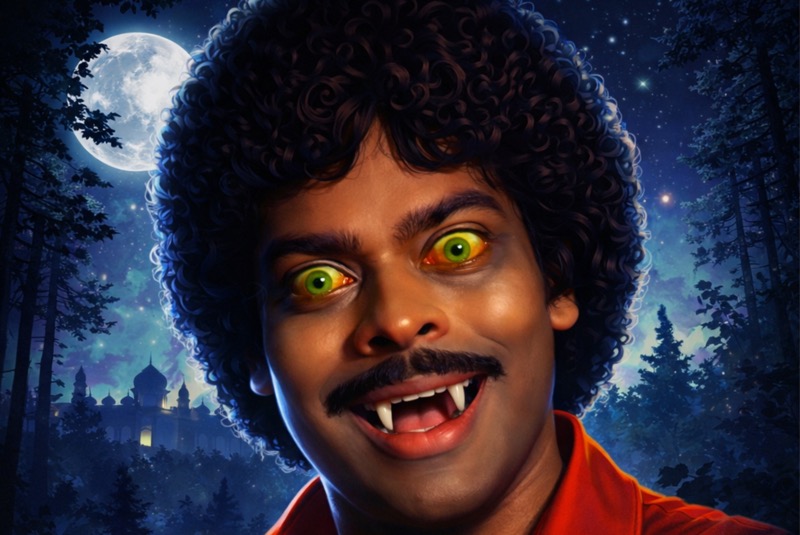
Take, for example, the Telugu film Donga (1985), starring Chiranjeevi, a man whose career has revolved around grand gestures and gloriously over-the-top spectacles. The film opens with a scene that is, well, strikingly familiar: Chiranjeevi struts down a street in a flashy red leather outfit, flanked by his girl, when suddenly, a horde of zombies emerges from a nearby graveyard. The real kicker? These zombies break into a neck-jerking dance routine, and the hero joins them, morphing into a zombie himself.
Now, unless you’ve been living under a rock for the past 40 years, this particular scene is a blatant copy of Michael Jackson’s Thriller—from the costumes to the choreography, even the zombie-as-dance-partner motif. The result? A resounding hit, with the song racking up millions of views on YouTube, Chiranjeevi earned millions more and shamelessly branded himself “Mega Star.” Yet, the fact that the entire sequence is a cheap remake of Michael Jackson’s Thriller is rarely acknowledged. Creatively speaking, the “Mega Star” is nothing but a Mega Fraud. But hey, it worked—Chiranjeevi made his money, the audience got their entertainment, and everyone walked away happy…except, perhaps, the ghost of Michael Jackson.
This isn’t the first time Chiranjeevi’s films have resorted to such copyright infringement. Khaidi (1983) was a blatant rip-off of Sylvester Stallone’s film, First Blood, released just a year earlier in Hollywood in 1982.
This type of cheap appropriation has been part of Indian cinema for decades. Remember Dil Hai Ki Manta Nahin (1991), a film starring Aamir Khan and Pooja Bhatt, which, if you’ve ever seen the classic Hollywood film It Happened One Night, will have you doing a double-take. The story, the romance, the plot twists—basically everything—feels as if it were repackaged from Frank Capra’s 1934 romantic comedy, with a little bit of Bollywood flair added for spice. Yet, this wasn’t exactly the sort of homage that earned awards for originality; it was more of a “let’s take the American film, tweak a few things, and make it our own” situation. And, unsurprisingly, it worked. The film became a box-office hit, Aamir Khan’s star power continued to soar, and the original creators wondered whether they should start charging royalties.
But let’s not kid ourselves—this isn’t just about a couple of outliers. For years, Indian directors and producers have been walking the fine line between adaptation and imitation, often straddling the boundary with shameless ease. After all, in the pre-Internet days of the 80s and 90s, when cable television was a novelty and foreign films were hard to find, the average Indian moviegoer had little access to original content. So when a Bollywood director lifted entire scenes, storylines, or even entire genres from Hollywood, it was less a matter of malicious intent— perhaps simply the easiest way to guarantee a commercial hit. Copy-Paste-Mint Money. Screw creativity and originality. The audience didn’t know better, and the filmmakers didn’t seem to care. Sarkaar (2005), for instance, lifted its plot directly from The Godfather, albeit with a much more “Indian” twist. Meanwhile, Zinda (2006) took its cues from the iconic Korean film Oldboy, with absolutely no shame.
It would be easy to dismiss these as harmless cultural exchanges, but when does homage cross the line into theft? Is it plagiarism when you replicate not just the plot but the entire essence of another’s intellectual property? Because in a country where ideas can sometimes be more valuable than the rupee itself, the question must be asked: How is it that someone else’s creativity has essentially bankrolled some of the most profitable Indian films?
Plagiarism isn’t just about stealing an idea—it’s about taking someone else’s blood, sweat, and tears, and profiting from them without so much as a thank-you. It’s a kind of fraud, where directors (and let’s not forget actors, who often rise to fame on the back of these borrowed plots) wrongfully claim credit for work that isn’t theirs. And the worst part? The industry doesn’t seem to care. For some directors, it’s just a cheap copy they shrug off with a wink. “Who cares if it’s the same plot,” they’ll say. “At least we made it colourful and gave it a song.” The moral? As long as you hit the audience and make enough money, who’s really going to notice the blatant theft? As it turns out, a lot of people—especially now, when the Internet allows fans to spot a rip-off from a mile away immediately.
This brings us to an even more troubling aspect: the exploitation of the audience’s loyalty. In the golden age of cable TV, the audience didn’t have the luxury of googling Dil Hai Ki Manta Nahin to check if it was really just a cheap copy. They trusted the filmmakers, who knew that the vast majority of moviegoers would take whatever was offered as new without questioning its origins. But now, with global access to films from every corner of the world, it’s becoming harder and harder to get away with it. You might call it “adaptation” or “inspiration,” but when the filmmakers are making millions off of someone else’s hard work, it’s hard to ignore the elephant in the room.
So here’s the question: Is this just a charming quirk of Indian cinema—its unique ability to take something borrowed and make it its own? Or is it a deep-seated, systemic issue of intellectual property theft that needs to be addressed? If we’re being honest, it’s blatant theft, devoid of morals and ethics. In the world of Indian Cinema, imitation may be the sincerest form of business. And no matter how many zeros you tack onto the end of the box office receipts, that still smells a lot like copyright infringement.
-30-
Copyright©Madras Courier, All Rights Reserved. You may share using our article tools. Please don't cut articles from madrascourier.com and redistribute by email, post to the web, mobile phone or social media.Please send in your feed back and comments to [email protected]