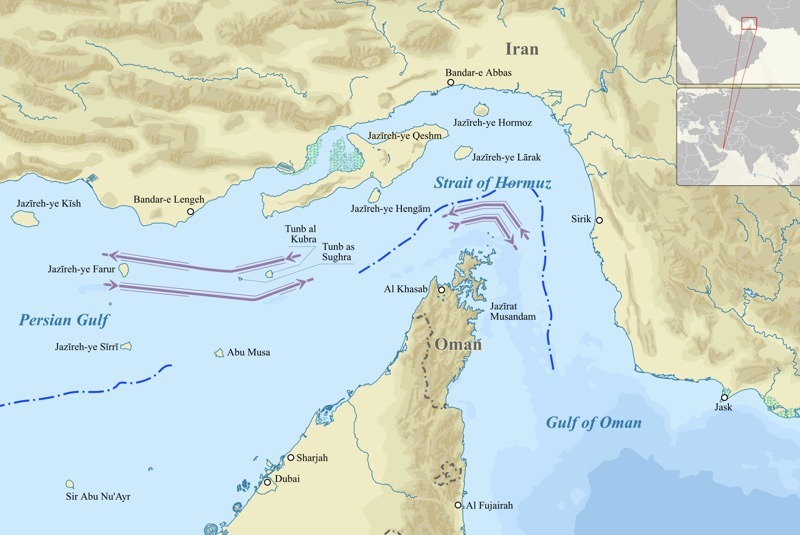
The Strait of Hormuz, a narrow artery through which roughly a fifth of the world’s oil supply passes, is no longer reliably open. The United States and Israel’s war against Iran has unsettled commercial shipping to the point of near paralysis. Tankers idle, insurers reprice risk with brutal speed, and energy markets shudder. Geography, which makes the strait indispensable, also renders it fragile.
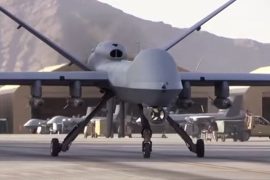
For Tehran, the logic is uncomplicated. Its long northern coastline hugs the Persian Gulf, placing it within easy reach of the shipping lanes. Rather than relying on expensive conventional platforms, it can project asymmetric force, using drones, fast attack craft, and mobile launchers dispersed along the shore.
Such tools are hard to detect and quick to deploy, often with plausible deniability. The aim is not a formal blockade but a climate of menace. Merchant captains and insurers, sensitive to even modest risks, respond accordingly. In practice, uncertainty can be as effective as interdiction.
In Washington, D.C., the rhetoric has been muscular. Donald Trump has demanded that Iran restore safe passage and has urged allies in NATO to contribute to maritime security. But the distance between rhetoric and execution is considerable.
Keeping commercial shipping moving through a contested chokepoint is not a matter of dispatching a handful of warships. Naval planners describe it as a campaign: phased, resource-intensive and laden with escalation risks. The opening stage would seek to reduce Iran’s capacity to threaten vessels, plausibly through sustained air strikes on the infrastructure that enables such attacks.
American air power could degrade radar systems, command networks, depots and launch sites along Iran’s coast. Its advantages in intelligence, surveillance and reconnaissance are formidable. But the apparent neatness of this approach dissolves when it comes into contact with reality. Iran’s arsenal includes large numbers of drones that require little in the way of fixed infrastructure. They can be assembled and launched from warehouses, improvised strips or sites embedded near civilian activity.
The intelligence burden is therefore heavy. Fixed targets can be mapped; mobile and concealable systems are another matter. Even an effective strike campaign would leave residual capabilities intact, sufficient to sustain a low-level but significant threat.
Only then could a second phase begin. Commercial shipping depends not on absolute safety but on tolerable risk. Lowering that risk would require a dense mesh of monitoring and protection. Airborne early-warning aircraft would extend radar coverage across the strait and into adjacent waters; maritime patrol planes would scan for suspicious movement; fighters would maintain continuous patrols; shipborne helicopters would respond rapidly to small, fast-moving threats.
At sea, naval vessels would both deter and escort. Convoys—an echo of earlier maritime conflicts—would likely return in some form. But the arithmetic is awkward. Each convoy demands protection; each additional ship increases both capacity and exposure. Large formations may appear safer but also present more attractive targets unless the adversary’s strike capabilities have been substantially curtailed. The result is a voracious demand for ships and crews at a time when military planners are already stretched across theatres.
Complicating matters further is the enduring menace of naval mines. These need not be numerous to be effective: suspicion alone can halt traffic. Some float visibly; others lurk below the surface, triggered by contact or by the acoustic signature of a vessel. Clearing them is painstaking and slow, often taking weeks or months.
Iran’s incentives are not entirely aligned with maximal disruption. Its own exports, much of them shipped from terminals such as Kharg Island, depend on the same corridor. Extensive mining would therefore impose costs on Tehran itself. More sophisticated mines, designed to discriminate between targets, face technical limits in crowded waters, raising the risk of unintended strikes.
Even so, ambiguity favours Iran. Mines can be laid covertly from a range of platforms, including civilian-looking vessels. Detection, though aided by American surveillance, is not assured in real time. Strategic uncertainty magnifies the disruptive effect of relatively modest actions.
Why, then, has America not already mounted a comprehensive effort to secure the passage? The answer lies less in capability than in priorities and risk. Resources are finite, and the broader campaign extends beyond maritime security. Strikes on Iran’s ballistic-missile programme and nuclear infrastructure—often hardened, concealed or buried—require sustained sorties and specialised munitions. Diverting aircraft and intelligence assets to escort duty would dilute those efforts.
Geography, too, intrudes. Securing a strait is not solely a naval task; it implicates the land on either side. As long as Iran can operate from its coastline, ships remain within reach of drones, missiles and swarming boats. Neutralising that threat comprehensively could entail operations ashore, with all the attendant risks of escalation and political cost. For a military already engaged in a high-intensity campaign, opening even a limited additional front is no small matter.
There is also the human calculus. A single American warship carries hundreds of personnel. In an environment where relatively cheap systems—uncrewed explosive boats, loitering munitions or anti-ship missiles—can inflict serious damage, commanders must weigh the value of reopening the strait against the risk of losing lives as well as hardware. Until the threat is sufficiently reduced, that trade-off may look unfavourable.
The result is a form of maritime conflict that defies simple remedies. Control of a narrow waterway, once the preserve of fleets and firepower, now depends on dispersed technologies, intelligence and the psychology of risk. Iran need not seal the strait entirely; it need only make passage uncertain enough to deter. America, for its part, possesses ample means to contest this strategy, but aligning its use with broader war aims while containing escalation is a subtler task than public statements suggest.
For now, the world watches with a mixture of anxiety and weary acceptance. Some ships continue to pass, threading through a landscape of largely invisible dangers; others linger, tallying costs that reach far beyond freight rates. The water remains what it always was—narrow, strategic and exposed—but the balance of power that governs it is being renegotiated in real time, shaped as much by caution as by force.
-30-
Copyright©Madras Courier, All Rights Reserved. You may share using our article tools. Please don't cut articles from madrascourier.com and redistribute by email, post to the web, mobile phone or social media.Please send in your feed back and comments to [email protected]