“The Indians are bastards anyway,” Henry Kissinger told Richard Nixon in December 1971 as Indian forces advanced toward Dhaka. Nixon, for his part, had described Indian Prime Minister Indira Gandhi as “old witch.” These were not merely expressions of private prejudice. They revealed the mindset that shaped American policy.
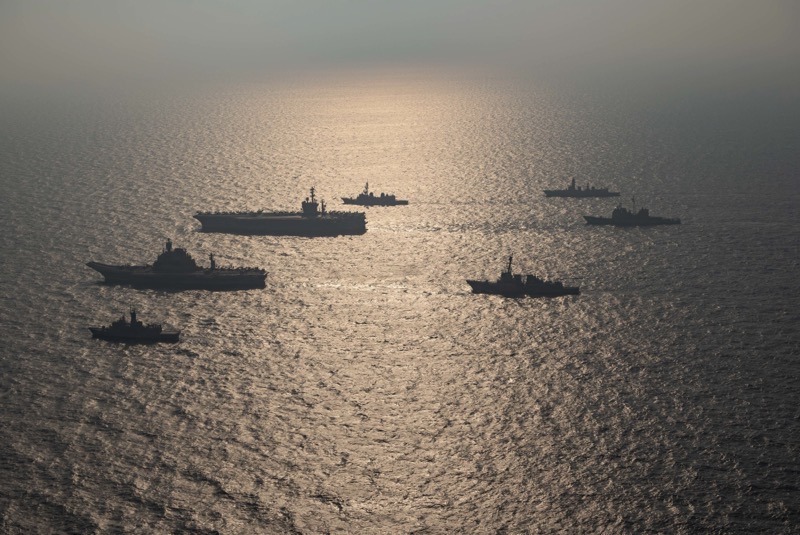
Eight months before that conversation, U.S. Consul General Archer Blood had warned Washington, in what became known as the Blood Telegram, that the United States was complicit in the “moral bankruptcy” of Pakistan’s brutal military campaign against Bengalis in East Pakistan, before its liberation to become Bangladesh. The warning was largely ignored. Eight months later, the Nixon administration dispatched the USS Enterprise into the Bay of Bengal—a nuclear-backed signal of support for Pakistan and coercive pressure on India, even as American diplomats had already documented, in their own cables, atrocities they believed amounted to genocide. The USS Enterprise was more than an instrument of intimidation. It stood as a testament to an unequal partnership that, half a century later, has merely adopted more sophisticated terminology.
If New Delhi believes the United States regards India as a strategic partner, it is mistaken. To Washington, India is a strategically indispensable recruit. Strategic partners shape the agenda by mutual consent; recruits serve it. India’s defenders of the Washington relationship will argue that New Delhi uses the partnership instrumentally — extracting technology and hardware while gradually modernising its armed forces and leveraging the Quad to balance China. Though this argument is persuasive and politically appealing inside South Block, it mistakes tactical manoeuvrability within an asymmetric relationship for strategic autonomy. In the end, it describes, with apparent satisfaction, the act of choosing which leash to wear.
One of the most seductive arguments for leaning into Washington is the case for technology transfer. The United States has offered India access to advanced defence technologies — the GE F414 engine deal, the Defence Technology and Trade Initiative (DTTI), and co-production frameworks under iDEX. These come with fine print buried beneath the celebratory joint statements. End-Use Monitoring Agreements (EUMAs) require American officials to inspect Indian military platforms on Indian soil. The intellectual property restrictions prevent India from reverse-engineering, modifying, or exporting what it nominally owns. Co-production arrangements stop well short of substantive co-development. The F414 deal, hailed as a landmark, enables licensed manufacture, while withholding the design knowledge that underpins genuine strategic capability.
In the early 1990s, when India sought cryogenic rocket engine technology from Russia, American pressure under the Missile Technology Control Regime compelled Moscow to strip the technology-transfer component from the deal, leaving India with engines but no blueprints. ISRO eventually developed the capability independently, after years of costly delay. Capability denial required neither hostility nor sanctions—only leverage.
The contrast is evident in the BrahMos programme. The Indo-Russian joint venture built Indian engineering capacity, created genuine co-ownership, and produced a missile system India has since exported to the Philippines, Vietnam, and Indonesia. That is technology transfer in substance. American policy, by contrast, transfers manufacturing, not mastery.
What exactly does India purchase when it buys an American weapons platform? The aircraft is only the visible component. When India acquires F/A-18 fighters, Apache attack helicopters, or C-17 transport aircraft, it also acquires long-term obligations for American spare parts, maintenance schedules, software support, and contractual restrictions that can limit modifications, upgrades or integration with non-American systems. You don’t just buy the hardware. You buy the relationship — permanently, on their terms. The recent American pressure on India to reduce Russian arms procurement, reinforced by the possibility of CAATSA sanctions, illustrates the coercive logic underlying an ostensibly commercial relationship. India’s push for Atmanirbhar Bharat (self-reliant India) in defence is, in part, an acknowledgement that dependency is a liability.
Despite years of Quad declarations on supply-chain resilience, India remains heavily dependent on Chinese processing of rare earths and critical minerals, which are essential to defence electronics, missile guidance systems, and clean-energy infrastructure. No Quad initiative has meaningfully changed this. Instead, the Quad has layered a security commitment against China atop an unresolved economic dependency on it — asking India to assume strategic risk while remaining tethered to the country’s supply chains it is expected to confront. This is strategic exposure masquerading as resilience.
India’s patent regime and compulsory licensing provisions are the legal foundations of its role as the “pharmacy of the Global South”—the source of affordable generics for HIV, cancer, and tuberculosis treatment across dozens of countries. These same provisions have repeatedly placed India on the U.S. Trade Representative’s “Special 301” Watch List, accompanied by sustained pressure to weaken them in the name of intellectual property protection. Section 3(d) of India’s Patents Act bars drug companies from extending patent monopolies through cosmetic modifications to existing molecules — a manoeuvre the industry dignifies as “evergreening” and public health advocates recognise as an extension of monopoly pricing. American pharmaceutical firms have consistently lobbied to dismantle it under the euphemism of “regulatory alignment.”
What the United States considers a trade barrier is, for the world’s poorest patients, the legal foundation for affordable medicine. This is what a partnership looks like when one partner holds the Special 301 pen. The relationship that offers India “partnership” on defence technology simultaneously pressures it to dismantle the policy architecture that underpins its soft power and its value to the developing world.
It promotes India as a partner in global health, particularly after COVID, when Indian vaccine manufacturing became diplomatically convenient while simultaneously pressuring India to weaken the legal framework that makes affordable medicine possible in the first place. Nobody in Washington appears to find this hypocritical because the costs fall entirely on India’s side of the relationship.
The Quad is often portrayed as the crowning glory of US-India strategic partnership. It is also its most glaring vulnerability. The Quadrilateral Security Dialogue serves American realpolitik interests: it provides the geographic depth and maritime reach that containment of China warrants. India’s inclusion is geopolitically valuable to Washington. India is not the Quad’s primary beneficiary. Rather, India is the asset.
Geography imposes constraints the Quad cannot erase. They share 3,488 kilometres of frontier, marked by unresolved territorial disputes, and more than $ 150 billion in bilateral trade. China is India’s largest trading partner, surpassing the US. Above all, they share a neighbourhood and a chequered history that neither can escape by signing a joint statement in Canberra. The Galwan Valley clash of 2020 was real, bloody, and remains unresolved. The American response, however, was rhetorical. Washington expressed diplomatic support but offered neither treaty assurances nor a commitment to military intervention. It offered what great powers often reserve for partners in moments of crisis: diplomatic statements bereft of tangible guarantees.
The Quad is not NATO. Its limitations are explicit: no Article 5 equivalent, no integrated command, and no binding mutual-defence obligation. The Quad provides India with summits, working groups, and joint statements and a rhetorical solidarity – that conspicuously failed to translate into anything tangible when Indian soldiers were dying on the LAC. In an alliance, the risks and obligations are mutually shared. The Quad distributes geographic and military risk toward India while concentrating the principal strategic benefits in Washington.
Washington gets a democratic front for Indo-Pacific containment, a partner whose geography does the strategic heavy lifting, and a reliable buyer of American weapons — all without committing a single troop. The “democracy versus authoritarianism” framing is how this realpolitik overture gets sold to the public.
What, then, does India gain? Conditional technology and vendor dependence rebranded as modernisation. A seat at a table whose agenda it neither set nor can meaningfully influence. And the growing risk of being drawn into confrontations — from Taiwan to the South China Sea — whose strategic objectives are Washington’s, but whose costs would fall on New Delhi. The costs of American-led containment are not borne equally. They are borne proximately by those who share China’s geography, not by the United States, insulated from it by the Pacific Ocean.
The events of 2025 laid bare the hierarchy beneath the rhetoric of partnership. When India continued purchasing discounted Russian crude—an entirely defensible energy-security decision for a country as dependent on imported oil as India—it found itself facing American tariff measures explicitly linked to that choice. A “strategic partner” was penalised for exercising its independent judgment in its own national interest by the very administration that simultaneously presented the relationship as a partnership of equals. If Washington cannot accommodate India exercising the most fundamental prerogative of a sovereign state—deciding where to buy its energy— it was never a framework of sovereignty to begin with but of managed compliance.
India’s strategic elite should recognise the pattern. The Washington Consensus of the 1980s and 1990s presented the IMF and the World Bank as partners in development through structural adjustment programmes. What they delivered was austerity, constricted fiscal space, privatisation and market liberalisation under conditions largely shaped by external creditors. The weaponisation of the dollar against Iran, Russia, Venezuela, and Cuba did not present itself as coercion. It presented itself as the defence of a rules-based international order. American hegemony has long spoken the language of partnership. India, of all countries, should know how to read the fine print
BRICS is no panacea. The India–China relationship within the grouping remains structurally competitive, and no multilateral forum can dissolve a live border dispute. Nor is the BRICS immune to internal divergences and competing national interests. It can broaden India’s diplomatic options, but it cannot substitute for the deft statecraft required to manage India’s most consequential bilateral relationship.
BRICS is useful to India for purposes that have nothing to do with confronting China and everything to do with consolidating a multipolar global order. The New Development Bank extends development finance without the policy conditionality that has historically accompanied World Bank and IMF lending. The expansion of BRICS to include Saudi Arabia, the United Arab Emirates, Iran, Egypt, Ethiopia, and Indonesia reflects a grouping whose combined economic weight increasingly rivals that of the G7, while commanding enormous influence in global energy, agriculture, manufacturing, and critical supply chains. Its gradual pursuit of de-dollarisation, however uneven, represents an effort to build greater financial autonomy from a dollar-centred system that has repeatedly served as an instrument of American geopolitical leverage.
In 1971, India confronted a world in which great powers expected alignment and punished independence. New Delhi chose neither isolation nor subservience. The Indo-Soviet Treaty of Peace, Friendship and Cooperation was not an act of ideological loyalty to Moscow, but a recognition that independent statecraft sometimes requires balancing power to preserve sovereignty. It was a deterrence instrument — specifically designed to constrain American and Chinese intervention as Indian forces moved toward Dhaka. It worked because it created a credible deterrent, raising the perceived costs of American or Chinese intervention beyond what Washington was willing to pay. The liberation of Bangladesh demonstrated what an independent foreign policy could achieve when guided by national interest rather than external approval.
Every relationship — with Washington, Moscow, Beijing, Brussels, or Brasília — should be judged by one standard: does it expand India’s strategic choices, or does it narrow them?
When the British arrived to trade, India was a civilisation that accounted for roughly a quarter of the world’s economic output. Through a combination of economic extraction, political fragmentation, and imperial policy, that wealth and influence were progressively eroded as commercial dependence culminated in political subordination. Yet empire also relied on Indian acquiescence and division; the machinery of colonial rule was sustained as much by internal fragmentation as by external power.
A country that built a world-class space programme despite technology denial, supplies affordable medicines to much of the developing world, and spent decades defending its strategic autonomy after colonial rule has every capacity to remain the author of its grand strategy. The critical question is whether it chooses to be.
The most enduring cages are those whose bars are assembled from within.
-30-
Copyright©Madras Courier, All Rights Reserved. You may share using our article tools. Please don't cut articles from madrascourier.com and redistribute by email, post to the web, mobile phone or social media.Please send in your feed back and comments to editor@madrascourier.com