How The United States Of America Destabilises The World

US-War-Madras_Courier
Representational image: Public domain.
Historically, the imperial actions of US foreign policy were concealed in euphemisms of democracy and human rights. Now, they follow boasts of its invincibility.

Recently, in an interview with Tucker Carlson, Kurt Weldon, the Republican congressman and prominent whistleblower, narrated the US administration’s devious plan to eliminate Muammar Gaddafi. During his diplomatic trips to Tripoli, Gaddafi stated his intention to resign, contingent on the US approval of his unifying mission for African economies. He envisaged a customs and monetary union similar to the EU that facilitated the introduction of a pan-African currency backed by a gold standard. 

The United States unequivocally rejected his proposal, with then Secretary of State Hillary Clinton wanting him dead. Libyan oil fields and their sovereign wealth were the singular determinants of US military intervention, strategic prizes that the US imperialist history of overt and covert aggressions would never forfeit.

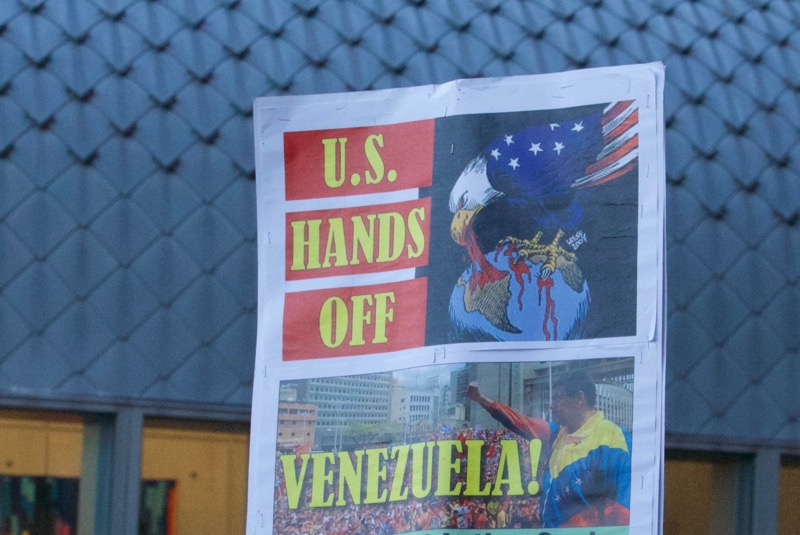
Throughout history, nearly every political “intervention” by the United States has been, in essence, an economic “coup” in disguise. The latest episode of the US Special Operations forces swooping down on the sovereign state of Venezuela, capturing and abducting its constitutionally elected President, Nicolas Maduro, exemplifies its long list of sordid invasions for economic gains. Indeed, the roots of corporate welfarism run deep in the nation’s history.

One of the reasons for the American Revolution against its imperial coloniser, Britain, was the Royal Proclamation of 1763 by King George, which prohibited westward expansion by Appalachian colonists into Indian territory. It was a decree that posed a significant threat to prominent land speculators, including George Washington, and so, it encountered firm and unequivocal opposition. Soon after American Independence, the colonists went on a murderous rampage, killing the native Americans, eviscerating them from their sacred lands, and destroying their properties.

A University College London (UCL) study estimates that European settlers caused the death of approximately 56 million indigenous Indians in one of the most disastrous civilisational erasures in history, in just over 100 years. John Quincy Adams, the intellectual leader of “Manifest Destiny” and one who fiercely opposed Andrew Jackson’s Indian Removal Act of 1830, called it “an act of enormous injustice…a crime against humanity.” He also exposed the moral relativism and hypocrisy of the foundational ideals of equality and liberty when he wrote, “The same nation that proclaimed liberty was ‘extirpating’ entire peoples for land.” 

By the time Abraham Lincoln delivered the Gettysburg address — in which he called it “a government of the people, by the people and for the people” — 90 per cent of native Indians were mercilessly wiped out, and the remaining were confined to “reservations.” Many white colonists espoused the view of California’s first governor, Peter Hardeman Burnett, who openly endorsed the extermination of Native Americans as inevitable and necessary.

For almost a century, Lincoln’s “government” was no more than a byword for the exclusive privileges of white settler colonists; they denied the ideals of liberty, equality and justice to African Americans, whom they ostracised and profited from hideous chattel slavery.

The psychological trauma and identity crisis caused by enslavement and colonisation continue to this day; the Nobel Laureate Frantz Fanon’s book, “Black Skin, White Masks,” explores in great detail the dire consequences of the dehumanising rhetoric of white settler colonialism.

The “founding fathers” of the United States condemned British colonialism and territorial expansion. The Declaration of Independence is a direct anti-imperial indictment; the official transcripts ironically castigate the British crown for refusing to “assent to laws,” “imposing taxes on us without consent,” “transporting us beyond seas to be tried,” “quartering large bodies of armed troops among us,” “for cutting off our trade with all parts of the world,” and “plundering our seas and ravaging our coasts.”

After declaring independence, the US adopted the expansionist strategies of the British Empire by annexing the territories of Mexico in the Mexican-American War. It was partly to gain control of fertile lands for cotton cultivation, a strategic resource then regarded as “Black Gold.” Settlers moved into Texas, then a Mexican territory, attracted by its vast landmass. Texas had banned slavery, but Southern slave owners saw it as an opportunity to expand the institution of slavery into new regions.

President Ulysses S. Grant, who served in the war as a young officer, denounced it, saying, “I do not think there was ever more a wicked war than that waged by the United States against Mexico.” At the signing of the Treaty of Guadalupe Hidalgo in 1848, the US, which deplored the imperial British for territorial usurpation, appropriated nearly half of Mexican territory, including present-day California, Nevada, Utah, Arizona, New Mexico, and parts of Colorado and Wyoming.

Partisan historians argue that US “interventionism” was aimed at spreading democracy and justice, but historical evidence often contradicts this view. For example, the Spanish-American War (1898) led to the Philippine-American War, resulting in the deaths of between 200,000 and one million Filipinos. President William McKinley termed it a civilising mission to educate and Christianise the Philippines through the doctrine of “benevolent assimilation.” Death and mayhem follow the so-called American benevolence.

One of the most egregious examples of abuse of power and violations of human rights took place in Haiti in 1915. Under President Woodrow Wilson’s leadership, U.S. Marines landed in Port-au-Prince and orchestrated the overthrow of President Vilbrun Guillame Sam. The subsequent dissolution of the Haitian army and installation of a U.S.-backed puppet government marked a blatant subversion of Haitian sovereignty. In an act that further solidified American hegemony, the United States rewrote the Haitian constitution to permit U.S. corporations to purchase land and exploit it for commercial interests.

American corporations intentionally undermined Haitian agriculture and export industries, creating conditions that drove rural Haitians to urban centres where they were employed at meagre “sweat shop” wages. These developments were deeply at odds with the democratic ideals Wilson purportedly championed; they expose the contradiction between his professed support for democracy and his imperial ambitions.

The doctrine of “Wilsonian Legalism” crumbled under the ponderous weight of these imperial pursuits. Between 1913 and 1921, Wilson authorised U.S. military attacks, occupations, and interventions in several countries across Latin America and the Caribbean, including Mexico, Nicaragua, Honduras, Guatemala, the Dominican Republic, and Cuba. The persistent application of force and subversion reflected a profound cognitive dissonance in American presidential leadership, as lofty ideals were repeatedly sacrificed for expansionist goals.

Throughout the twentieth century, the US often cited democracy, human rights, and anti-Communism to justify its foreign interventions. However, declassified records show that overt US military actions and covert destabilisation missions frequently led to the replacement of democratically elected Latin American governments with dictatorships or military juntas. These cronies had acquiesced to the US foreign policy of creating ‘façade rulers’ that supported US interests, especially those of American corporations and hegemonism of the Western Hemisphere, in adherence to the Monroe Doctrine.

One of the most explicit regime changes occurred in Guatemala in 1954, when a CIA-organised coup (Operation PBSUCCESS) overthrew democratically elected Jacobo Arbenz with the military dictatorship of Castillo Armas. The primary motivation was land reforms in Guatemala that threatened the operations of the United Fruit Company, a major U.S.-owned corporation. In Chile (1973), socialist leader Salvador Allende was replaced by the brutal tyrant Augusto Pinochet through US covert operations and economic warfare to protect the interests of Anaconda Copper, a US multinational, after its assets were nationalised.  

A similar fate awaited Brazil in 1964 when João Goulart was replaced (Operation Brother Sam) with 21 years of military dictatorship; in 1965, Dominican leader Juan Bosch was ousted by a full-scale US military invasion, installing the authoritarian regime of Joaquin Balaguer. In Argentina — Henry Kissinger’s favourite use case — the socialist government of Isabel Peron was deposed by a US-assisted military coup in 1976, replaced by a US crony military junta that triggered the “Dirty War” during which more than 30,000 people disappeared. Similar regime change operations were initiated by the US in Bolivia (1971) and Nicaragua (1936-1979), which installed the authoritarian regimes of Hugo Banzer and the Somoza dynasty, respectively.

The authoritarian regimes installed through these U.S.-backed interventions after deposing democratically elected governments led to widespread human rights abuses across Central and Latin America. Under these dictatorships, the region endured the proliferation of death squads, murder, genocide, brutal civil wars, pervasive state repression, and the institutionalisation of torture. Censorship became rampant, with freedom of expression severely curtailed. Permanent scars on these societies remain.

The United States extended its influence into the Middle East to secure oil reserves. In 1953, Iran’s Prime Minister Mohammad Mosaddegh was overthrown in a coup led by the US and UK after he nationalised the Iranian oil industry. The CIA’s Operation AJAX and MI6’s Operation Boot facilitated the Shah’s rise to power, suppressing Arab nationalism. The Shah’s rule, supported by the US, is widely described by historians as a period of severe human rights abuses, executions and corruption enforced by SAVAK, Iran’s intelligence and security agency.

Before the Iraqi invasion sanctioned by President George W Bush Jr., the American media whipped up a hysteria of Saddam Hussein’s imminent attacks on US soil with weapons of mass destruction (WMD). Expecting a “mushroom cloud” over Washington, the US public was coaxed into approval of the Iraq War. 

Furthermore, crippling US sanctions led to catastrophic social consequences of an alarming rise in child mortality in children under five, levels comparable to those observed in Sub-Saharan Africa. The United Nations had to institute an “Oil for Food” program to alleviate the effects of the sanctions. Despite these efforts, the program was mired in controversy. 

Two successive directors, respected diplomats Dennis Halliday and Hans von Sponeck, ultimately resigned from their posts. Both cited their belief that the U.S.-driven sanctions violated the Genocide Convention. It underscores the profound ethical and legal dilemmas posed by the international response to Iraq’s humanitarian crisis after a million deaths and the splintering of the society. Additionally, US sanctions are third-party applicable, which categorically states America’s enemies must be the enemies of its allies, further encroaching on the sovereignty of nations.

The Vietnam War started because the US policymakers misconstrued an anticolonial uprising as the rise of communism, exacerbated by the “Domino Theory” of potential regional expansion. The Global War on Terror (GWOT) was aimed at exterminating Islamic radicalism and terrorism from Afghanistan. However, it only succeeded in replacing the Taliban with the Taliban when President Joe Biden unceremoniously withdrew US forces in 2021. The GWOT cost US taxpayers $8 trillion to fund a fiasco intended at regime change, under the guise of “nation-building” and “democratic transition.” The biggest beneficiary was corporate America, especially the five “merchants of death” of the military-industrial complex.

The US nurturing of Afghan Mujahedin and unconditional terror financing in its offensive against Soviet invasion laid the foundations of “Kalashnikovization” of Pakistan, the rise of the military-mullah-militant nexus and mushrooming of anti-American militant forces. US interventions never made these societies better, wealthier, healthier, more peaceful, or more democratic. 

The election of Donald Trump is a symptom of a society that has deteriorated into a military security state. The democratic deficit is stark, and governance is regressing into authoritarianism where “Trump’s morality” subordinates international law and the UN Charter. In context, Adolf Hitler’s moral universe was “always ethical”, even though he forced millions of innocent victims into a death march to the gas chambers.

A US foreign policy whose imperial ambitions were historically concealed in euphemisms of democracy and human rights now boasts of its invincibility. America’s plans a “take over” and “own” Gaza, to transform it into a “Riviera of the Middle East”, its silence over the genocide shows its hollow rhetoric. Trump says he is resolute in reclaiming the Panama Canal, wants to “own” Greenland, and claims Venezuelan sovereign oil as “our own.” The mask has fallen, and the veil of deceit is torn; it exposes the gross injustice meted out to humanity in its ‘America Only’ policies of power and dominion.

As the United States of America trudges towards the inevitable fate of empires, the administration and most of society are circumscribed in a “confirmation bias” despite all evidence to the contrary of waning American exceptionalism and growing multipolarity. A nation that seeks to police the globe is, in essence, a global thug. If history is a guide, America will soon destroy itself through its excesses.

-30-

Copyright©Madras Courier, All Rights Reserved. You may share using our article tools. Please don't cut articles from madrascourier.com and redistribute by email, post to the web, mobile phone or social media.
Please send in your feed back and comments to [email protected]

0 replies on “How The United States Of America Destabilises The World”