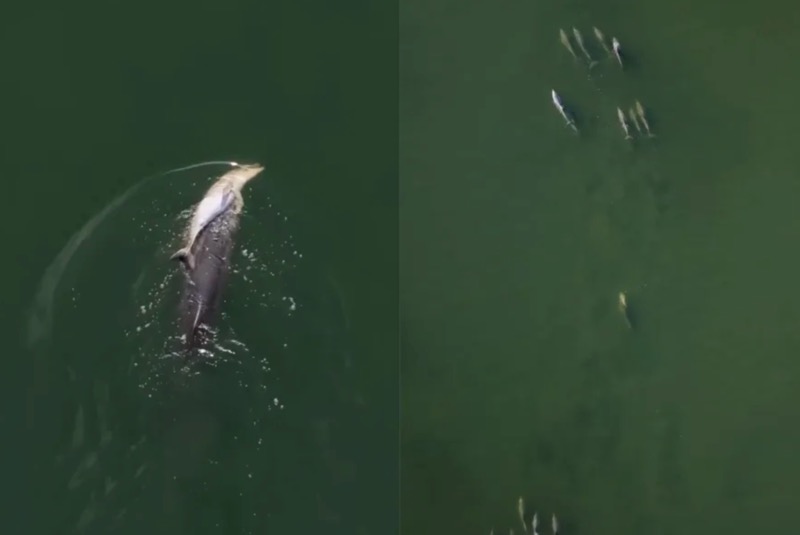
Recently, a well-known bottlenose dolphin named Fraggle was found and filmed around Leschenault Estuary, south of Perth, Australia, by Geographe Marine Research. Fraggle carried her dead calf for eleven long days, apparently trying to keep it from sinking into the depths, where hungry predators would have torn it apart. The video that circulated widely showed a pod of about a dozen dolphins surrounding the grieving mother. Marine biologists confirmed that Fraggle had already lost three calves before this one.
The footage of cetacean grief created a stir. Social media, news channels, newspapers, marine biologists, and a vast number of viewers across the world reported it and offered their views, sympathising with a mother for whom carrying the dead weight of her calf for eleven consecutive days, while eating nothing, was not only a physically onerous task but one that appeared emotionally shattering.
This led people to compare Fraggle’s ordeal to their own experiences of loss, and many comments insisted that grief, suffering, and emotional bonds are not the property of humans alone. Scientists termed this behaviour epimeletic: the caregiving and sustained attention that pod members give to the dead or the dying.
The philosopher and author of Playing Possum: How Animals Understand Death (2024), Susana Monso, wrote in an email: “What is most remarkable in these cases is that the mothers don’t have hands and live in an aquatic medium where they have to regularly surface to breathe as well as hunt. This makes holding on to the corpse something very difficult and shows a strong motivation on the part of the mother.”
After reading from so many sources about this behaviour, I was struck at once by a proposition from a very different animal, in a very different essay. My colleague Dr Mubashir Hamid had forwarded Thomas Nagel’s “What Is It Like to Be a Bat?” (1974) to me, and I read it early one morning, when the mind was still fresh and the dawn still yawning to wake up.
What struck me first was not the bat itself but the shape of the problem Nagel was posing: the limits of our imagination when we try to foreground the subjective experience of another creature, while remaining unable to live that experience from its exact interior position. And this indicates something important. Whatever the nature or the fidelity of our imaginative reconstruction of another creature’s experience, the truth of that experience is untouched by our failure to reach it. Our inability to exactly describe the subjective state of a grieving dolphin cannot change the subjective state of the dolphin itself. The fact does not wait on our concepts to be true.
The Bat, the Dolphin, and the Point of View
Nagel’s essay begins from a simple but devastating observation: an organism has conscious mental states if and only if there is something it is like to be that organism. Not something it resembles from the outside, but something it is like for the subject, from within.
He chose the bat because bats are mammals, close enough to us that we do not doubt they have experience, but their primary sense, echolocation, is so structurally unlike anything in the human sensory repertoire that the gap between us becomes vivid rather than merely theoretical. We can describe bat sonar exhaustively in terms of physics and physiology. We can never, Nagel argues, know what it is like to be the bat undergoing it.
His argument against the reach of imagination is precise. We might imagine having webbing on our arms, hunting insects at dusk, hanging upside down in an attic by our feet. But this only tells us what it would be like for us to behave as a bat behaves. It does not tell us what it is like for a bat to be a bat. Imagination works by adding to, subtracting from, or recombining our own existing experiential material. Since that material is irreducibly human, no amount of imaginative renovation gets us across the species line. The extrapolation, in his words, is incompletable.
Fraggle’s case sits somewhere along this same continuum, but not at its far end. Nagel is careful to note, almost as an aside, that the point of view in question is not the property of one isolated individual; it is a type, and it is often possible to take up a point of view other than one’s own, with success falling anywhere along a continuum depending on how similar the other creature is to us.
A person blind from birth, using a cane or vocal clicks to detect objects, might by extension partially imagine something of what refined bat sonar involves. We are mammals; dolphins are mammals. We form attachments, grieve losses, recognise individuals, and carry our dead in something like ritual, however differently expressed. This kinship licenses a degree of imaginative reach that the bat’s sonar forecloses almost entirely. And yet the core problem does not dissolve; it only narrows.
However much closer dolphin subjectivity sits to our own than bat subjectivity does, we still cannot cross into Fraggle’s interior. We can watch epimeletic behaviour, count the days, note the refusal to feed, and still never arrive at what it is like, from within a body that must surface every few minutes to breathe, to keep pushing a dead calf’s body toward the light for the eleventh consecutive day.
What the Facts Cannot Reach
This is where Nagel’s most philosophically radical claim becomes useful. He argues that we can be certain such facts exist even while remaining permanently unable to state their content. He offers the analogy of transfinite numbers: they existed as mathematical facts even before Georg Cantor discovered them, and it would be foolish to think that everything humans will ever conceive exhausts everything that is true.
Some facts, he suggests, may be facts that human concepts are not built to hold, regardless of how long our species endures or how much science advances. Applied to Fraggle, this means the following: our incapacity to name, quantify, or fully imagine her grief does not diminish the reality of whatever she underwent. The absence of a human concept adequate to her interior state is not evidence against that state. It is only evidence of the limit of our concepts.
This distinction matters because public response to the Fraggle video ran in two opposite and equally mistaken directions. One crowd rushed to describe her experience in the vocabulary of human bereavement, as though grief in a dolphin must mirror grief in a mother who has lost a child, full instrumental narrative and all.
The other, more scientifically cautious crowd, worried that any such language was projection, and preferred inert behavioural description: epimeletic response, corpse-carrying, extended contact. Both positions, I think, misread Nagel. To insist Fraggle’s experience is exactly like ours is to commit the error of imagining “what it would be like for me” and mistaking it for “what it is like for her,” the very confusion Nagel spends his essay dismantling.
But to refuse her any interior life at all, on the grounds that we cannot verify or describe it, commits a different and in some ways graver error: treating the absence of a concept as proof of an absence of fact. The Dutch-American primatologist Frans de Waal has a name for this second mistake among scientists who habitually deny mental continuity between humans and other animals: anthropodenial. It is the mirror image of anthropomorphism, and just as capable of distorting the truth.
Knowing All the Facts Without Knowing the Fact
There is a companion argument here from another analytic philosopher, Frank Jackson, whose thought experiment about a scientist named Mary runs roughly like this: Mary knows every physical fact there is to know about colour vision, yet has lived her whole life in a black-and-white room. The day she steps outside and sees red for the first time, she learns something new, even though she already possessed every physical fact in advance.
The upshot, for our purposes, is unsettling. Marine biologists can catalogue every physiological and behavioural fact about Fraggle: hormone levels, feeding refusal, pod formation, and the biomechanics of pushing a decomposing body through the water for 11 days. And they will still not have reached the point of understanding what it is like to be a Fraggle undergoing this.
The physical description, however complete, leaves a residue that physical description cannot touch. This is exactly Nagel’s point, restated from a different angle: reduction moves us toward greater objectivity by leaving the point of view behind, but experience is the point of view. Strip it away, and there is nothing left that was the thing you were trying to describe.
Ludwig Wittgenstein made a related observation, in his own idiom, when he suggested that if a lion could speak, we would not be able to understand him. The barrier he had in mind was not linguistic but experiential: a creature whose whole form of life, whose hunger, whose sense of time and threat and satisfaction, is organised so differently from ours that shared vocabulary would not guarantee shared meaning.
Fraggle cannot speak in any case. But even a hypothetical dolphin language, fluent and fully translated, would not by itself hand us her interior state, any more than a fluent lion would hand us his. The problem is not translation. It is the fact that understanding another mind requires, in Nagel’s phrase, taking up its point of view, and some points of view resist being taken up no matter how much data or vocabulary we accumulate.
Another Australian philosopher of science, Peter Godfrey-Smith, writing on cephalopod minds in Other Minds, makes a similar case from the opposite direction of the mammalian spectrum: the octopus is so evolutionarily distant from us, its nervous system so differently distributed through its body, that its consciousness, if it has one, is likely to be almost unrecognisably alien.
Dolphins are not octopi. They are closer to us, evolutionarily and behaviourally, than almost any other wild animal we might have chosen for this comparison. But “closer” is a matter of degree along Nagel’s continuum, not a different kind of access altogether. Fraggle remains, in the end, irreducibly herself.
Toward an Objective Phenomenology of Grief
Nagel does not end his essay in despair. He proposes, speculatively, that we might develop what he calls an objective phenomenology: a method for describing the structural features of another creature’s experience in terms comprehensible to beings who lack that experience, without depending on empathy or imaginative projection. He is honest that this method would reach “a blank wall eventually,” that something would always be left out. But it might let us go further, with greater precision, than loose analogy allows.
I think the vocabulary of epimeletic behaviour is itself a modest, unglamorous instance of exactly this project. It does not claim to know what Fraggle felt. It names a structural pattern, observable across cetacean and primate species, in which the group orients its behaviour around the dead or dying member: proximity, touch, resistance to separation, disruption of normal feeding and travel routines.
This is not grief-language borrowed uncritically from human bereavement, and it is not behaviourist denial either. It is an attempt to describe, from outside, a structure that we suspect corresponds to something significant on the inside, without pretending the description closes the gap.
But even this careful term is not as neutral as it sounds. To call a behaviour epimeletic, to note that it is organised around a corpse, is already to have decided the corpse matters to the animal in some way worth naming. A purely inert description would not have reached for a Greek root meaning care.
So the scientific vocabulary, for all its clinical distance, carries a small commitment inside it, smuggled in through the choice of word. I do not think this is a flaw to be corrected. I think it is close to unavoidable.
We cannot describe another creature’s behaviour from absolutely nowhere. The alternative to a slightly compromised vocabulary is not a purer one. It is only a duller one, pretending to a neutrality it lacks. Which returns me to the image itself, the one that started all this, and the one the arguments keep threatening to talk over.
A dolphin has no hands. She cannot cradle a body against her chest the way a human mother might. To keep her calf from sinking, she has to swim beneath it, or nudge it along with her rostrum, again and again, for eleven days, while still surfacing every few minutes to breathe, still, presumably, needing to eat and choosing not to.
Monso is right to call this a strong motivation. I would go further and call it a cost, paid daily, in a currency of breath and hunger and exhaustion, by a creature who had already lost three calves before this one. Whatever word we reach for—grief, distress, disorientation, confusion—none of them was written for a body built like hers, moving through a medium like that, doing what she did for as long as she did it. The word will always arrive a little late, and a little wrong.
That gap, I want to suggest, is not a failure of marine biology, or of philosophy, or of language. It is close to being a permanent feature of what it means to be a conscious creature among other conscious creatures. Consciousness, watched from close enough, starts to look less like a single mystery awaiting a single solution, and more like an uncountable plural: not consciousness, but consciousnesses, each one sealed within its own point of view, each one real regardless of whether any other point of view can reach it.
Fraggle carried her dead calf through the water for eleven days. Whatever that was like for her, it was like something. That fact does not require our understanding to be true. It only requires that we stop mistaking the limits of our imagination for the limits of what is real.
-30-
Copyright©Madras Courier, All Rights Reserved. You may share using our article tools. Please don't cut articles from madrascourier.com and redistribute by email, post to the web, mobile phone or social media.Please send in your feed back and comments to [email protected]