Rabies Has Been Preventable For More Than A Century. So Why Are People Still Dying?

Rabies-Madras-Courier
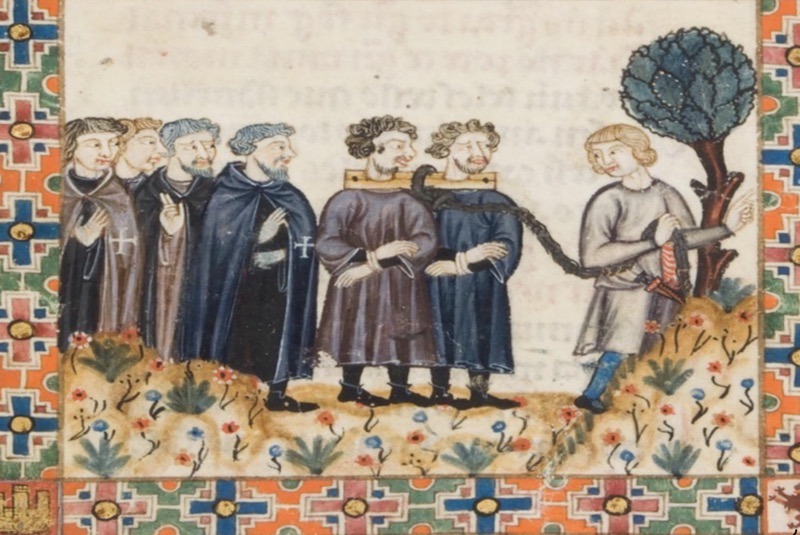
Two Hospitaller monks with rabies are accompanied by four healthy Hospitaller monks and led by a layman to Saint Mary of Terena. Miniature of Cantiga #275; Image; Wikimedia
From ancient observations to modern vaccines, rabies reveals how knowledge can save lives—if prevention reaches everyone.

Rabies is an old disease. Older, perhaps, than any written account of it. For thousands of years, humans have lived alongside the animals that carry it. Dogs, foxes, bats and other mammals have shared our settlements and landscapes.

Somewhere in that long history of proximity between species, rabies entered the human story. What makes rabies remarkable is the gap between its antiquity and our ability to prevent it. Humanity learned how to stop the disease more than a century ago, yet people continue to die from it in 2026.

Rabies is caused by a virus in the genus Lyssavirus. Once it enters the body, usually through the bite of an infected animal, it travels through the nervous system towards the brain. The resulting disease can cause agitation, spasms, difficulty swallowing, hydrophobia, aerophobia and profound changes in behaviour. Once clinical symptoms appear, rabies is almost always fatal. However, humans had begun to observe the disease long before they understood viruses or the nervous system.

Archaeological evidence shows that an ancient relationship with potential carriers of rabies existed. At Uyun al Hammam in present-day Jordan, a red fox was buried alongside a human approximately 14,500 years ago. The discovery does not prove the presence of rabies, but it does point to the long and sometimes intimate relationship between humans and wild canids. That relationship became closer still with the domestication of dogs. Dogs became companions, hunters and guards, living alongside people within their settlements. Such proximity also created opportunities for pathogens to move between animals and humans.

Some of the earliest surviving written evidence concerning dangerous dog bites comes from Mesopotamia. The Laws of Eshnunna, dating to around 1930 BCE, prescribed consequences for a dog that seriously injured a person. Other Mesopotamian tablets, dating from roughly 1900 to 1600 BCE, contain incantations concerning dogs and dangerous bites.

These texts belonged to a world in which illness was understood through ritual as well as observation. Yet some contain a striking recognition of the danger associated with the saliva of an afflicted animal. Thousands of years before the rabies virus was identified, people had recognised an important feature of its transmission: the bite was dangerous because something harmful could enter the wound.

Greek and Roman physicians later described rabies in animals and humans with greater medical precision. They recognised that a person could remain apparently healthy for a period after being bitten before becoming severely ill. They recorded agitation, spasms, difficulty swallowing and the characteristic fear or violent reaction to water that came to be known as hydrophobia. Sensitivity to moving air, or aerophobia, was also observed. However, recognising the disease did not make it treatable.

For centuries, wound cleansing and cauterisation were among the recommended responses. Religious remedies, prayers and amulets existed alongside them. None could reliably prevent death once clinical rabies had developed. The crucial breakthrough came from understanding what happened between the bite and the onset of symptoms.

By the eighteenth and nineteenth centuries, physicians had observed that the risk of developing rabies varied according to the location of the bite. Wounds closer to the head were particularly dangerous. Saliva was understood to be involved in transmission, while experiments increasingly suggested that the infectious agent travelled through the nervous system rather than simply circulating in the blood.

This raised a possibility that would change the history of the disease. If the infectious agent took time to reach the brain, there might be a window after exposure in which it could be stopped.

In 1879, the French veterinarian Pierre Victor Galtier demonstrated the experimental transmission of rabies and investigated whether protection could be conferred after exposure. Rabies had become a subject of experimental medicine rather than merely an object of fear.

Louis Pasteur and his collaborators took the next decisive steps. Through experiments on infected animals, including rabbits, they developed a method to weaken the infectious material. Infected rabbit spinal cords were dried for progressively longer periods, producing preparations of reduced virulence that could be used to induce protection. The idea was extraordinary: perhaps rabies could be prevented after a person had already been bitten.

On 6 July 1885, the idea was put to its most consequential test. Joseph Meister, a nine-year-old boy, was brought to Paris after being bitten fourteen times by a rabid dog. Pasteur had never tested his treatment on a human being. There was no certainty that it would work, but there was little to offer a child who had suffered such an exposure. After consultation with physicians, treatment began. Over ten days, Meister received thirteen injections prepared from infected rabbit spinal cord, with the preparations becoming progressively more virulent. Meister survived. He never developed rabies.

The case marked a turning point. In 1885, humanity had developed a scientific method of preventing rabies after exposure. The principle remains fundamental to rabies prevention today: the virus must be stopped before it reaches the central nervous system. Yet the disease did not disappear.

The World Health Organisation estimates that rabies causes approximately 59,000 human deaths each year, with about 95 per cent occurring in Africa and Asia. Up to 99 per cent of human infections are transmitted by dogs, and children are disproportionately affected. The paradox is stark. Rabies is preventable, but prevention depends on access.

After a potentially infectious bite, prompt wound cleansing and appropriate post-exposure vaccination and treatment can prevent the virus from progressing to the brain. But the intervention has to happen in time. A person may live far from a healthcare facility, a family may struggle to afford treatment, or vaccines may not be readily available. A bite from an apparently healthy animal may also be dismissed as insignificant. Where knowledge of rabies is limited, delay can have fatal consequences.

Therefore, controlling rabies cannot be a matter for hospitals alone. Vaccinating dogs is central to preventing human deaths. So are surveillance, responsible animal management, public education and reliable access to post-exposure care. Rabies is, in this sense, a clear example of ‘One Health’: human health is inseparable from the health of animals and the environments we share with them. Preventing human deaths requires interventions on both sides of the human-animal relationship.

The history of rabies is also a reminder of how scientific knowledge accumulates. The Mesopotamians recognised the danger of dog bites. Ancient physicians described the disease and its symptoms. Later doctors began to understand its transmission and progression through the nervous system. Galtier demonstrated that it could be studied experimentally. Pasteur transformed that knowledge into a means of prevention. What began as observation eventually became intervention.

More than a century after Joseph Meister received his injections, the central scientific problem has largely been solved. The unfinished problem is ensuring that the solution reaches everyone who needs it.

Rabies remains a disease in which timing is everything. By the time the virus reaches the brain, medicine has little to offer. Before that point, there is a window in which a fatal disease can still be prevented. Four thousand years after the first surviving records of dangerous dog bites, that window remains open. The challenge is to make sure that no one is left without the knowledge, treatment or time needed to pass through it.

-30-

Copyright©Madras Courier, All Rights Reserved. You may share using our article tools. Please don't cut articles from madrascourier.com and redistribute by email, post to the web, mobile phone or social media.
Please send in your feed back and comments to [email protected]

0 replies on “Rabies Has Been Preventable For More Than A Century. So Why Are People Still Dying?”