Andrius Rudamina, Se Cathedral & The Unlikely Link Between Lithuania And India

Andrius-Rudamina-Madras-Courier
Representational Image: Wikimedia Commons
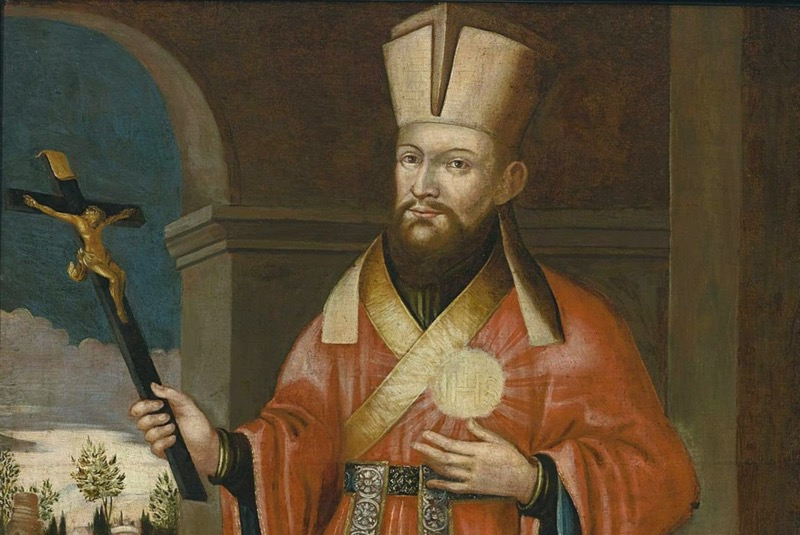
Andrius Rudamina, a forgotten Jesuit priest, reveals an unexpected historical connection between Lithuania and India, preserved within Goa’s largest cathedral.

In the grand sweep of global history, certain connections remain unexpected. Among these, the link between India and Lithuania stands out as particularly unlikely.

While India’s historical relations with major European powers like Britain, France, and Portugal are well documented, the interactions between India and Lithuania—an Eastern European country with a complex and often tumultuous history—are less well known. Yet, they are no less fascinating.

The earliest Lithuanian to set foot in India was a pioneering figure, a Jesuit priest named Andrius Rudamina. He arrived in India in the early seventeenth century, roughly at the same time the British East India Company began its operations. Though Rudamina’s time in India was brief—less than a year—his legacy remains embedded in the fabric of Goa’s history.

Rudamina’s journey to India was part of the Jesuit missionary efforts that spread across the globe during the Age of Exploration. As a missionary, Rudamina sought to spread the message of love and asked the local people to follow the footsteps of earlier Jesuits, such as St. Francis Xavier.

However, unlike his more famous counterparts, Rudamina’s stay in India was short-lived. His fragile health, which had long plagued him, forced him to return to Europe after less than a year in Goa. Despite his brief time in India, Rudamina’s memory has endured in an unlikely place: a monument dedicated to him at the Se Cathedral in Old Goa.

The cathedral is one of the most significant historical landmarks in the region. It stands as a testament to the enduring message of love. This monument, which has endured for centuries as a symbol of shared history, speaks to the connection between far-flung nations such as Lithuania and India.

The Se Cathedral is the largest church in Goa and among the most impressive examples of European architecture in India. It was consecrated in 1652, after nearly a century of construction that began in 1562. The cathedral, dedicated to St. Catherine of Alexandria, has a striking design. It has a cruciform interior and a rectangular exterior.

The most famous feature of the cathedral is its Golden Bell, which has rung through the centuries, summoning worshippers to prayer. This bell, with its deep resonance, has witnessed countless religious and political shifts in Goa, a region that was at the heart of Portuguese rule in India.

While the Se Cathedral is known primarily for its religious and architectural significance, it also holds a particular resonance for Lithuanians, thanks to the monument to Andrius Rudamina that is located within its walls. His statue, commemorating the first Lithuanian to set foot on Indian soil, remains a symbol of the deep historical ties between the two countries—ties often overlooked in the broader narrative of India’s interactions with the West.

When the monument was erected in 2012, it made headlines in Lithuania, with the country’s media covering the event as a rare and poignant reminder of the long-forgotten connections between Lithuania and India. For many Lithuanians, the statue in Se Cathedral represents not just a piece of history, but also a connection to a distant past that continues to resonate today.

Lithuanian diplomats have recognised the significance of this connection. In a speech marking the unveiling of the monument, the Lithuanian ambassador to India, Talat Kepsa, observed that the statue of Andrius Rudamina was “a symbol of how broad Lithuania’s international connections have been in the past and also a significant link with present-day India.”

Kepsa’s words reflect the broader significance of the statue, not just as a commemoration of an individual, but as a reminder of the unexpected and often overlooked ways in which Lithuania has played a part in the global story of exploration, trade, and cultural exchange.

Although Rudamina’s time in Goa was brief, his reputation as a compassionate and devoted missionary has endured in local memory. During his short time in India, he became known for his selfless service to the sick and elderly, offering comfort and aid to those in need. His actions embodied the Jesuit ideal of reaching out to the marginalised and the impoverished, a theme central to missionary work.

This aspect of Rudamina’s character is particularly significant given the historical context in which he lived. The seventeenth century was a time of great political and religious upheaval, with powers like Portugal and Spain vying for control of vast territories in Asia. Even amid this complex dynamic, Rudamina’s legacy remains one of compassion and service, qualities remembered by Lithuanians who visit the Se Cathedral.

Today, the Se Cathedral serves as both a historical landmark and a point of connection for Lithuanians travelling to India. For many, the cathedral has become a place of pilgrimage, where they can reflect on the history of their country’s unlikely connection to India.

When Lithuanian tourists visit Goa, they do not just think of it as a popular vacation destination, but also as the place where their country’s engagement with India began. The monument to Rudamina, along with the broader historical significance of Se Cathedral, makes Goa a destination where the past and the present intersect in meaningful ways.

The legacy of Andrius Rudamina and his monument in Se Cathedral serves as a reminder that the history of global interactions is often more nuanced. In the case of Lithuania and India, the ties that bind the two countries are both historical and cultural.

Though these connections may have been fleeting and largely forgotten by history, the monument to Rudamina stands as a silent witness to a moment when two distant cultures—one from the far reaches of Eastern Europe, the other from the vast subcontinent of South Asia—came into contact.

In this way, the Se Cathedral in Goa is not just a relic of history, but a symbol of the often overlooked and forgotten connections that have shaped the world we live in today. For Lithuanians, it is a place where the past is not just preserved but also honoured, offering a reminder of the unexpected paths through which history unfolds.

-30-

Copyright©Madras Courier, All Rights Reserved. You may share using our article tools. Please don't cut articles from madrascourier.com and redistribute by email, post to the web, mobile phone or social media.
Please send in your feed back and comments to [email protected]

0 replies on “Andrius Rudamina, Se Cathedral & The Unlikely Link Between Lithuania And India”