Wars can not be controlled. Every escalation begins with the promise of limited objectives; almost all end by unleashing forces no government can fully contain.
The debate in Washington over a possible agreement with Iran reveals how little policymakers have learned from two decades of catastrophe across the “Middle East.” Even as oil markets tumble and civilians continue to die — from Gaza to Lebanon — influential voices in America and Israel still speak as though diplomacy was weakness and perpetual confrontation a viable strategy. That view is reckless and strategically incoherent.
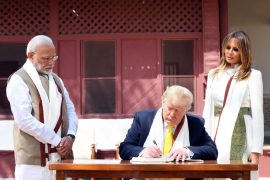
The Trump administration’s manoeuvres illustrate that contradiction in American Middle East policy. On one hand, officials reportedly seek an arrangement with Iran that would reopen the Strait of Hormuz, reduce regional tensions and avert a wider economic shock. On the other, many of the administration’s allies insist that no settlement is acceptable unless Iran is permanently crippled, its regional influence dismantled and its government fundamentally transformed. These are not compatible goals. One seeks de-escalation; the other demands total victory.
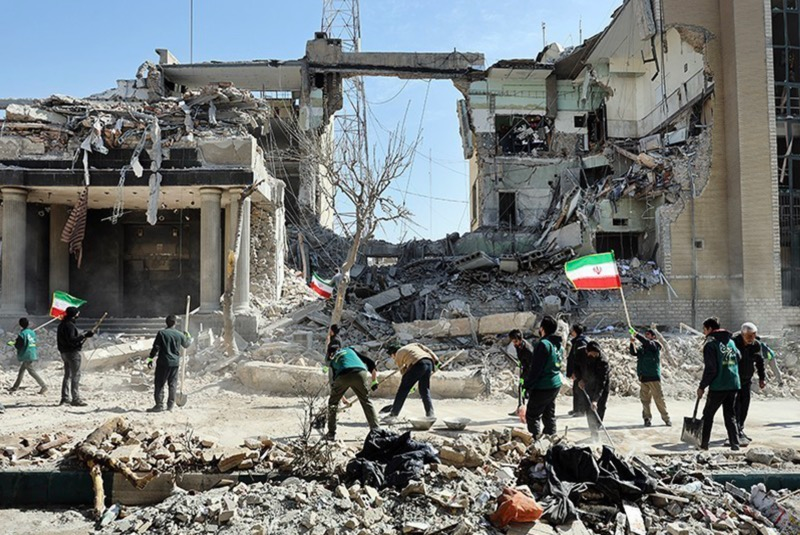
The incompatibility between those ambitions matters because the region is exhausted by war. Israel’s campaign in Gaza has already transformed the political landscape of the Arab world. Lebanon remains on the brink of deeper conflict. Iran has suffered economically for years under sanctions and military pressure. Gulf monarchies, despite their distrust of Tehran, increasingly view stability—not ideological confrontation—as their overriding priority. Yet hawks in Washington continue to speak in the language of regime collapse and military dominance, as though the failures of Iraq, Afghanistan and Libya never occurred.
The renewed enthusiasm for expanding the Abraham Accords reflects this fantasy. Donald Trump’s suggestion that countries such as Saudi Arabia, Qatar and Pakistan should normalise relations with Israel as part of a broader agreement with Iran was greeted enthusiastically by several prominent American conservatives. Senator Lindsey Graham, who only days earlier warned against ending the war prematurely, suddenly praised the proposal as “brilliant.” Others close to the Israeli government quickly followed suit.
Their argument is familiar: normalisation with Israel, combined with pressure on Iran, will supposedly create a new Middle East defined by prosperity, integration and peace. But this narrative ignores the central political reality that has repeatedly undermined such visions. No durable regional order can be built while the Palestinian question remains unresolved and while military campaigns continue to devastate civilian populations.
The Abraham Accords were always strategically significant, but they were also incomplete. The agreements normalised relations between Israel and several Arab states without addressing the occupation of Palestinian territories or the broader issue of Palestinian statehood. For Israeli leaders, this was the point: regional integration without territorial compromise. Yet Israel’s war on Gaza exposed the limits of that formula. Arab governments may cooperate quietly with Israel on security and trade, but public opinion across the region has become increasingly hostile to normalisation amid images of destruction and mass displacement.
Saudi Arabia understands this reality. Riyadh has repeatedly reaffirmed the framework of the 2002 Arab Peace Initiative, which conditions full normalisation on the establishment of a Palestinian state based on the 1967 borders, with East Jerusalem as its capital. That position is not merely diplomatic theatre. It reflects domestic political realities and a broader recognition that unresolved grievances cannot simply be bypassed through economic deals and security pacts.
Indeed, one of the striking features of the current moment is the growing divergence between America’s strategic priorities and Israel’s military instincts. Richard Schmierer, a former American diplomat, recently observed that Washington increasingly appears interested in diplomacy and economic stabilisation, whereas Israeli leaders continue to pursue military solutions in Lebanon and elsewhere.
For the United States, the overriding concern is increasingly economic and geopolitical. A prolonged conflict threatening the Strait of Hormuz risks severe disruption to global energy markets and renewed inflationary pressure worldwide. Roughly a fifth of the world’s oil passes through that narrow waterway. Sustained closure would reverberate far beyond the Gulf, affecting European economies already weakened by war in Ukraine and slowing growth in Asia. American policymakers may speak the language of ideology, but financial realities impose discipline.
That explains why reports of a possible compromise with Iran have begun circulating despite fierce opposition from Republican hawks and pro-Israel lobbying groups. The logic of escalation collides with the logic of markets. Wars are expensive; instability is bad for business. Even administrations that posture as uncompromising often discover that they cannot subordinate economic interests to military maximalism.
Yet the critics of diplomacy offer remarkably little beyond slogans. Senator Ted Cruz warns against any arrangement that leaves Iran’s government intact. Mike Pompeo demands that America “deny Iran access to money” while expanding military pressure. Such rhetoric may satisfy domestic political constituencies, but it offers no plausible route toward long-term stability. Iran is not a minor militia that can be eliminated. It is a nation of nearly 90 million people with extensive regional networks, deep nationalist traditions and considerable strategic depth.
More importantly, decades of sanctions and confrontation have failed to produce the political transformation advocates promised. Instead, they have entrenched hardliners, weakened civil society and encouraged Tehran to deepen security ties with Russia and China. Maximum pressure did not end Iran’s nuclear ambitions; it accelerated them. Nor did isolation reduce regional tensions. It helped create an environment in which proxy conflicts multiplied across the Middle East.
Engaging diplomatically with adversaries is not a weakness. It is often an admission of reality. America negotiated arms-control agreements with the Soviet Union at the height of the Cold War, not because it trusted Moscow, but because the alternative was perpetual escalation between nuclear powers. Successful diplomacy rarely emerges between friends. It emerges between rivals who recognise that endless conflict carries unacceptable costs.
That principle applies to the Middle East today. A sustainable settlement with Iran would not require trust or ideological alignment. It would require enforceable constraints, economic incentives, and mutual recognition that regional war serves no one’s long-term interests. Such an arrangement would inevitably be imperfect. Critics would denounce it as appeasement. But imperfect diplomacy is frequently preferable to perfect destruction.
Security achieved solely through force is not durable. Violence can suppress threats for a time, but unresolved grievances eventually return in radical forms. The Middle East has become a graveyard of short-term military victories that have produced long-term instability.
Ending the current wars, therefore, requires abandoning the illusion that regional order can be imposed indefinitely through coercion. Israel has legitimate security concerns; so do Gulf states; so does Iran. The challenge is to construct a framework that manages these competing interests politically rather than militarily. That process will be frustrating, uneven and morally unsatisfying. Yet the alternative is a permanent state of low-grade regional war periodically erupting into catastrophe.
The central question is no longer whether any side can claim symbolic victories. It is whether leaders are willing to prioritise survival over triumphalism. Every additional escalation risks widening a conflict already stretching from Gaza to Lebanon and the Gulf. Every new strike increases the probability of miscalculation. Every refusal to compromise deepens the humanitarian and economic damage.
Peace in the Middle East will not emerge from grand declarations or social-media bravado. It will come through negotiations between governments that distrust one another. That may seem uninspiring. Yet history suggests that durable peace is usually built not by idealists, but by exhausted rivals who finally recognise that continuing the war is worse than ending it.
-30-
Copyright©Madras Courier, All Rights Reserved. You may share using our article tools. Please don't cut articles from madrascourier.com and redistribute by email, post to the web, mobile phone or social media.Please send in your feed back and comments to editor@madrascourier.com