
On January 17, 1991, as American cruise missiles struck Baghdad, the Dow Jones Industrial Average rose. Within hours, defence stocks rallied. Raytheon, maker of the Patriot missile, saw its shares climb by roughly five per centas television networks broadcast footage of Scud interceptors over Saudi Arabia. The Gulf War had begun, and Wall Street had already priced it in before the first shots were fired.
Thirty-five years later, the pattern repeated with precision. In the early hours of February 28, 2026, as American and Israeli aircraft opened Operations Epic Fury and Roaring Lion over Tehran, the stocks of Northrop Grumman, RTX, and Lockheed Martin rose three, four, and five per cent, respectively. Before the world had recovered from the shock and awe, the ordnance markets were responding in anticipation to the heydays ahead.
The war on Iran is not an aberration. It is a never-ending chapter in the story of modern capitalism. Simply put, destruction is the engine that activates the industry of ruin. For over a century, it has been among the most reliable growth sectors of the global economy. In earlier eras, it was called “devastation”; the modern system is called “resilience.”
The relationship between war and economic recovery is not a conspiracy theory. It is documented history. The Great Depression was not resolved by the New Deal alone — the Second World War decisively ended it. Between 1939 and 1945, America’s GDP grew by 72 per cent. Unemployment collapsed from 14.6 per cent in 1940 to 1.2 per cent by 1944. The war did what no peacetime policy could: it put the entire industrial economy to work almost immediately.
The pattern recurs with regularity. The Korean War pulled the United States out of its post-war slump. Vietnam sustained a military-Keynesian boom through the late 1960s, but the inflation it helped fuel soon destabilised the economy. The Gulf War and the invasion of Iraq each generated vast, immediate flows of capital through military procurement and the reconstruction contracts that followed. As the historian Edward Gibbon noted, Rome’s roads, aqueducts, and cities were built on the labour of conquered peoples and the plunder of conquered territories. In modern capitalism, this principle has been merely modernised and dressed in the language of procurement contracts.
In 1918, the American intellectual Randolph Bourne quipped, “War is the health of the state.” What Bourne observed about the state, we might extend to the market. War is a boon for the defence, logistics, energy, and construction industries that swarm around every major conflict. The logic is simple: destruction creates demand. In a world of overcapacity, year-on-year (YOY) growth pressures, and shrinking fiscal budgets, demand is the rarest commodity.
In 2024, the world’s 100 leading arms-producing companies collectively generated a record $679 billion in revenue, according to the Stockholm International Peace Research Institute. More than three-quarters posted revenue increases, with 42 reporting double-digit growth. The United States alone accounted for nearly half at $334 billion.
Between 2020 and 2024, private firms received $2.4 trillion in Pentagon contracts – approximately 54 per cent of total spending, up from 41 per cent in the 1990s. Lockheed Martin earned $68.4 billion in 2024. RTX generated $43.6 billion from defence alone.
Global military expenditure crossed $2.7 trillion. These figures do not appear in debates about global poverty or climate change. They appear in quarterly earnings reports framed as “favourable geopolitical tailwinds.” Eisenhower’s poignant observation made in 1953—that “Every gun that is made, every warship launched, every rocket fired signifies, in the final sense, a theft from those who hunger and are not fed”—rings true even today.
In his 1961 farewell address, President Eisenhower, who coined the phrase “military-industrial complex,” gave a stark warning about its pervasive power. It was an insider’s warning about an insidious machinery. More than half a century later, that machinery has not merely survived his warning. It has metastasised into what we might call “militarised accumulation”: the integration of war, markets, and political power into a perpetual engine of profit, impervious to human suffering and indifferent to human pain.
If the arms business profits from destruction, the reconstruction business profits from the ruins. They are partners in crime in a vertically integrated economy of ruin—one industry breaks the country, another rebuilds it, and both send invoices to the same government.
In Iraq, in 2003, reconstruction contracts were pre-awarded before the invasion. Halliburton, through its subsidiary Kellogg Brown & Root (KBR), had secured a ten-year ‘indefinite delivery, indefinite quantity’ logistics contract from the Pentagon in December 2001—fifteen months before the invasion. By the time the occupation was underway, KBR had collected at least $10.8 billion in Iraq contracts, including $5.6 billion under the Army’s Logistics Civil Augmentation Program. Bechtel, Fluor, Parsons, and Washington Group International were close behind, each awarded up to $500 million. More than 70 American companies—many of them donors to the Bush presidential campaigns—won up to $8 billion in the first two years alone.
The contracts were structured on a cost-plus basis: expenses were reimbursed, then marked up for profit, creating an immediate incentive to overspend. Former Halliburton accountants later alleged systematic inflation of costs, while the Army briefly moved to withhold 15 per cent of KBR payments over billing irregularities, only to reversethe decision without adequate explanation.
The career of Dick Cheney illustrates this unholy nexus. Between serving as Secretary of Defence and Vice President, he led Halliburton, leaving with millions in deferred compensation. As Vice President, he was central to the decision to invade Iraq. The Army Corps of Engineers awarded KBR “sweetheart” contracts, despite senior procurement official Bunnatine Greenhouse calling the process “the most blatant and improper” witnessed in two decades. She was subsequently demoted. The revolving door had swung and swung profitably and predictably.
The Gulf War exposed a persistent truth. Performance benchmarks for munitions often evade scrutiny. When Raytheon’s Patriot missile appeared to intercept Iraqi Scuds in 1991, George H. W. Bush publicly praised its success. Interception rates were claimed at up to 97 per cent, and orders surged. But post-war analysisby Massachusetts Institute of Technology physicist Theodore Postol found the actual success rate to be extremely low, and a House sub-committee later concluded that Congress and the public had been misled. The missiles had largely missed, but the sales had not.
The current U.S.–Israel war on Iran exposes a deeper asymmetry: systems costing hundreds of millions are being threatened by drones that cost a fraction of that sum. The question is: are modern weapons designed for war, or for sale?
Afghanistan was a reprise. The reconstruction of Afghanistan—a country that, after twenty years of American involvement, fell in eleven days to the Taliban—generated billions in contracts and, by the Special Inspector General for Afghanistan Reconstruction’s (SIGAR) own account, staggering levels of waste, fraud, and projects abandoned within months of delivery.
Private security contractors like Blackwater and DynCorp, logistics firms, intelligence subcontractors—the post-9/11 war economy had become an ecosystem unto itself, impervious to military failure, indifferent to human cost, and remarkably resistant to accountability. Theodore Roosevelt prophetically said in 1912, “Behind the ostensible government sits enthroned an invisible government owing no allegiance and acknowledging no responsibility to the people.”
In the last couple of decades, defence lobbying in the United States reached a staggering $2.5 billion, while the aerospace and defence sector’s market capitalisation more than doubled. More than a dozen members of Congressoverseeing defence spending hold financial interests in the industry they regulate.
The defence contractors operate on multiple tracks: direct lobbying and funding for think tanks. There is a revolving door between the Pentagon and private contractors, and the careful geographic distribution of production facilities to make any budget cut politically impossible.
Lockheed Martin’s F-35 program has suppliers in more than forty states—cutting it threatens hundreds of thousands of jobs; a fact its lobbyists remind legislators at every budget cycle. This is a classic case of engineering consent. In recent years, Silicon Valley has joined the complex: Palantir, Anduril, and SpaceX have secured multi-billion-dollar Pentagon contracts for AI-driven targeting and autonomous weapons.
The current US-Israel war on Iran is not old enough to have reconstruction contracts attached to it. But the pattern is already visible. For defence contractors, however, this is a favourable tailwind. Wars that end quickly are bad for sustained revenue streams. The business model profits from broadening escalation and widening conflict.
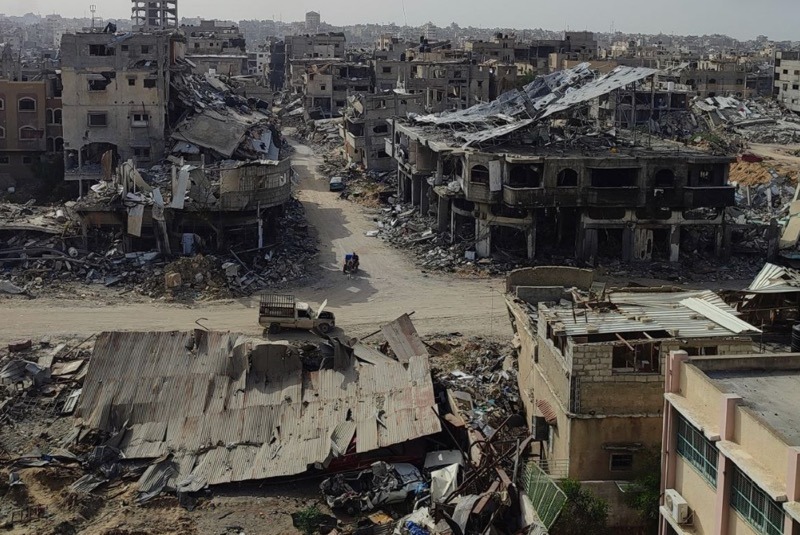
The scale of the spoil is not trivial. Conservative estimates put Iran’s direct reconstruction bill at tens of billions of dollars in energy and infrastructure alone, with total rebuilding costs projected between $100 billion and $250 billion over a decade—the most expensive Middle Eastern reconstruction effort since Iraq.
Damage to energy infrastructure across the broader region adds another $25 billion. Harvard economist Linda Bilmes estimates the total cost of the war to the United States alone will reach at least $1 trillion. Destruction at this scale does not merely create suffering. It creates markets.
Reconstruction in Iran will be a contested space. It will unfold as an extension of diplomacy—war conducted by other means. Western reconstruction firms help design the structure of peace while war rages on.
Companies like Halliburton, Bechtel, SLB, and Technip Energies have long understood that the most lucrative contracts are not won through competitive tender but through political access—through lobbyists who brief trade delegations, think tanks that frame reconstruction as a stabilisation imperative, and officials who calibrate sanctions relief to open doors for specific industries. Market access, in post-conflict environments, has become a diplomatic instrument.
This dynamic has deep historical precedence. Post-war Japan and Germany were rebuilt by American capital under American strategic supervision. Iraq’s contracts were pre-awarded before the invasion.
In Iran, the sequencing will be more complex. The IRGC’s dominance of the domestic economy through its engineering arm, Khatam al-Anbiya, alongside Chinese and Russian strategic interests, will complicate Western entry.
As the negotiations have fallen apart, US and Israeli airpower may reduce Iranian infrastructure to rubble, and Washington will work to extract political concessions that open doors to its reconstruction industry. The US’s geopolitical interests are inseparable from economic interests. Reconstruction is not the end of the war economy. It is its next phase.
Hannah Arendt’s “banality of evil” illuminates the functioning of this ecosystem. The defence contractors and the post-war reconstruction firms are functionaries involved in the grind of earning their daily bread. They are simply indifferent, often choosing to ignore the death and destruction in Minab, Beirut and elsewhere.
The geopolitical analyst who writes ‘favourable geopolitical tailwinds’ has insulated himself, linguistically and morally, from the tailwind’s origin: human lives, human cities, and human futures obliterated beyond hope, leaving permanent social and individual scars.
The tragedy is the normalisation of war and its use as a platform for business and profit. A deeper tragedy is that of the shareholder who profits from the cycle of destruction and reconstruction, believing he is acting in perfect harmony with a rules-based system.
In glass towers in Houston or Paris, executives in tailored suits leaning over a spreadsheet, formulating a reconstruction roadmap of Tehran and Isfahan, do not have the same moral equivalence as a father in Tehran who is petrified of an aerial bombardment and therefore keeps his door unlocked in the dark.
Humanity will remain imperilled for as long as it fails to grasp the difference between the two.
-30-
Copyright©Madras Courier, All Rights Reserved. You may share using our article tools. Please don't cut articles from madrascourier.com and redistribute by email, post to the web, mobile phone or social media.Please send in your feed back and comments to editor@madrascourier.com