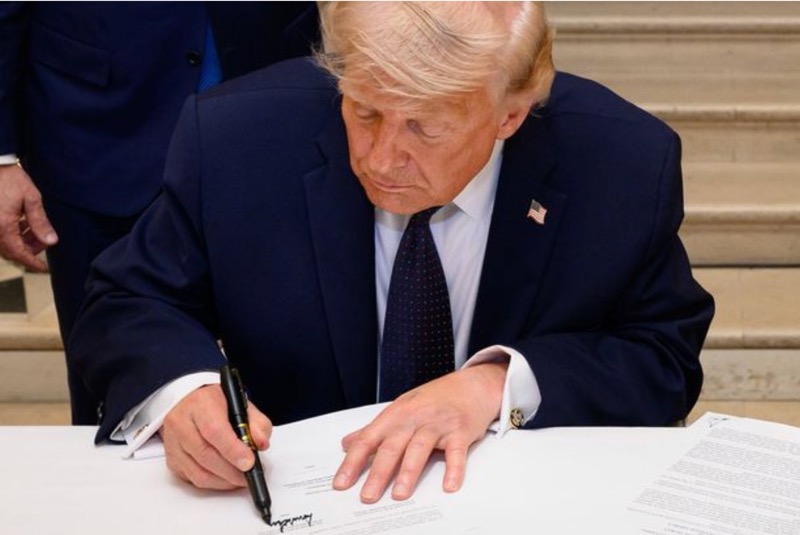
The endgame seems to have started. Trump has signed on the dotted line. The whole scene is reminiscent of Shakespeare’s Macbeth, Act 1, Scene 1, when the three witches assemble to meet Macbeth, the second witch says:
When the hurlyburly’s done,
When the battle’s lost and won.
In the current context, Trump and Iran have lost and won. Iran lost less and won more than Trump. Netanyahu has lost and lost.
However, we need to distinguish between Netanyahu’s personal interests and Israel’s interests. For him, the attack on Iran, which he had dreamt of for forty years, was not meant to prevent Iran from making an atom bomb. His primary concern is that if economic sanctions are removed, Iran would emerge as a regional power and contest Israel’s regional hegemony. Hence, he went on asserting that Iran was about to make a bomb, and concluded that it is in Israel’s interest to destabilise and dismember Iran. Sadly, he is wrong.
In fact, it is in Israel’s interest to co-exist in peace with a state of Palestine rather than continue as a contemporary version of the despicable Apartheid regime of South Africa. The Netanyahu government seems to be keen on losing friends and making enemies. For example, the EU foreign affairs chief, Kaija Kallas, said publicly that Israel is practising Apartheid, and Israel’s foreign minister, Gideon Saar, has suspended contacts with her.
Trump was keen to include the formal ceremonial signing of the MOU as part of his birthday celebration on Sunday, 14 June. Iran demurred, but Pakistan persuaded it to proceed with digital signing to freeze the text. On that day, Trump and Vance signed, and Speaker Ghalibaf signed on behalf of Iran.
It was announced that a formal signing will take place in Geneva on 19 June. Trump could not wait till then. While attending the G7 at Evian-les-Bains, close to Geneva on 15 June, Trump decided to sign as soon as possible, and President Macron suggested the Château de Versailles, built by Louis XIV, as an appropriate venue. Trump signed the two texts – English and Persian – on 17 June while President Pezeshkian of Iran simultaneously signed in Tehran. There will be no formal signing with the two parties physically present.
Reading the text, it is clear that it was mostly drafted in Iran, and one might say that Trump had to sign on the dotted line, as evident from the fact that the text contradicts claims made by Trump days before the signing. For example, Trump and Marco Rubio had publicly repeated that the full quantity of the 60 per cent enriched uranium would be transported to the U.S. The MOU states that it will be down-blended in Iran under IAEA supervision. It does not even say that any American, per se, will be present.
Another example: Marco Rubio reiterated that Iran will not get any money paid at all. The MOU states that $300 billion will be made available for reconstruction in Iran. It is not a payment from the U.S. Government as such, and the language is slightly convoluted:
The United States of America undertakes with regional partners to develop a definitive, mutually agreed plan with at least USD $300 billion for the reconstruction and economic development of the Islamic Republic of Iran. The mechanism for the implementation of this plan will be finalized as part of a final deal within 60 days. All required licenses, waivers, and permissions needed for the relevant financial transactions will be granted by the United States of America.
I congratulate President Trump, 80, for recognising the folly of believing Prime Minister Netanyahu’s fairy tale that he could repeat what he did in Venezuela once again in Iran. It is human to err. Only a few human beings are capable of recognising and correcting an error in good time.
Trump has been finding fault with the JCPOA (Joint Comprehensive Plan of Action) agreed to by Obama and has been insisting that he would get a better deal.
Ironically, Iran had agreed to a nuclear deal more stringent than the 2015 JCPOA on 27 February at the talks concluded at the Embassy of Oman in Geneva, chaired by Omani foreign minister Badr Albusaidi, who revealed details in an interview with the CBS programme called FACE THE NATION– on 27th February 2026, one day before Netanyahu attacked Iran, joined by Trump in hours.
Iran had agreed to zero enrichment, zero stockpiling, down-blending of the 60 per cent enriched uranium weighing about 1000 pounds, and never to seek a nuclear bomb.
Will Trump get the same deal after more than sixty days of negotiations? Unlikely. But he might get a deal that looks better on paper than the JCPOA.
Why did Trump sign on the dotted line?
First, Trump was playing poker, whereas Iran was playing chess. Trump will know that the English word ‘checkmate’ comes from the Persian word’ Shah mat’, meaning ‘the king is helpless.” To be checkmated by Iran in Iran is a rare privilege! Trump, obviously, has been projecting the MOU as a brilliant victory of ‘the master of the art of deal-making.’
Acknowledging the superiority of its enemies in terms of GDP, military capability, and diplomatic clout, Iran concluded that the asymmetrical war required a response that would compel Trump to come to the negotiating table.
The best example of the asymmetrical war in recent history is the war in Vietnam, started by France, the colonial power, and joined by the U.S. in 1955. The Pentagon dropped 7.5 million tonnes on Vietnam, Cambodia, and Laos as compared to 3.5 million tonnes in World War 2.
Over 2.7 million U.S. troops fought in Vietnam, with more than half a million present at a time. Yet, America lost. The war ended on 30 April 1975 when Ambassador Graham Martin was evacuated from the embassy in Saigon by helicopter after he collected the flag he had hoisted earlier in the day.
The strategy adopted by Iran will be studied by the world’s militaries for years to come. Iran attacked the GCC countries as they had hardly any air defence against missiles and drones. The GCC governments had thought it was self-evident that, given the U.S. bases on their territory, Iran would not dare to attack them.
Iran attacked the oil and gas installations, hotels, and airports, too, in the GCC. The impact on the global economy, including higher pump prices for American motorists and inflation, combined with political costs, raised the political costs for Trump, who reluctantly decided to seek a diplomatic settlement as Iran wanted. If he had resumed war, even American experts hold the view that Iran has the wherewithal to resist for weeks and even months. Can Trump afford to get body bags in October as the midterms come closer?
Will Netanyahu sabotage the deal by violating the clause in the MOU requiring a ceasefire in Lebanon?
It is widely believed that Netanyahu sabotaged the talks in Islamabad during Vance’s marathon 21-hour session on 11 and 12 April. This time, Trump decided not to share the progress of the talks with Netanyahu, who has come under attack in his country. He had proclaimed that there would be ‘regime change in Iran, and that the war would continue till Iran surrendered’. The clause for ending the war in Lebanon is resented in Israel.
As of now, Netanyahu has continued with attacks on Lebanon, and 16 were killed on 19 June, and the talks between Iran and the U.S., as a follow-up to the MOU due on 18th June, have been postponed owing to Israel’s attacks.
There is a popular notion that the IDF (Israeli Defence Forces) is invincible in the region. That perception is only because of Washington’s arms, technology, and diplomatic protection.
Vance reminded Israel and its supporters in the U.S. that two-thirds of the arms that the IDF used in the recent war were supplied gratis by the U.S.
As Trump appears determined, Netanyahu will have to comply, even at the cost of his political ambitions. If Israel- U.S. relations deteriorate, that will be another gain for Iran and also for the rest of West Asia.
The MOU came into force on the 17. Iran reopened the Strait of Hormuz, and Washington announced it was lifting the blockade on Iranian ports. For two days, ships crossed the strait. On the third day, Iran closed it as Israel went on bombing Lebanon, and that too after Qatar and the U.S., working with Iran, arranged for a ceasefire between Hezbollah and Iran.
The MOU categorically states that the ceasefire applies to Lebanon. The language is such that, technically, the MOU equates Israel and Hezbollah as neither is mentioned by name. The ceasefire is between Iran and the U.S. and their ‘allies’.
The latest is that Vance and the Iranian delegation, led by Speaker Ghalibaf, are at the Buergenstock Resort, owned by Qatar. Mediators Qatar and Pakistan are also there. We can only wish and pray for the success of the talks. The IDF has not fired at the time of publication.
-30-
Copyright©Madras Courier, All Rights Reserved. You may share using our article tools. Please don't cut articles from madrascourier.com and redistribute by email, post to the web, mobile phone or social media.Please send in your feed back and comments to editor@madrascourier.com