
Religious Persecution: India’s Dangerous New Normal

Religious-Persecution-Madras-Courier
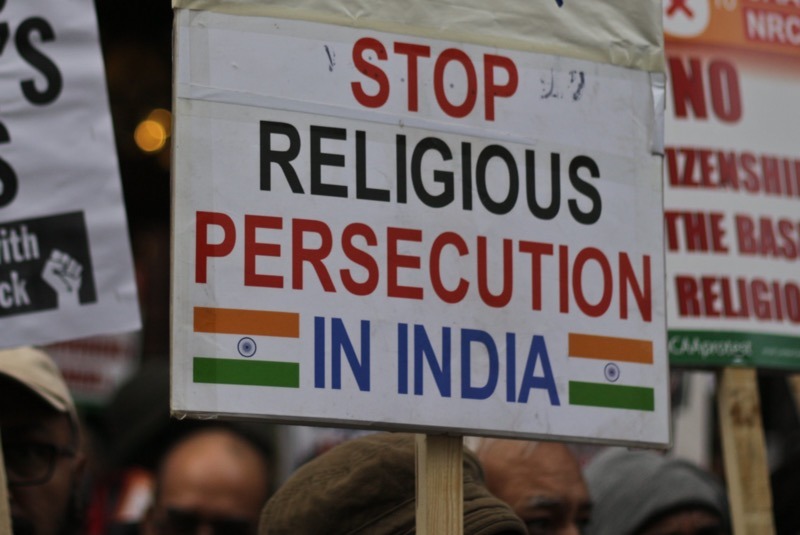
Representational image: Public domain.
The India we inherited may have been flawed, but it was striving towards a noble idea: that all faiths could exist in harmony and that all citizens could exist without fear.

On July 25, 2025, at Durg railway station in Chhattisgarh, two Catholic nuns—Sisters Preeti Mary and Vandana Francis of the Assisi Sisters of Mary Immaculate—were arrested while they were accompanying three tribal women to Agra for jobs in a church-managed hospital. 

The women were all between 19 and 22 years of age, and all three women had proper identification, letters from their parents, and paperwork detailing their employment. None of the girls had made any complaint. Nonetheless, the two nuns were arrested ostensibly for human trafficking and forced religious conversion.

This incident—condemned by the Catholic Bishops’ Conference of India (CBCI), Opposition Members of Parliament, and civil rights organisations—is not isolated. There have been several such targeted attacks against religious minorities in India.

It is a worrying reminder that India—constitutionally a secular republic—is becoming increasingly hostile to those who do not accept the majoritarian religious identity.

Christian institutions in India have had a long history of service, particularly in education, health, and social work. Today, even people serving the community through service or upliftment work are subject to vigilantism condoned by the state.

The United Christian Forum reported that there were 834 incidents of violence against Christians in 2024, the most we have ever seen in India. These incidents range from church demolitions, mob lynching, and vandalism to social boycotts and false cases under the guise of anti-conversion law; states like Chhattisgarh, Madhya Pradesh, Uttar Pradesh, and Odisha account for most of the cases.

For Indian Muslims, things are even worse. Communal polarisation has been mounting since at least 2014, but now even the state seems fully in agreement with this sectarian agenda in 2025.

In Assam, in just the last three months alone, nearly 1800 Muslims—including some with Aadhaar and voter IDs—have been deported to Bangladesh. Victims of these deportations have told stories of being blindfolded, beaten, and dumped across the border at night, without hearings or due process.

Evictions are being executed under the guise of anti-encroachment. Muslims in Uttar Pradesh are facing a similar reality of injustice as the Waqf Amendment Act 2025 is about to take over Muslim endowments, with touted protests set to arise nationwide. This resembles the erasure of Muslim space within the public and physical environment.

What links these occurrences is the state’s increasing use of the law as a sword.

On the same day that the two nuns were arrested, the Chief Minister of Chhattisgarh announced that he was proposing an even harsher anti-conversion law and cited the case of the two nuns as illustrative. But this is legal trickery. The “victims” were both adults, traveling with established proof of consent. No attempt was made to convert any one of them. Nor was there any inducement.

Anti-conversion laws operate in a dozen states of India. They use ambiguous language: “force,” “fraud,” “inducement,” and leave a vast scope for abuse. In most contexts, the fallacy of due process is created, as the arrested individuals are arrested prior to a factual determination of their guilt before a Judge.

The burden of proof is shifted to the accused, upending the presumption of innocence. This rising tide of persecution should not only be seen as a communal issue, but it is also a constitutional crisis.

Article 25 of the Indian Constitution protects the right to practice religion. Article 21 grants the right to life and liberty. Article 14 promises the right to equality before the law. These are not just abstract promises. These are foundational elements of Indian democracy.

But when State apparatuses arrest nuns for charity work, demolish Muslim homes without trial, and look the other way as mobs beat pastors, those provisions become meaningless.

The social cost is also staggering. The diversity of India — whether based on faith, language, or culture — has always been a hallmark of strength for India. However, when minorities are demonised, as “outsiders,” or worse yet, as “anti-nationals,” the social fabric begins to fray.

It diminishes India’s moral authority in the world. No longer the bastion of pluralism as it once was, India now finds itself in global reports on religious persecution. In fact, the U.S. Commission on International Religious Freedom (USCIRF) recently recommended sanctions against India’s intelligence agencies. This has economic, diplomatic, and geopolitical ramifications.

The arrest of Sisters Preeti and Vandana is more than an aberration of the law. It is a travesty of morality. When those who help the poor are classified as “criminals,” when prayer meetings are labelled as “sedition,” and when graveyards are turned into battlegrounds, it is time for the Republic to pause and ask: what have we become?

There are still some voices. The CBCI has issued its unequivocal condemnation of the police action. Opposition MPs have protested in Parliament. Human rights lawyers have gone to court. But these voices are often lost in the crowd of hateful speech amplified by media newsrooms, WhatsApp groups, and political leaders.

Those who speak on behalf of Muslims, Christians, Dalits, and Adivasis are being labelled as “anti-nationals.” However, silence is no longer a choice. What is at stake is not simply the safety of minorities. It is the very soul of the Indian republic.

The India we inherited may have been flawed, but it was striving towards a noble idea: that all faiths could exist in harmony and that all citizens could exist without fear. But this idea is now on trial.

The real danger is not in persecution. The real threat is the normalisation of persecution. When we start to regard injustice as commonplace, we stand to lose much more than we will ever realise.

Let us not forget that India’s secular fabric has successfully survived arduous moments: the Partition riots, the Emergency, and the 2002 Gujarat pogrom. What is needed is courage – legal, political, and moral — to stand up not only for one religion or another, but for the right to belong, meant in the broadest sense. It is not about what kind of nation India is becoming, but what kind of nation we, as Indians, are prepared to embrace.

-30-

Copyright©Madras Courier, All Rights Reserved. You may share using our article tools. Please don't cut articles from madrascourier.com and redistribute by email, post to the web, mobile phone or social media.
Please send in your feed back and comments to [email protected]

0 replies on “Religious Persecution: India’s Dangerous New Normal”