Nepal’s youngest generation, ‘Gen Z,’ has erupted in a political rebellion that threatens to dismantle a decades-old system built on corruption, nepotism, and broken promises. What started as an outcry against the government’s attempt to control social media has created a seismic shift in the nation’s political landscape.
In September 2025, the government banned 26 major social media platforms—Facebook, Instagram, TikTok, WhatsApp, YouTube and so on. The ban felt like an existential strike for a generation that had grown up in virtual communities. They felt that the state wasn’t merely curbing misinformation but trying to silence a generation’s voice.
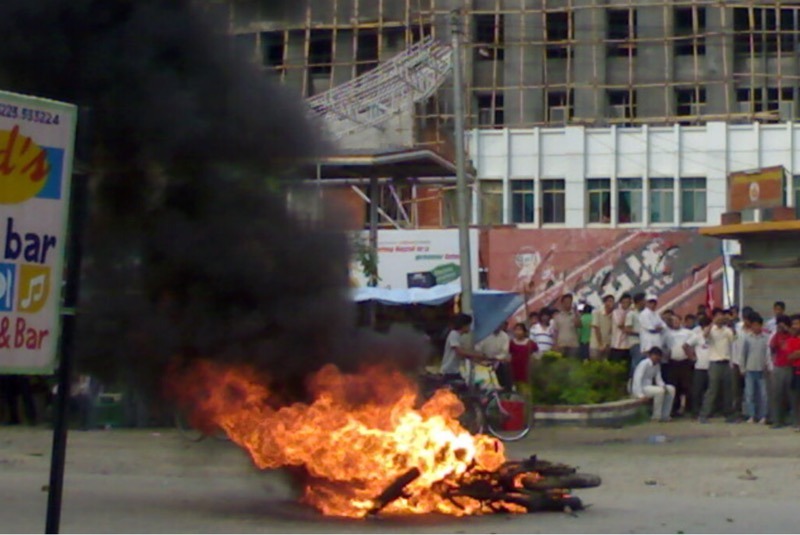
The government’s attempt to cut off that communication was perceived as an act of authoritarianism. And so, the response was swift and overwhelming. On September 8, thousands of students, many still in school uniforms, gathered at Maitighar Mandala, a key rallying point in Kathmandu. They took to the streets with one message: “Stop stealing our future!”
The message was clear: enough is enough. These were not the voices of a disillusioned few that could be crushed. This was a force that the old political guard could no longer contain.
But the government’s answer was not to listen but to silence. The state responded with brutality: tear gas, rubber bullets, live fire. By the end of that first day, 19 protesters were dead. Dozens more were injured, their blood staining the streets.
The images of young bodies, their school uniforms soaked in blood, became the emblem of what was now a revolution. Yet the media, both state-run and independent, framed the protests as riots, an outburst of chaos and violence.
The truth, however, was far more complicated. While some opportunists used the unrest as cover for looting, the core of the protests remained peaceful. The youth were not merely angry. They were deeply frustrated by a malfunctioning, corrupt system.
Ethnic and communal tensions lurking beneath the surface flared up in the aftermath. Anti-minority sentiment, particularly targeting Indian migrants, grew more pronounced. The country’s social fabric, long held together by fragile threads, seemed on the verge of unravelling. The fire burning in Kathmandu threatened to spread across the country, threatening to ignite deep-seated divisions that could take decades to heal.
Amid the carnage, the political elite found themselves in a precarious position. For decades, leaders like Prime Minister K.P. Sharma Oli had clung to power through cronyism and manipulation. However, pressure mounted, forcing the old guard to step down.
The resignation of key figures in the government marked a political earthquake. But while the buildings of Kathmandu could be rebuilt, the rot at the heart of Nepal’s political system remained intact. The military immediately took control and imposed curfews.
Talks between youth leaders and the army surfaced, but negotiations broke down swiftly. Some youth leaders rejected proposals involving figures tied to the old political establishment, fearing their revolution would be hijacked by the very forces they had risen against. Nepal’s political future, uncertain before, became even murkier. While the youth may have the vision, the forces of division and co-optation were already at play.
Despite this, the demands of Nepal’s youth are unmistakable. They are not asking for mere concessions. They are calling for a complete reimagining of the country’s political order. They want a new constitution which guarantees true representation and participation from all segments of society, not just the elites. They want to dismantle the existing parliament, which they view as a corrupt relic of a bygone era. They are demanding fresh elections—fair and free, without the interference of political cronies or the military.
Perhaps most striking, the youth are calling for a reckoning—a national investigation into the vast wealth stolen by politicians and their families over the past three decades. They want justice for the billions siphoned off by corrupt officials, who have enriched themselves while the country languished in poverty.
They also want to rebuild the very foundations of Nepali society: education, healthcare, the judicial system, the police, and communication. These, they believe, must be rebuilt from the ground up, on principles of merit, transparency, and accountability. The culture of nepotism, so ingrained in Nepali society, must be dismantled.
The youth are not just demanding a return to normalcy; they are demanding a fair, just future for all Nepalis. And they are not afraid to pay the price. “We want more than survival,” said Sareesha Shrestha, a young protester. “We want dignity. We want justice.” For them, the fight is not about political survival; it is about securing a future where their children do not have to leave the country in search of opportunities.
The message is clear: Nepal’s youth will no longer settle for less than they deserve.
The voices of this revolution are not only those of anger and loss. They are voices of hope, of an unwillingness to accept the status quo. Pramin, a young filmmaker who had been at the forefront of the protests, explained:
Social media was not just entertainment for us—it was our voice, our community, our link to the world. When they banned it, they tried to silence our very lives.
But Nepal’s struggle is not confined to its own borders. The country’s upheaval has sparked concerns throughout South Asia. India, Nepal’s giant neighbour, watches with a mix of anxiety and caution. The implications of a destabilised Nepal could reverberate across the region, with spillover effects on everything from migration patterns to trade relations. The situation is precarious, and while the international community has largely turned a blind eye to Nepal’s plight, the events unfolding in Kathmandu are impossible to ignore.
The road ahead for Nepal remains uncertain. The youth have created a movement that refuses to be silenced, but the old political structures, though shaken, are not yet toppled. The military’s role in the country’s future is still a point of tension, and the social fractures that have emerged in the wake of the protests could undermine the movement’s broader goals. There is a risk that the revolution will be co-opted, diluted, or violently suppressed. Yet one thing is clear: Nepal’s youth will not fade quietly into the background.
They are demanding more than survival—they are demanding a future. Whether that future is realised depends on whether Nepal’s political elites are willing to dismantle the structures of power that have oppressed so many for so long. The question is no longer if change will come, but how fiercely it will be resisted.
Nepal is at a crossroads. And the youth, for the first time in decades, hold the keys to the country’s future.
-30-
Copyright©Madras Courier, All Rights Reserved. You may share using our article tools. Please don't cut articles from madrascourier.com and redistribute by email, post to the web, mobile phone or social media.Please send in your feed back and comments to [email protected]