
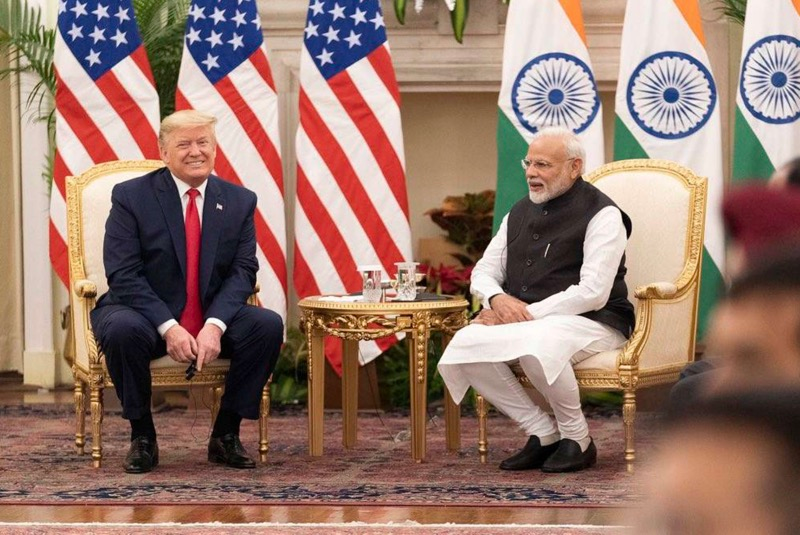
In September 2025, in a televised interview, Howard Lutnick, the United States Secretary of Commerce, summed up the Trump administration’s hostility to India. With characteristic arrogance, he said, India “should say their sorry,” exit BRICS and pledge allegiance to the US dollar. Soon, the Trump administration imposed 50 per cent tariffs on Indian exports under the pretext of ‘punishing’ India for buying Russian oil.
It was yet another display of erratic US trade and foreign policy; for context, the United States did not impose punitive tariffs on China, the largest buyer of Russian oil. Such coercive tactics highlight the risks in the US-India trade deal announced last week. It raises critical questions: Is this deal a strategic reset in a geopolitical global order shaped by the idea of Making America Great Again’? Does the India-US trade deal serve India’s long-term geoeconomic and geostrategic objectives?
Trump’s solipsism makes US policy unpredictable and erratic. Therefore, it is necessary to carefully assess the agreement’s potential benefits and risks for India’s autonomy and future strategic positioning.
Despite Trump’s assertion on ‘Truth Social’ that India will stop buying Russian oil, there is no official confirmation from New Delhi or Moscow. He also stated that US companies plan to enter India’s agricultural market, introducing products such as soybeans, cotton, ethanol, and corn.
This development is particularly disconcerting for Indian farmers, for cheaper American imports could threaten local agriculture, overwhelm domestic markets, and undermine local livelihoods, especially after their negative experiences with the now-withdrawn 2020 Farm Bill.
Stakeholders in India’s agricultural sector are concerned about US lobbyists’ push to relax biosafety rules to allow genetically modified crops, such as corn and soy, into India. In return for these commitments and halting Russian oil imports, the US offers to cut reciprocal tariffs from 25 per cent to 18 per cent and drop punitive tariffs. The proposed interim agreement largely favours US interests, potentially undermining India’s geoeconomic independence.
Following the joint declaration, Indian oil refiners are shifting March and April allocations away from Russian crude. This shift raises cost pressures, as U.S. shale oil and Venezuelan crude are more expensive than Russian Urals. Moreover, longer shipping distances will increase freight and insurance costs, with voyage lengths of roughly 12,000–13,300 nautical miles compared with 5,600–6,600 nautical miles for Russian supplies.
Beyond logistics, extended shipping routes lead to longer shipping cycles and increased working capital requirements, tying up more financial resources. The resulting incremental cost differences are passed on to consumers. Given that oil serves as a key intermediary good globally, there is a heightened risk that these additional costs could contribute to a general rise in inflation.
Indian refineries—including Indian Oil Corporation, Nayara, and Reliance—are mainly set up for processing Middle Eastern and Russian crude. They aren’t designed for Atlantic Basin crude, especially Venezuela’s extra-heavy, sour oil, which requires deep conversion and more energy for coking and desulphurization. Venezuelan crude gives less petrol and diesel than Middle East and Russian blends. U.S. shale oil also poses challenges due to its low diesel yield and limited cost optimisation.
Currently, Russia offers India deep discounts and flexible payment arrangements, which not only ensure long-term supply security but also foster political alignment in energy trade. Russia considers India a priority partner, whereas U.S. corporations are more likely to view India strictly as a buyer, focusing primarily on maximising shareholder returns, capitalising on spot market prices, and exploiting export arbitrage opportunities.
If India ceases its imports of Russian crude, the foundational pillars of its energy security—namely, price stability, supply reliability, and strategic autonomy—are at risk of being compromised. Such a move could expose India to higher inflation, reduced fiscal space, and an increased trade deficit, all of which would be particularly detrimental at this critical stage in the country’s economic development.
Even more disconcerting is that India has agreed to a US monitoring panel to ensure that Russian Federation oil doesn’t reach its shores; otherwise, punitive tariffs will be reinstated. Surrendering national sovereignty under the pretext of integration into the world’s largest economy is not pragmatism.
The Modi government has celebrated the drop in tariffs on MSME exports from 50 per cent to 18 per cent, but the impact may be exaggerated. Many exports to the US already faced low tariffs, with textiles at 8 per cent, gems and precious stones at 1.8 per cent, chemicals at 2.7 per cent, auto parts at 1.05 per cent, and leather at 5–10 per centfrom 2021 to 2024.
The new deal sets a flat 18 per cent tariff on plastics, rubber, and chemicals, excluding pharma, at 3.39 per cent. Most agricultural goods had little to no tariffs, so zero-duty access changes little. However, Indian concessions on certain agricultural imports—soybean oil, dried distillers’ grains (DDG), tree nuts, wine and spirits and “unspecified” other additional products—could harm domestic producers and facilitate a ‘dumping ground’ for American goods that are heavily subsidised and corporatised. For MSMEs in cities like Agra, Kanpur, and Tirupur, the new 18 per cent tariff represents a 100 to 150 per cent increase over rates two years ago.
While the new trade agreement may boost local production and exports, its benefits for Indian exporters are likely more limited than its advocates suggest. Given previous tariffs and existing market access, gains remain modest. Given that agriculture accounts for less than 1 per cent of US GDP, tariff reductions on Indian agricultural exports offer little strategic value to the US as a major net importer.
Within this interim trade framework, one of the most profound risks to India’s autonomy and sovereignty emerges in the digital realm. US technology companies maintain a global monopoly over advanced technology products and platforms, giving American negotiators significant leverage. They are expected to strategically deploy their bargaining chips to push for legislation enabling unfettered cross-border data flows and establishing non-taxable revenue streams for these companies.
India’s Digital Personal Data Protection (DPDP) Act of 2023 has been a robust defence of data localisation, mandating that the personal data of Indian citizens be stored in data centres located in India. This policy is designed to safeguard national security and ensure law enforcement agencies have the necessary access to data. However, the US administration has consistently criticised these localisation requirements, calling them discriminatory and restrictive. Should India yield to US demands and relax these mandates, it would undermine efforts to build a domestic data-centre industry independent of foreign jurisdictions, posing significant risks to national interests.
In addition, the potential reduction in trade barriers on the import of Graphic Processing Units (GPUs) from firms such as Nvidia presents a complex set of trade-offs. In the short term, such a move could accelerate India’s ambitions in artificial intelligence and support the expansion of data centres. However, over time, it risks creating a digital ecosystem that is deeply reliant on US-manufactured hardware and proprietary software. This dependency could impede India’s long-term objectives of achieving self-reliance in semiconductors and hardware manufacturing.
India has demonstrated exceptional capability in developing state-backed, open-source Digital Public Infrastructure (DPI) at scale, exemplified by initiatives like the Open Network for Digital Commerce (ONDC). Such achievements highlight the nation’s capacity for innovation and efficiency in the digital sector. Nevertheless, US technology lobbyists are expected to vigorously advocate for a level playing field, aiming to secure equal market access for their corporations in the Indian market.
By contrast, China understood a basic truth: sovereignty in the twenty-first century is exercised less at borders and more through standards, data, and regulation. Foreign firms entering China had to comply with domestic regulations on data, competition, procurement, and state oversight—or stay out. The result is visible today—from electric vehicles and batteries to telecoms and platforms. China is not merely a large market; it is a market-maker and system-shaper. Therefore, the existential question for India is striking a balance between future autonomy—playing by India’s rulebook—and appeasing Washington today.
The US push for greater economic security alignment entails that, should India accede, it would have to consult the US before implementing any digital regulations if they are perceived as trade barriers to American firms. In 2025, India dropped the 6 per cent equalisation levy (“Google Tax”) on foreign digital service providers to resume trade talks, resulting in windfall profits for US tech firms but loss of revenue to the Indian exchequer.
The Indian pharmaceutical industry heralded as “the pharmacy of the world,” faces significant long-term challenges under the new trade agreement. India is a leading exporter of pharmaceutical products to the United States, supplying a broad spectrum that includes generic formulations, active pharmaceutical ingredients (APIs), branded/ patented drugs, and medical devices. During the Biden administration, tariffs on these exports were relatively favourable: generic formulations and APIs faced 0 per cent to 2.7 per cent, branded drugs faced 0 per cent to 2.5 per cent, and medical devices faced 0 per cent to 3 per cent.
However, the 2026 relief trade deal introduced substantial changes. Except for generic formulations, all other pharmaceutical exports from India are now subject to a flat 18 per cent tariff. This increase places considerable cost pressures on Indian manufacturers, especially those producing branded drugs and medical devices.
It is important to note that the 0 per cent tariffs on generic drugs and APIs are only provisional. Their continuation depends on the outcome of ongoing Section 232 National Security Investigations in the United States. This clause grants the U.S. government the authority to override trade treaties and World Trade Organization (WTO) regulations on the grounds of national security. As a result, there is a real possibility that these 0 per cent to 18 per cent tariffs could be revoked at any time if the US invokes Section 232.
India’s stance against the “evergreening” of pharmaceutical patents—extending monopoly rights by making minor modifications to existing drugs—remains a critical point of contention. Indian law, specifically Section 3(d) of the Patents Act, prohibits this practice to prevent unwarranted extensions of patent life. In contrast, US pharmaceutical companies strongly advocate for evergreening and are pressuring India to move towards “Regulatory Alignment.” This would entail relaxing India’s anti-evergreening laws, which the US perceives as a trade barrier.
If the maintenance of the 18 per cent tariff rate is contingent on India softening its position on Section 3(d), this could have significant repercussions for Indian manufacturers, particularly MSMEs. Such a shift would legally prevent these companies from producing affordable generic versions of essential drugs, including insulin, modern cancer treatments, cardiovascular medicines, and other vital therapeutic prescriptions. Generic drugs are the lifeline of millions of Indians, and limiting their availability could restrict access to affordable healthcare.
The US has successfully coerced India into buying $500 billion in American goods—$100 billion annually for 5 years—spanning aircraft, technology, energy, and coal. The current import value is around $41.5 billion, and the pledge is a more than 100 per cent increase that could become highly unsustainable by compressing the fiscal space and curtailing government funding for key sectors of the economy. Interestingly, there are no reciprocal commitments from the US, suggesting a trade deal skewed towards US interests.
Trade deals encode power. The current interim trade deal belies all characteristics of a negotiated settlement based on convergence of interests. It is a framework to safeguard America’s position as the global hegemon. This arrangement prompts legitimate questions on how much policy sovereignty New Delhi is willing to trade for market access and diplomatic alignment. Autonomy once relinquished is not reclaimed in rhetoric and summits. It is lost quietly, legally and permanently.
-30-
Copyright©Madras Courier, All Rights Reserved. You may share using our article tools. Please don't cut articles from madrascourier.com and redistribute by email, post to the web, mobile phone or social media.Please send in your feed back and comments to [email protected]