In March 2026, at the World Trade Organisation (WTO), a group of more than sixty countries developed a framework for digital trade despite opposition from India and South Africa. Reuters described this as an effort by member states to move away from the WTO’s consensus rule, which historically ensured that all member countries, regardless of size or power, had a voice in shaping global trade rules. This should not be viewed as an isolated event. Rather, it signals the direction in which the global trading system is moving.
At the same time, negotiations to extend the WTO moratorium on customs duties on electronic transmissions collapsed. India and several developing countries have argued that the moratorium restricts their ability to regulate their digital economies and deprives them of substantial revenue, with some estimates suggesting that developing economies may be losing billions of dollars annually under both current and previous arrangements. On the surface, these disputes may appear technical. Taken together, however, they reveal something far more significant: the gradual erosion of multilateralism within the WTO.
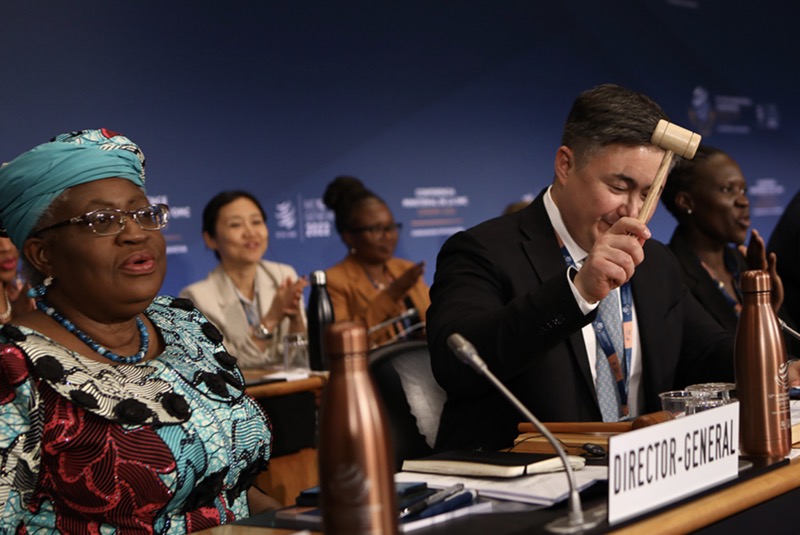
For decades, the WTO represented the principle that global trade rules should be negotiated collectively. Because decisions were made through consensus, even the weakest economies retained a meaningful role in determining outcomes. Although this process was often slow and frustrating, it was also broadly inclusive. Today, however, the WTO is increasingly being circumvented in practice. The Director-General of the WTO, Ngozi Okonjo-Iweala, has acknowledged the deep divisions within the organisation and the growing pressure for reform. Yet what is emerging is not merely institutional reform, but a fundamental shift in the way trade rules are made: when consensus cannot be achieved, countries increasingly move ahead through coalitions.
This trend is visible not only in digital trade negotiations but also in discussions surrounding investment facilitation and environmental measures among subsets of WTO members. These initiatives are commonly described as “plurilateral,” a technical term that obscures their broader significance. In essence, they allow groups of countries to negotiate rules among themselves without securing a fully multilateral agreement.
Supporters argue that such arrangements are necessary because a consensus-based system with more than 160 members and widely divergent interests has become too unwieldy to function effectively. From this perspective, plurilateral agreements are presented as the only practical means of keeping the trading system operational. Yet this argument overlooks what may ultimately be lost in the process.
First, coalition-based rule-making redistributes power away from developing countries and towards coalitions composed of states with unequal levels of economic and political influence. Under the traditional multilateral framework, developing countries often exercised collective leverage by blocking proposals or negotiating concessions. In a fragmented system, however, influence increasingly depends on whether a country is included within the relevant coalition. Countries excluded from these arrangements face a stark choice: either accept rules they played no role in shaping or risk marginalisation within emerging trade regimes.
Second, coalition-based rule-making contributes to the fragmentation of the legal architecture of international trade. Instead of operating through a single coherent framework, international trade law is gradually evolving into a patchwork of overlapping agreements, some multilateral and others selective. Analysts have warned that this form of unregulated pluralism could undermine the predictability, consistency, and universality that historically characterised the global trading system.
More importantly, the fragmentation of trade rules coincides with a broader transformation in the purposes for which trade law is being used. The European Union’s Carbon Border Adjustment Mechanism (CBAM), scheduled for implementation in 2026, will extend the EU’s climate policy beyond its borders by imposing carbon-related costs on imported goods. At the same time, governments are increasingly linking trade policy with industrial strategy, digital regulation, and national security concerns.
According to the United Nations Conference on Trade and Development (UNCTAD), global trade policies are becoming more interventionist and less uniformly liberalised, driven increasingly by geopolitical competition and developmental priorities. The rules governing international trade are therefore no longer concerned solely with reducing barriers to commerce. They are also becoming instruments through which states shape markets, regulate technology, and pursue strategic objectives.
Taken together, these developments indicate that global trade is increasingly organised through selective, issue-specific regimes rather than through universally negotiated rules. Cooperation among smaller groups of willing countries is gradually replacing comprehensive multilateral bargaining as the primary mechanism for developing trade norms. The WTO continues to exist, and its formal commitment to multilateralism remains intact. In practice, however, the nature of rule-making has changed: the process is no longer genuinely universal, but increasingly conditional and selective.
The implications for the Global South are immediate and far-reaching. Trade remains central to industrialisation, employment generation, and long-term economic development. Yet a system characterised by selective rule-making may significantly narrow the policy space available to developing countries. It is also likely to increase compliance burdens while reducing opportunities for these countries to influence the terms on which they integrate into the global economy.
For countries such as India, this is not merely a theoretical concern. It raises a fundamental question: will developing countries continue to shape the rules governing international trade, or will they increasingly be compelled to accept standards formulated elsewhere, particularly in areas such as digital taxation, data governance, and trade-related climate measures?
Preventing fragmentation from hardening into exclusion is still possible. Open, transparent, and broadly participatory plurilateral initiatives can still be pursued, but only if current trends are acknowledged honestly and addressed directly. The central challenge facing the international trading system today is not simply institutional paralysis. It is the gradual institutional drift away from genuinely inclusive rule-making.
The WTO has continued to function formally while increasingly ceasing to operate as a fully multilateral system in substance. Until this transformation is openly recognised, global trade rules will no longer be negotiated collectively. Instead, agreements will increasingly be written by some countries and presented to others for acceptance.
-30-
Copyright©Madras Courier, All Rights Reserved. You may share using our article tools. Please don't cut articles from madrascourier.com and redistribute by email, post to the web, mobile phone or social media.Please send in your feed back and comments to editor@madrascourier.com