How The US Military-Industrial Complex Drives The Unholy Business Of War

Military-industrial-complex-madras-courier
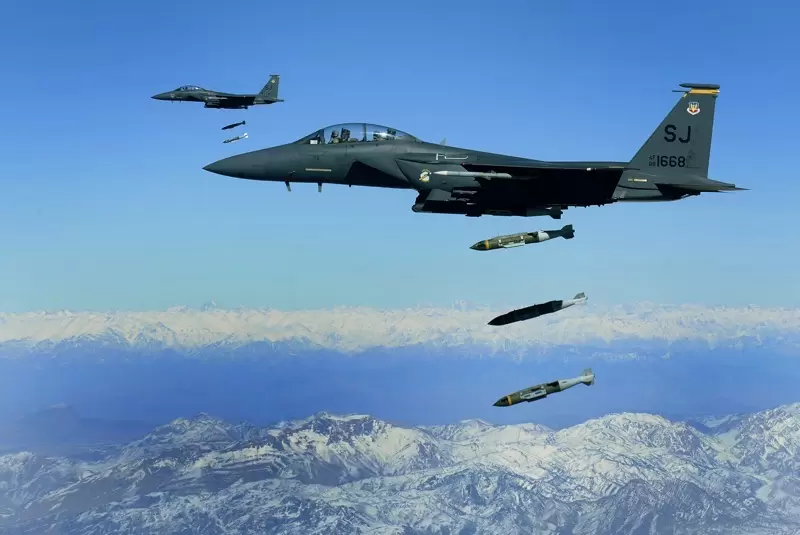
Representational image: Public domain.
Advocates of defence manufacturers hypocritically exhort their pivotal role in building democracies and global security. In reality, these unscrupulous corporations create a phenomenon called “military metaphysic.”

On January 17, 1961, President Dwight Eisenhower’s political farewell to the American people, televised from the Oval Office, made a sharp point of departure in its content. The revered military leader and World War II war hero didn’t ruminate on the “Old Soldier” nostalgia as expected. However, his final address contained grave warnings on the emergence of a “military-industry complex,” the phrase he famously coined during his speech. He cautioned that the blending of business and war and Congressional patronage posed enormous danger to the American people and the world.

In the following decades, the “military-industry-congressional” complex has explicitly transformed the world into a war machine. The political discourse in the US was deftly manipulated; the threat of an “evil empire” — the Soviet Union and the spread of Communism — triggered the Cold War and accelerated a nuclear arms race. The Bay of Pigs Invasion and the Cuban Missile Crisis brought the world closer to a nuclear flashpoint between the US and the Soviet Union. Though a civilizational catastrophe was averted, Eisenhower’s apprehensions came to pass. The Cold War entrenched the omnipotence of the defence corporations. Through their unholy nexus with the political establishment, they manufactured consent among the American public for global military superiority. The psyche of peace was effectively supplanted with the business of “threat-creation.”

During the 1990s, the collapse of the Berlin Wall, the disintegration of the Soviet Union, and the waning relevance of the Warsaw Pact caused turmoil within the US military-industrial complex. General Colin Powell, chairman of the Joint Chiefs of Staff, summarised the predominant gloom: “I’m running out of demons. I’m running out of villains. I’m down to Castro and Kim Il Sung.” For the defence corporations, peace is death and decay.

However, in August 1991, Saddam Hussein invaded Kuwait, offering a fresh lease of life for the military-industrial complex. At a convention of US defence contractors, the master of ceremonies publicly offered gratitude to Saddam Hussein. War has to be perpetually on the US political agenda and national consciousness so that the Pentagon gets substantial appropriations from the US budget. This entails a win-win proposition for the behemoth defence corporations dominated by Boeing, Lockheed Martin, Northrop Grumman, Raytheon (now RTX) and General Dynamics.

The heydays of these companies, nevertheless, were post-9/11 when President George Bush launched the Global War on Terror (GWOT). His ‘modest’ foreign policy was not just obliterating the mortal enemy Al Qaeda and its global network, but also focused on regime change, nation-building and humanitarian assistance in countries that are not “democratic” in the US perception. The war in Afghanistan cost the US taxpayers in excess of $2 trillion.

Lofty political and ethical ideals of reinstating democracies and the rule of law were a farce; staggering corporate profits were the singular motivation and dominant ideal behind the GWOT. In a war with its stated aim of displacing the radical fundamentalist Taliban and eliminating its ally Osama Bin Laden, the United States — after two decades of war, with thousands of its military personnel killed, over 200,000 Afghans dead, including military, civilian and insurgent fighters — effectively installed the Taliban when they abruptly exited Kabul in 2021.

Corporate America was the biggest beneficiary of the Afghan War, with the five famed “merchants of death” registering unprecedented profits in their corporate history. It is baffling that the US expended astronomical sums to fight a ragged band of terrorists and extremists in Afghanistan than the standing armies and organised rebels of the Red Army, Viet Cong, Khmer Rouge and Korean People’s Army combined.

The Pentagon budget has two components. A base budget that funds the existing force structure within the US and more than 800 military bases in 70 countries. It also includes maintenance of the massive nuclear weapons arsenal. The Overseas Contingency Operations (OCO) outlays for ongoing wars abroad. Since 2001, the Pentagon budget has cumulatively risen over the following decade, peaking at $800 billion in 2010, unprecedented in US history. In fiscal year 2025, the Department of Defence (DOD) budget approved by Congress is $1.92 trillion. Since 9/11, the total Pentagon spending is over $14 trillion, of which almost one-third went to the big five weapons contractors. They received $286 billion in contracts in FY 2019 and FY 2020 alone, and to put things into perspective, the $75 billion received by Lockheed Martin in FY 2020 far outweighed the budget allocation for the State Department and Agency for International Development at $44 billion in the same fiscal.

Allegations are also rife that the US defence corporations have appropriated illegitimate funds due to corrupt business practices amounting to fraud, wastage, abuse, price-gouging and profiteering. In 2024, Frank Kendall, then US Air Force Secretary, was summoned to a congressional hearing committee, when Florida Congressman Mike Waltz held a bag of bushings that cost 100 dollars in market price. To Kendall’s utter embarrassment, these electrical bolts were sourced by the Pentagon at $90,000 a bag, even though supply chains were directly from the factory and devoid of middleman distributors.

The extent to which corporate America made windfall gains from the War in Afghanistan is illustrated by a statement made by Boeing Vice-President Harry Stonecipher in October 2001. He intimidated lawmakers in a statement made to the Wall Street Journal: ” The purse is now open…any member of the Congress who doesn’t vote for the funds we need to defend this country will be looking for a new job after next November.” Under the guise of national security, accountability and transparency were forfeited for outrageous profiteering.

The involvement of private security contractors, such as Blackwater and DynCorp, in various operations has introduced additional layers of complexity to oversight and accountability. These contractors perform a broad range of roles, including securing critical infrastructure like oil pipelines in Iraq, protecting U.S. embassies, providing personal security, offering training services, and supporting operational needs such as laundry, food services, repair and maintenance of military vehicles, and logistical assistance with transporting fuel and equipment.

In 2018, the Pentagon decided to stop reporting the number of US troops deployed in combat zones. This lack of transparency has enabled human rights violations by guards of Blackwater Security Consulting, which gained notoriety in the 2017 massacre of 17 civilians in Nisour Square in central Baghdad while escorting a US embassy convoy. Several perpetrators of this heinous crime were later pardoned by President Donald Trump.

Logistics and reconstruction work in war zones is another lucrative area for corporations to reap astronomical profits. In Iraq and Afghanistan, Halliburton was appointed as the principal logistics and reconstruction contractor through their Kellogg, Brown and Root (KBR) subsidiary. The company drew scathing criticism for its underperformance, poor quality and egregious corruption from the press, independent analysts and key members of Congress. In 2004, the Special Inspector General for Iraq Reconstruction (SIGIR) exposed KBR for overcharging for fuel and food supplies to US forces, apart from shoddy construction and outright theft. One of the appalling cases of substandard work culminated in the electrocution of 17 military personnel in various military bases in Iraq due to faulty electrical installations.

Reconstruction efforts in Afghanistan have faced similar challenges related to mismanagement and inefficiency. Examples include expenditures such as $150 million on luxury housing for the Pentagon’s Afghanistan unit, $43 million on a gas station that never became operational, and $3 million spent on patrol boats for the Afghan police that were not utilised.

Congressional investigations also uncovered that approximately $2 billion in transportation contracts awarded to U.S. and Afghan firms resulted in funds being diverted as bribes to Afghan warlords, police, and kickbacks to the Taliban, reportedly up to $1,500 per truck in large convoys of 300 vehicles.

In 2011, the Commission on Wartime Contracting in Iraq and Afghanistan estimated that waste, fraud and abuse cost the American taxpayers between $31 billion and $60 billion. Interestingly, Dick Cheney, who served as Defence Secretary during the Bush administration and initiated logistics privatisation, later became CEO of Halliburton. The nexus between policymakers and large corporations is irredeemable.

The United States remains the leading global exporter of arms, surpassing Russia, France, China, and Germany by a substantial margin. In 2024, U.S. foreign military sales rose by 29 per cent to $318.7 billion, a growth influenced partly by the ongoing conflict between Russia and Ukraine, as European governments sought to replenish stockpiles sent to Kyiv. The primary beneficiaries are Lockheed Martin (F-16 and F-35 combat aircrafts), Boeing (F-15 and Apache attack helicopters), RTX (precision guided bombs and air-to-surface missiles), General Dynamics (highly sophisticated Abrams Tanks, Stryker an AJAX armored combat vehicles) and Northrop Grumman (missiles and guided projectiles, aviation, cybersecurity and surveillance systems). Richard Aboulafia, the managing director at Aerodynamic Advisory, a boutique aerospace consulting firm, quipped, “Putin is unquestionably the best F-35 salesman of all time.”

The “Leahy Law” provides statutory guardrails for the US government that prohibit it from selling arms and ammunition to countries that engage in genocide and human rights violations. Despite overwhelming evidence that Israel commits a horrendous genocide in Gaza against the Palestinian population, it continues to arm Tel Aviv with weapons, especially Boeing-made Joint Direct Attack Munitions (JDAM) to conduct deadly airstrikes that erase homes, hospitals and schools. Similar crimes against humanity by the Saudi-led coalition in the decade-long civil war in Yemen, using American-made weapons and ammunition, have been reported by Amnesty International and Human Rights Watch.

Boston Consulting Group (BCG), the blue-chip US management consulting firm was hired to create the Gaza Humanitarian Foundation (GHF), the aid distribution entity in Gaza backed by Israel and the Trump administration. BCG designed the foundations’ business strategy, logistics and operational framework amidst global criticism of GHF militarising aid. Global human rights agencies, including the United Nations, have condemned these sites as “death traps”, where Israeli forces have been butchering hundreds of starving Palestinian civilians, who were crowding for food. Internal documents of BCG have unravelled reprehensible plans for “humanitarian transition areas” where Gazans would be relocated into compounds under heavy surveillance and issued identity cards to access aid. The BCG model’s uncanny resemblance to “concentration camps” in Nazi Germany is inescapable. In the quest for profits, ethical concerns are like ephemeral mists, fading from corporate vision and mission statements.

The behemoth defence corporations have spent over $2.5 billion in lobbying with the US Congress in the last twenty years. A significant portion of the money has gone to campaign contributions to pro-arms candidates who have lynchpin roles in shaping the Pentagon budget. As of 2024, the arms industry has employed 950 active lobbyists, almost twice the size of the 535 members of Congress. In the last five years, the military-industrial sector has expanded to incorporate military technology companies such as SpaceX, Palantir, and Anduril.

The global war on terror has shifted to a global power competition with China, despite China not posing a military threat to the United States. The rueful consequence is that gargantuan funds are used to develop innovative methods of killing humans that could have been used to solve humanity’s existential problems.

The parallels between the character Andrew Undershaft in George Bernard Shaw’s philosophical play Major Barbara and the military-industrial complex is striking. Undershaft asserts:

I am not one of those men who keep their morals and their business in watertight compartments. All the spare money my trade rivals spend on hospitals, cathedrals, and other receptacles for conscience money, I devote to my experiments and research in improved methods for destroying life and property. I have always done so; and I always shall… My morality—my religion—must have a place for cannons and torpedoes in it.”

Advocates of defence manufacturers hypocritically exhort their pivotal role in building democracies and global security. In reality, these hawkish corporations and their unscrupulous lobbyists create a phenomenon called “military metaphysic”, coined by the sociologist C. Wright Mills. It is characterised by conjuring a hypnotised reality defined in terms of military; of bellicose enemies, insurgencies, Machiavellian conspiracies and Sun Tsu’s art of war responses for preserving nationhood. Peace without war is a sacrilege for these elites in designer suits, strategising in boardrooms and lobbying in the corridors of power. Propaganda is deftly employed to enlist soldiers in the prime of their youth to march to the battlefront and die for these sponsors of mayhem to reap huge profits. The irony is that both belligerent nations are made to believe: “God is on our side.”

The costs of war are socialised, but profits are privatised. The costs are mangled bodies, rows of tombstones, shattered minds, devastated homes, seared consciences, lifelong prisoners of PTSD’s, generations of crippling taxation and economic instability. The bigger reality is that there are no discernible lines between the victor and the vanquished. This loss of human spirit and deprivation of future is poignantly encapsulated by the German novelist Erich Maria Remarche in his magnum opus, All Quiet on the Western Front. It is poured out as a libation in silent contemplation of the fallen enemy soldier:

But now, for the first time, I see you are a man like me. I thought of your hand-grenades, of your bayonet, of your rifle; now I see your wife and your face and our fellowship. Forgive me, comrade. We always see it too late. Why do they never tell us that you are poor devils like us, that your mothers are just as anxious as ours, and that we have the same fear of death, and the same dying and the same agony–Forgive me, comrade; how could you be my enemy?”

-30-

Copyright©Madras Courier, All Rights Reserved. You may share using our article tools. Please don't cut articles from madrascourier.com and redistribute by email, post to the web, mobile phone or social media.
Please send in your feed back and comments to [email protected]
0 replies on “How The US Military-Industrial Complex Drives The Unholy Business Of War”