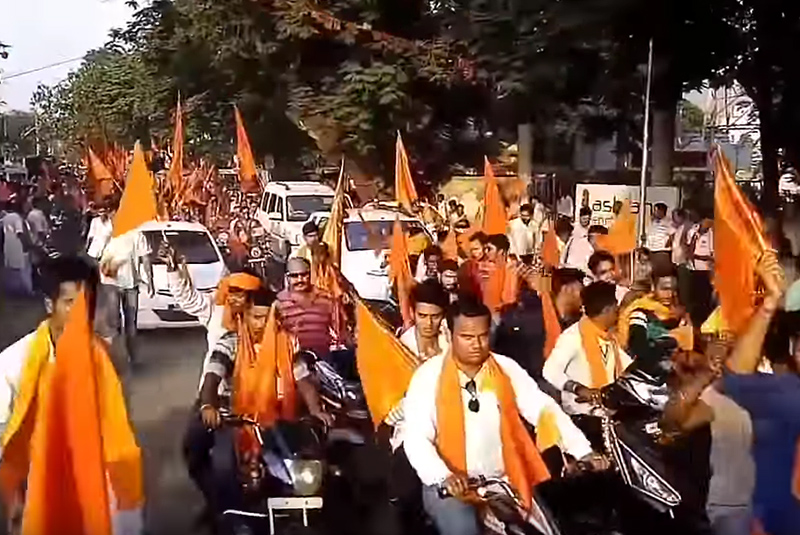
On Christmas Eve 2024, groups of men carrying wooden sticks stormed a shopping mall in Raipur and vandalised Christmas celebrations. The pretext was a well-worn allegation of “forcible conversion” by Christians—a charge for which no credible evidence has been produced. The Government of India offered no condemnation. In the twelve years since the BJP came to power in 2014, the reassurances offered to India’s minorities have become formulaic—repeated to placate international observers, while the reality narrates a different story. The language of protection and inclusion has been emptied of substance. What remains is a ritual performance invoking “Vishwa guru” (Teacher of the World) and “Vasudhaiva Kutumbakam” (The World is One Family), even as a narrow, exclusionary project targets minorities deepens.
Attacks on Christians, recorded by the United Christian Forum, rose from 151 in 2014 to 834 in 2024; it’s a fivefold increase in a decade, with many incidents targeting Sunday worship services. For India’s 200 million Muslims, 90 per cent of religion-based hate crimes between 2009 and 2019 occurred after 2014, alongside a sustained escalation in hate speech in recent years, often linked to political mobilisations and election cycles.
IndiaSpend documented that 86 per cent of cow vigilante violence victims from 2010–2017 were Muslim, with 97 per cent of those attacks post-2014. By 2025, the India Hate Lab recorded 1,318 hate speech events in a single year, more than three per day, with 1,289 targeting Muslims. These are not the statistics of a democracy protecting its minorities, nor isolated incidents. They signal a society being reconfigured along majoritarian, ethnonationalist lines.
India’s Buddhist and Jain communities face persecution of a different kind. It pertains to absorption rather than mob violence. RSS-aligned ideology anchors both traditions within a Hindu civilizational framework, directly contradicting Ambedkar’s 1956 conversion to Buddhism, conceived explicitly as a rejection of caste supremacy.
Ambedkarite symbols are periodically vandalised. These attacks are often responses to Dalit assertions, which continue to provoke violence. One of the most prominent examples is the Bhima Koregaon attack, where Hindu nationalist organisations reportedly targeted an annual Dalit Buddhist gathering. The hounding of Rohith Vemula, who was suspended from university under pressure from BJP-affiliated student unions and died by suicide, remains a glaring case of institutional bias.
The Jain grievance is primarily legal. Hindu personal law statutes—the Succession, Marriage, Adoption, and Guardianship Acts—subsume Jains as a sub-group within Hinduism. Sikhs and Buddhists also face the same legal absorption.
Though administratively convenient, such classification is contested by those who assert their distinct religious identities. For Buddhists, particularly Ambedkarite Dalits who converted to escape the oppressive caste system, being legally governed by Hindu law frameworks is a source of enduring grievance.
Sikh farmers who protested against the Modi government’s farm laws were quickly denounced as “Khalistani terrorists,” “Pakistani stooges”, and “anti-nationals,” who sought to destabilise the government.
By contrast, Muslims bear the brunt of physical atrocities. In September 2015, in Dadri, Uttar Pradesh, a fifty-two-year-old Muslim man, Mohammad Akhlaq, was dragged from his home and lynched by a mob on suspicion of storing beef in his refrigerator. His son was left critically injured, and his family was displaced. Forensic tests indicated the meat was mutton. The accusation, later disproven, had already done irreversible damage. A decade later, such incidents no longer shock the system. They recur with increasing normalisation.
The Mughal experience—the scourge of BJP ideologues—offers a counterpoint to the present trajectory of exclusionary politics. The empire reached its zenith not under its most sectarian rulers but under its most cosmopolitan ones. Emperor Akbar (1556–1605) presided over a court defined by pluralism. He abolished the jizya and convened the Din-i-Ilahi as a syncretic dialogue across Islam, Hinduism, Zoroastrianism, Jainism, and Christianity. Akbar appointed Hindus to the highest administrative and military offices—among them Todar Mal and Man Singh. The result was an empire whose administrative sophistication, cultural glory, and territorial consolidation placed it among the great polities of the early modern world.
It was precisely when later Mughals—conspicuously Aurangzeb—reversed pluralism and reimposed the jizya, destroyed temples, and alienated the Rajput and Maratha confederacies that the empire began its long disintegration. Inclusive governance built the empire. Exclusion and ostracisation dismantled it.
The capitulation of India to foreign invaders in history was partly facilitated by social fractures manufactured by the ruling order. The deliberate exclusion of the subaltern, whose dignity and humanity were subjugated, impeded collective sociopolitical cohesion. When Muhammad of Ghor defeated Prithviraj Chauhan at Tarain in 1192, the absence of unified Rajput resistance was the outcome of a fractured society. Communities humiliated by the caste order had little investment in preserving the system that oppressed them. As Dr B. R. Ambedkar observed, a society that maintained millions in untouchability could not generate the solidarity required for genuine self-determination and the creation of an egalitarian society.
The BJP’s Hindutva project is a strategic gift to those who would like to see India divided. A nation in which 200 million Muslims are rendered suspect, Christians are mob-attacked during prayer, and Dalits are reminded daily of their place in an immutable hierarchy built on myth is not building the social cohesion required for great power status. It is systematically reproducing the exact conditions of its historical vulnerability.
To counter international scrutiny, the RSS has mounted an ambitious campaign of global image management: foreign dignitaries are invited to Nagpur shakhas (branches), and spokespeople deploy a carefully curated language of cultural and civilisational pride. The Hindu Swayamsevak Sangh, the RSS’s overseas unit, is active in 156 countries, with nearly 220 branches in the United States alone, and promotes cultural programming that reframes discourse away from political critique of the RSS and the BJP. Both the RSS and HSS venerate early Hindutva ideologues, despite their supremacist and bigoted worldview. Savarkar declared Muslims and Christians could never be fully Indian; Golwalkar admired the Nazi model of minority suppression. Prime Minister Modi has publicly praised Savarkar and invoked his legacy.
In 2015, an undercover investigation by ITV’s Exposure program recorded an HSS summer camp teacher telling children that good Muslims “can be counted on one finger.” This is how ideology is indoctrinated—not only through manifestos and speeches, but through classrooms and summer camps, sowing the seeds of intolerance in the young minds. The RSS’s global campaign is merely Hindutva repackaged for Western consumption.
The Constitution of India, shaped by B.R. Ambedkar, protected freedom of religion because he understood that without such protections, minorities would be vulnerable within a majoritarian democracy. The BJP has not amended this framework; it has hollowed it out. The Citizenship Amendment Act of 2019 (CAA) introduced religion as a criterion for citizenship, extending protection to persecuted minorities from neighbouring countries except Muslims. Its logic was unmistakable: Muslims, even when persecuted, fall outside the State’s obligation.
Alongside this legislative shift runs a regression toward caste hierarchy—the elevation of Brahminical cultural vocabulary as authentic “Indian” identity and the failure to prosecute atrocities against Dalits. The dispossession extends to India’s Adivasi (original inhabitants) communities; approximately 104 million people whose ancestral lands sit above some of the country’s most valuable mineral deposits. Resistance to land acquisition for mining and forest clearance is frequently interpreted as Maoist or Naxalite activity, reframing a struggle for land rights as an insurrection. In Chhattisgarh, Jharkhand, and Odisha, communities have been displaced from forests their ancestors inhabited to make way for coal extraction and industrial corridors. These uprisings are condemned as anti-national – the new untouchable in India.
The incendiary rhetoric of those in power leaves little ambiguity about the project itself. A human rights panel documented hundreds of dehumanising speeches against Muslims by BJP leaders: 108 by Uttar Pradesh Chief Minister Yogi Adityanath, 85 by Home Minister Amit Shah, 81 by Prime Minister Modi, 52 by Assam Chief Minister Himanta Biswa Sarma. At a 2019 West Bengal rally, Shah called undocumented immigrants “termites” to be removed, while promising citizenship to Hindu and Buddhist refugees — a discriminatory distinction later encoded in law by the CAA. In April 2024, Modi described Muslims at a Rajasthan rally as “infiltrators”plundering India’s wealth, prompting thousands of formal complaints to the Election Commission. Adityanath warned that those who followed Aurangzeb’s path would be “buried by bulldozers.” These are not fringe voices. They govern India’s largest states and hold its highest offices.
India’s five-trillion-dollar ambition is inseparable from the social conditions its government is creating. Seventy-nine per cent of Indian Muslims report fearing violence and government persecution, with this anxiety suppressing economic participation. A community comprising 14 per cent of the population, excluded through discriminatory enforcement, housing segregation, and social ostracisation, compresses productive capacity. In several Indian cities, Muslims were denied rental housing in mixed neighbourhoods, pushing entire communities into segregated enclaves with weaker access to infrastructure and credit. In Uttar Pradesh and Madhya Pradesh, the routine use of “bulldozer justice”—demolishing homes and shops of those accused, often without due process—has extended punishment beyond individuals to families and livelihoods. Inequality and exclusion carry measurable economic consequences.
The global auditors have recorded the democratic backsliding. V-Dem classifies India as an “electoral autocracy,” a status it entered in 2017 and retains, ranking 105 out of 179 countries on the Liberal Democracy Index in 2025. The V-Dem report for 2026 is unsparing in its diagnosis. It describes the ruling BJP as an “anti-pluralist, Hindu-nationalist” party whose “derailing of democracy” includes “deteriorations in freedom of expression and independence of the media, harassments of journalists critical of the government, and attacks on civil society and the opposition”.
Freedom House downgraded India from “Free” to “Partly Free” in 2025, scoring it 63 out of 100, down from 77 in 2017. The US Commission on International Religious Freedom has recommended that India be designated a Country of Particular Concern (CPC) for its treatment of religious minorities alongside China, North Korea, Pakistan, and Saudi Arabia. The Modi administration has reportedly approached think tanks to develop a rival democracy index in response to this damage to its international reputation—an unusual move for a state seeking to project institutional confidence. Taken together, these are not isolated downgrades. They point to a system that retains electoral form while narrowing the meaning of citizenship.
India stands at a civilisational crossroads whose stakes extend beyond any election cycle. The choice between the secular and plural democracy that Ambedkar and the founding fathers built, and the narrow ethnonationalism of Hindutva, is not a contest between political ideologies. It is a contest between the modern, inclusive constitutional idea of India and a regression into exclusionary majoritarianism.
India’s minorities—200 million Muslims, 30 million Christians, millions of Sikhs, Buddhists, Jains, Dalits, and Adivasis—are not enemies of the republic as the BJP portrays them to be. They are the co-owners. They built its roads and staffed its armies, composed its epics and tilled its soil, shed their blood and prayed in languages as old as its civilizational memory—histories the Hindutva imagination cannot fully contain. To unmake them is not to purify India. It is to dismember it. Nations, like human bodies, do not thrive on dismemberment. They survive it—diminished, disfigured, haunted by the ghost of what they chose to cut away.
The men who stormed the mall in Raipur on Christmas Eve were not defending India. They were, in the most precise historical sense, unmaking it.
-30-
Copyright©Madras Courier, All Rights Reserved. You may share using our article tools. Please don't cut articles from madrascourier.com and redistribute by email, post to the web, mobile phone or social media.Please send in your feed back and comments to editor@madrascourier.com