
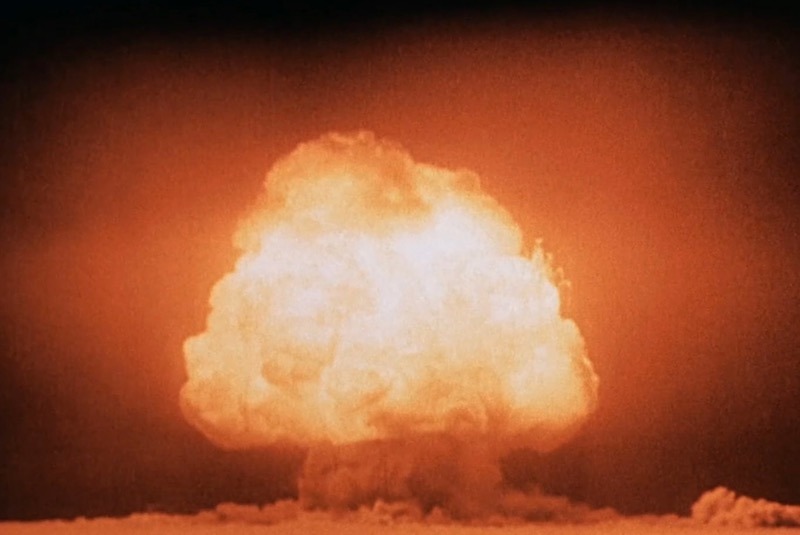
On July 16, 1945, scientists working for the United States Army gathered in the New Mexico desert to witness the Trinity Test—part of the Manhattan Project—the first nuclear detonation in human history. Robert. J. Oppenheimer, widely regarded as the “father of the atomic bomb,” watched in stunned silence as the towering inferno of the mushroom cloud ascended to the heavens, and recalled verses from the Bhagavat Gita: “Now I am become death, the destroyer of the worlds.”
The finest scientific minds—cultivated sophisticates in suits—ushered in the devastating Nuclear Age. And the success of the Manhattan Project stands as a testament to the failure of moral imagination.
Albert Einstein, who saw it as a civilisational Armageddon, issued a grim warning:: “The unleashed power of the atom,” he wrote, “has changed everything save our modes of thinking, and thus we drift toward unparalleled catastrophe.” The success of the Manhattan Project reveals that technology has become sophisticated, but the people who use it have not.
This asymmetry lies at the heart of modern civilisation. Science and technology operate on an exponential curve; each generation inherits and builds upon accumulated knowledge. However, moral growth does not follow this cumulative pattern. Every human being is born vulnerable, haunted by primal fears. No child arrives in the world endowed with the wisdom of Socrates. Character is formed in the storm and stress of the world—in the face of adversity, hardship, rejection, and pain. If technology is cumulative, wisdom is painstakingly acquired.
The Manhattan Project remains the purest expression of this imbalance. American scientists accomplished in three years what centuries of science had made possible, then handed the result to politicians and generals whose imagination had scarcely advanced beyond ancient siege warfare. The result was devastating: the incineration of Hiroshima and Nagasaki, even as Japanese forces already suffered catastrophic reversals after months of relentless firebombing of their cities by the U.S. military. What had advanced with breathtaking speed was not human judgment, but human capability.
This tension between capability and judgment is not accidental; it is deep-rooted in human nature. The British philosopher Thomas Hobbes, in his book Leviathan, argued that humans—driven by fear, competition, and an incessant quest for power—exist in a state of perpetual insecurity, producing “a war of all against all.” In this sense, the mismatch between technological progress and moral development is not a temporary failure but a structural condition: we have evolved our tools, but not ourselves.
This pattern repeats itself in contemporary geopolitics. Imaginary external enemies are constructed to foster security paranoia and ideological threats, and such enemies often become a source of immense profit. For instance, the United States, in collusion with the military-industrial complex, funded the “Global War on Terror” and reaped astronomical profits for major defence contractors such as Boeing, RTX Corporation, Northrop Grumman, Lockheed Martin, and General Dynamics. Here, advanced military technology did not eliminate fear; it monetised it.
A similar logic underpinned the propaganda surrounding weapons of mass destruction (WMD) used to justify the invasion of Iraq. In Libya, humanitarian rhetoric was deployed to overthrow Gaddafi and support NATO intervention, framed as the Responsibility to Protect (R2P) Civilians under a United Nations mandate. Beneath these stated intentions lay a more material motive: the drive to control vast oil resources. In each case, technological superiority did not produce moral clarity; instead, it enabled the strategic pursuit of power under more sophisticated justifications.
The Russia–Ukraine war offers another compelling case in point. Frequently described as one of the most technologically mediated conflicts in human history, it has unfolded under the gaze of commercial satellites tracking troop movements, drones redefining asymmetric warfare, and social media broadcasting developments in real time. Yet beneath this sophisticated digital architecture lie strikingly archaic impulses—security anxieties, territorial expansionism, and an enduring struggle for power that would be familiar to the medieval mind. The tools have changed; the instincts have not.
Similarly, the ongoing US-Israel war on Iran is deeply rooted in strategies reminiscent of medieval regional expansionism. This war is a manifestation of Benjamin Netanyahu’s advocacy for a Greater Israel—Eretz Israel Hashlema—a vision that the US ambassador to Israel, Mike Huckabee, sympathetically acknowledges. Their actions—characterised by illegal aggression, attempts at regime change, and the pursuit of personal vendettas—mirror the cunning and deception employed by rulers of warring medieval European kingdoms. Sadly, they justify their grandiose visions by selective Biblical readings—particularly the notion of a land stretching from the “Nile to the Euphrates”—that blur the line between theological symbolism and modern geopolitical ambition.
Tensions are not confined to immediate adversaries. At various points, Israeli leaders such as Naftali Bennett have also expressed concern about Turkey’s regional posture, reflecting a broader pattern in which shifting geopolitical landscapes create new enemies and revise hierarchies of threat perception.
Central to these operations is the philosophy embodied by Mossad’s motto—“By way of deception, thou shalt do war”—a reinterpretation of Proverbs 24:6 of the Tanakh. This principle underscores the enduring influence of medieval tactics in contemporary warfare, where misinformation and manipulation are used to sway political figures to achieve strategic objectives. The parallels between current conflicts and ancient power struggles reveal how, despite technological advances, the fundamental instincts driving war remain conspicuously ancient.
If modern warfare reveals the persistence of ancient impulses, the digital age exposes how deeply embedded those impulses remain in everyday life. Smartphones, social media platforms, and machine learning algorithms have not transcended human nature; they have amplified humanity’s most primitive instincts. Modern digital environments echo the mob mentality of the medieval marketplace, the ferocity of warring fiefdoms, and the public spectacle of collective punishment.
In contemporary society, these phenomena carry sanitised names—cyberbullying, echo chambers, and filter bubbles. Yet they remain expressions of collective aggression and tribalism. Engagement algorithms, designed to maximise user interaction, often incite hatred and bigotry by curating feeds that foster misinformation and disinformation. This attention-capture business model has, in effect, monetised contempt.
The consequences are no longer abstract. Facebook was accused of allowing hate speech that contributed to massacres of Rohingya Muslims and of inciting ethnic conflict in northern Ethiopia by failing to moderate content. In these instances, technology did not restrain humanity’s darker impulses; it granted them scale, speed, and a veneer of legitimacy. Online networks have enabled the rise of coordinated propaganda, political manipulation, and character assassination—forms of conflict that unfold not on battlefields, but in the architecture of information itself.
To understand why these systems are so effective, it is necessary to examine the human mind closely. The psychologist Daniel Kahneman describes two modes of thinking in Thinking, Fast and Slow: System 1—fast, instinctive, and emotional—and System 2—slow, deliberate, and rational. The tools of the digital age are engineered to ensure that System 1 dominates user engagement. Doom-scrolling, notification pings, “like” buttons, and algorithmically curated feeds are designed to privilege speed and emotion over reflection and reason.
As a result, even highly intelligent individuals with significant academic and professional achievements often succumb to cognitive biases when deliberative thinking is disengaged. The accumulation of knowledge does not necessarily translate into wisdom. This helps explain the erosion of scientific temper and the resurgence of religious obscurantism, even among educated populations. Once again, capability advances while judgment lags behind.
Group dynamics further intensify this problem. The social psychologist Henri Tajfel’s Social Identity Theory explains how individuals derive meaning and self-worth from group membership, creating an instinctive divide between “us” and “them.” This dynamic is evident in contemporary political movements, where complex policy debates are reframed as identity struggles—nation versus outsider, people versus elite. Digital platforms reinforce these divisions by rewarding emotionally charged content, strengthening echo chambers, and amplifying conflict.
History offers stark evidence of where such dynamics can lead. King Leopold II of Belgium reduced Congolese Africans to sub-human instruments instruments of rubber extraction, combining modern industry with brutal coercion. Nazi propaganda dehumanised Jews by calling Jews Untermenschen (subhuman) before industrialising their extermination with railway timetables and Zyklon B. In Rwanda, radio broadcasts labelled Tutsis as “cockroaches” before slaughtering 800,000 people in 100 days. In each case, technology did not civilise human behaviour; it magnified the consequences of dehumanisation.
These examples reveal a consistent pattern. The finest human minds have developed technologies that are repeatedly weaponised to serve the destructive aspects of human nature. The human capacity that produced great works of art and culture has also produced instruments of unprecedented violence. Civilisations capable of extraordinary creativity have also demonstrated an equally extraordinary capacity for destruction.
By designing nuclear warheads, advanced weapons systems, and powerful digital infrastructures, humanity has created tools that extend its reach far beyond its moral grasp. These systems amplify fear, intensify division, and increase the efficiency with which harm can be inflicted. What has changed is not the underlying impulse, but the scale at which it can operate.
Humanity today stands at a dangerous precipice. Our tools outpace our judgment, and our reach exceeds our restraint. We have created systems that amplify our fears, weaponise our identities, and industrialise our capacity for harm. In that sense, the greatest risk we face is not that our machines become more like us, but that they faithfully execute the worst parts of who we are.
-30-
Copyright©Madras Courier, All Rights Reserved. You may share using our article tools. Please don't cut articles from madrascourier.com and redistribute by email, post to the web, mobile phone or social media.Please send in your feed back and comments to [email protected]