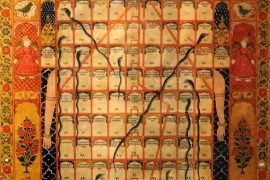
In the summer of 1943, an Italian political cartoon depicted Benito Mussolini in the midst of a botched snake-charming act. The image, designed to criticize Italy’s disastrous entry into World War II, portrays Mussolini as a hapless figure—sweating, shaking, and wearing only a loincloth and turban—helpless before a snake that he had foolishly tried to control. The snake, of course, is not just any snake but a representation of the war, which spiralled beyond Mussolini’s ability to manage, eventually consuming his dignity, his power, and his life. The cartoon’s humour is biting, almost absurd, and yet, it delivers a harsh truth: Mussolini’s decision to align Italy with Nazi Germany had turned disastrously against him. In this moment of ridicule, there is a dark justice. Mussolini, once the proud dictator of Italy, was reduced to a puppet, fleeing his country before meeting his end at the hands of Italian partisans. There is something grimly amusing in the image of a man who believed he could charm the snake of war only to be swallowed by it—his fate a testament to the disastrous folly of his choices.
Humour in political cartoons, particularly during times of war, serves a purpose far beyond mere entertainment. While satire has always been a tool for criticism, in times of conflict, it becomes a form of propaganda that can shape public perception, rallying support for the war effort, demonising the enemy, and rendering the brutalities of war more palatable through ridicule and mockery. The Mussolini cartoon is an excellent example of how a simple drawing can convey complex political realities: Mussolini’s loss of control over both his military and his country, his subjugation to Hitler’s whims, and ultimately, his humiliating death. This approach to propaganda—combining humour with an unflinching look at political failure—was widespread during World War II. Cartoons such as these not only commented on current events but also shaped public understanding, forcing people to confront the dire consequences of their leaders’ decisions, albeit with a laugh.
Political cartoons, in their simplicity, are a powerful tool for propaganda. They are not only quick to consume but also potent in shaping the attitudes of a wide audience, from children to adults. During World War II, cartoons were widely distributed in newspapers, pamphlets, and other media, becoming an integral part of both Allied and Axis efforts to sway public opinion. They worked by reducing complex geopolitical conflicts to digestible, often humorous, caricatures of enemy leaders and ideologies. In the United States, one of the most prolific cartoonists of the war effort was Theodor Seuss Geisel, better known as Dr. Seuss. While his beloved children’s books remain timeless, the political cartoons he produced for the New York newspaper PM during the war reveal a far more troubling side of his work. His depictions of the Japanese were openly racist, portraying them as vermin or subhuman creatures—rats, monkeys, and even snakes, similar to the ones that figured in European caricatures of Mussolini. Geisel’s drawings were effective propaganda, amplifying the growing hatred of the Japanese and justifying the brutal tactics employed by the U.S. military. His cartoons, filled with dehumanising imagery, played a part in the public’s acceptance of atrocities like the firebombing of Tokyo, which killed over 100,000 civilians, and the atomic bombings of Hiroshima and Nagasaki, which led to an estimated 200,000 deaths. These acts, though horrifying, were presented as necessary to defeat an enemy, in large part due to the public’s perception of the Japanese as less than human.
The dehumanisation of an enemy is a key function of wartime propaganda, and cartoons are uniquely suited to this task. By reducing the enemy to an animalistic or monstrous form, cartoons strip them of their humanity, making it easier for the public to accept extreme measures of violence against them. This was evident in how Japanese Americans were treated during the war. Propaganda worked so effectively that the U.S. government was able to intern over 120,000 Japanese Americans in camps, often with little public outcry. The widespread portrayal of the Japanese as an unworthy enemy laid the groundwork for these actions, as well as for the general indifference to the civilian casualties of the war. It is not unlike how slavery dehumanised Black people, reducing them to caricatures of primitivism and savagery, thereby justifying their exploitation. Cartoons from the nineteenth century, such as the notorious rhyme “Ten Little Niggers,” reinforced these stereotypes, presenting Black people as subhuman, fit only for servitude. Similarly, the portrayal of Black men and women as apes or beasts helped fuel the justification for slavery, depicting them as lacking the moral and intellectual capacity of their white counterparts. In both cases, the creation of an “other,” a dehumanised enemy, made the brutality of war, colonisation, or slavery easier to justify in the eyes of the public.
This process of dehumanisation through caricature is not limited to wartime propaganda or the history of slavery. Throughout the twentieth and twenty first centuries, political cartoons have been used to construct enemies and cement political identities. In fact, political cartoons are often seen as a mirror of the society in which they are created. They reflect not only the political issues of the day but also the social attitudes and values of the time. The cartoonist’s pen becomes a tool not just for critique but for shaping the very nature of political discourse. Cartoons are often used in political campaigns, where they serve to build or dismantle the public image of candidates. By focusing on qualities like character, competence, and charisma, these cartoons can sway public opinion and build a specific identity for the candidates they depict. Whether used to glorify or vilify, political cartoons distill complex political struggles into visual shorthand, making them accessible to a wide audience.
It is easy to overlook the profound impact that political cartoons can have on public perception. We might laugh at the exaggerated features of a leader or the absurdity of a situation, but behind the humour lies a concerted effort to shape our understanding of the world. Mussolini’s failed snake-charming act is more than just a moment of ridicule; it is a sharp commentary on his catastrophic leadership. Just as cartoons once turned Mussolini into a figure of fun, so too have they been used to vilify or uplift leaders, to mock ideologies, and to push forward agendas. Political cartoons are a tool, as potent as any speech or manifesto, that can sway hearts and minds by simplifying the complex, deflating the powerful, and rallying support for causes both righteous and questionable. Next time you find yourself laughing at a political cartoon, take a moment to consider the forces at play in that seemingly simple image. What are they trying to make you believe? And what truths, hidden beneath the humor, are they asking you to ignore?
-30-
Copyright©Madras Courier, All Rights Reserved. You may share using our article tools. Please don't cut articles from madrascourier.com and redistribute by email, post to the web, mobile phone or social media.Please send in your feed back and comments to [email protected]