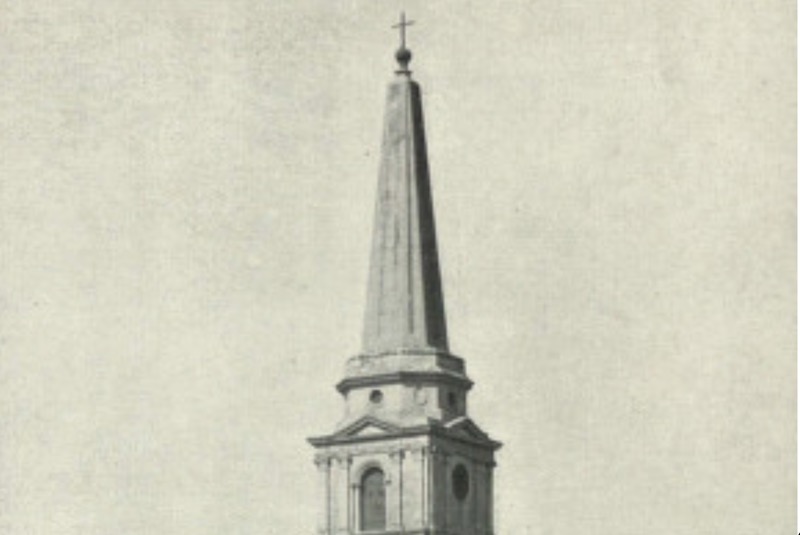
The whitewashed walls of St Mary’s Church inside Fort St. George have survived wars, sieges, cyclones and three centuries of tropical heat. Visitors often marvel at its elegance: the thick lime-plastered walls, the barrel-vaulted roof and the polished memorial tablets that commemorate Britain’s colonial dead. But the church is more than a relic of colonial architecture. It is one of the few surviving witnesses to the uncertain beginnings of what would eventually become the British Empire in India.
When St Mary’s was consecrated in 1680, the English did not possess an empire. They occupied a narrow strip of land on the Coromandel Coast, surrounded by rival European powers and powerful Indian kingdoms. Their foothold in Madras—today’s Chennai—was fragile, commercial and constantly under threat. The church they built reflected that insecurity.
Founded in 1639, Fort St. George was the English East India Company’s first permanent fortified settlement in India. The Company had arrived as a merchant enterprise seeking textiles, spices and access to Asian markets. Local rulers granted the Company permission to establish a trading post on what was then a sparsely populated stretch of coastline. Warehouses came first. Defensive walls soon followed.
Around the fort, a settlement would grow into Madras, one of the most important cities in British India. Long before Calcutta became the capital of the Raj or Bombay emerged as a commercial powerhouse, Madras served as the Company’s principal base on India’s eastern coast. The church rose at the heart of this expanding settlement.
St Mary’s is widely recognised as the oldest surviving Anglican church in India and the oldest surviving Anglican church east of the Suez. That geographical description predates the Suez Canal by nearly two centuries. Before the canal opened in 1869, “east of Suez” referred broadly to Britain’s possessions and commercial interests across Asia, a phrase that would later become shorthand for Britain’s imperial reach.
The church was designed by Edward Fowle, a master gunner rather than an architect, and built under the supervision of William Dixon. Its appearance reflected necessity more than ecclesiastical fashion. Unlike the soaring Gothic cathedrals of Europe, St Mary’s resembles a fortified hall. Its roof is a massive brick barrel vault, constructed to withstand bombardment. The walls are exceptionally thick, helping to keep the interior cool while also providing protection during attacks. Those precautions proved justified.
Throughout the seventeenth and eighteenth centuries, Fort St. George stood at the centre of competing imperial ambitions. The Dutch challenged English commercial ambitions across Asia. The French East India Company emerged as a formidable rival. Indian rulers, including the Mughal Empire and later the rulers of Mysore, were powerful military forces whose interests did not always align with those of European merchants.
The church periodically became a refuge as much as a place of worship. During military threats, civilians sheltered within its solid walls while cannon fire echoed across the fortifications outside. Its greatest test came during the Carnatic Wars.
In 1746, French forces under Bertrand-François Mahé de La Bourdonnais captured Fort St. George after a naval assault. For nearly three years, the French occupied the settlement before returning it under the Treaty of Aix-la-Chapelle in 1749. Much of the fort suffered damage during successive conflicts, but St Mary’s survived largely intact.
It survived later confrontations as well, including periods of tension during the wars against Hyder Ali and Tipu Sultan of Mysore. Few buildings associated with the Company’s earliest decades can claim such continuity. Inside the church are reminders that empire was often an unhealthy enterprise long before it became profitable.
Its memorial tablets record the names of soldiers, administrators and merchants who died not in battle but from disease. Cholera, malaria, dysentery and other tropical illnesses claimed lives with remarkable efficiency. For many Europeans arriving on India’s southeastern coast, survival depended less on military skill than on luck. Among those connected with St Mary’s is one figure whose legacy now stretches far beyond Chennai: Elihu Yale.
Yale arrived in Madras as an East India Company official and became Governor of Fort St. George in 1687. During his tenure, the settlement prospered commercially, but allegations of corruption also marked his administration. In 1692, the Company’s directors dismissed him after accusations that he had engaged in private trading and had accumulated wealth through activities that violated Company rules.
His reputation has become even more controversial because of his links to slavery.
Like many senior East India Company officials of his era, Yale operated within a commercial world that intersected with the global slave trade. Historical records indicate that slaves were bought and sold in Madras during his administration, and scholars have documented his involvement in transactions involving slaves. The institution of slavery in seventeenth-century India differed from the plantation slavery that developed in the Atlantic world, but both formed part of a wider network of human exploitation sustained by European commercial expansion.
Yale’s wealth, accumulated through trade and private business, later crossed oceans. In the early eighteenth century, he donated books, paintings and goods to the Collegiate School in Connecticut, helping rescue the struggling institution from financial difficulty. In recognition, the college adopted his surname in 1718. Over the following three centuries, Yale University grew into one of the world’s leading academic institutions.
The connection has prompted difficult questions in recent years. As universities across Europe and North America reassess historical links to slavery and colonialism, Yale has examined the life of its benefactor with increasing scrutiny. A well-known eighteenth-century portrait of Elihu Yale depicts him alongside an enslaved Black servant and a young page, probably of South Asian origin. The painting has become a focal point for discussions about race, wealth and empire. Rather than celebrating Yale uncritically, historians increasingly present him as a product—and beneficiary—of systems of exploitation that underpinned global commerce.
St Mary’s preserves a more tangible reminder of his presence. Yale contributed financially towards the church’s construction and married Catherine Hynmers there in 1680. A commemorative plaque inside acknowledges his role in the building’s history. Yet modern visitors cannot separate that contribution from the broader record of his career. The same individual who helped establish one of Asia’s oldest Anglican churches also profited from commercial practices that included slavery and corruption. The contradiction is hardly unique.
Colonial architecture often embodies competing histories. Buildings admired for their craftsmanship were at times financed by wealth generated through unequal trade, conquest or coerced labour. Churches, government houses and trading forts were not merely places of worship or administration; they were instruments of empire. Fort St. George reflected those inequalities.
The settlement developed into distinct racial and administrative zones. Inside the fortified walls lay what Europeans called White Town, where Company officials, merchants and soldiers lived. Outside grew Black Town, inhabited primarily by Indian merchants, artisans and labourers whose work sustained the colonial economy. The names themselves reveal the rigid social hierarchy that shaped early British rule.
However, British presence depended heavily on local society. Indian masons built the fort’s walls. Tamil merchants connected European traders to regional markets. Weavers across the Coromandel Coast supplied the textiles that made the East India Company’s fortunes. Soldiers recruited locally would later form the backbone of the Madras Army, one of the Presidency armies that eventually became part of the modern Indian Army. Empire was never created by Europeans alone.
That reality is easy to overlook when standing inside St Mary’s. The church’s polished floors, English inscriptions and Anglican liturgy speak overwhelmingly of Britain’s colonial elite. The lives of the countless Indian workers who quarried stone, mixed lime mortar, transported timber and maintained the settlement rarely appear in its memorials.
Today, Fort St. George remains the administrative headquarters of the Government of Tamil Nadu, while St Mary’s continues to function as a church and heritage site. Unlike many colonial buildings that have disappeared beneath expanding cities, it retains much of its original character. Visitors can still walk beneath the same vaulted ceiling that sheltered frightened civilians during eighteenth-century bombardments.
But the church’s greatest significance lies not in its age or architecture. It represents the moment when a trading company began to imagine permanence. The English who erected St Mary’s were not yet rulers of India. They were merchants attempting to secure fragile commercial interests on an unfamiliar coastline.
History has since transformed Fort St. George into a symbol of British power. St Mary’s tells a subtler story. It records ambition before conquest, commerce before empire and faith intertwined with violence and survival. To admire its architecture without acknowledging those contradictions would be to misunderstand the building entirely.
Few monuments capture the beginnings of British India so completely. Within its thick walls lies not simply the oldest Anglican church east of Suez, but the blueprint of an empire whose influence would reshape the subcontinent—and whose legacies continue to be debated long after its cannons fell silent.
-30-
Copyright©Madras Courier, All Rights Reserved. You may share using our article tools. Please don't cut articles from madrascourier.com and redistribute by email, post to the web, mobile phone or social media.Please send in your feed back and comments to editor@madrascourier.com