Mysore Pak: The Sweet That Outlived A Kingdom

Mysorepak-madras-courier
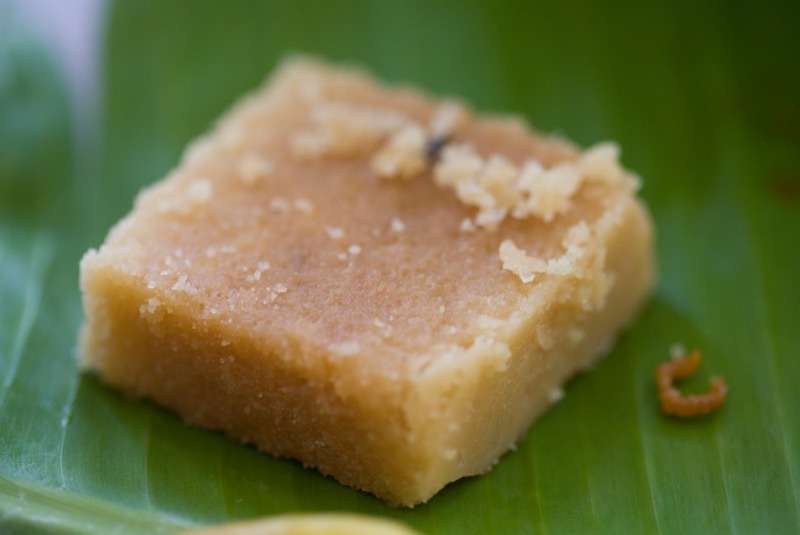
Representational image: Public domain.
Mysore Pak remains what it has always been: a simple sweet with a short ingredient list and a long cultural life.

Kakusura Maddappa’s name rarely appears in history textbooks, yet in the early 20th century, he created one of South India’s most enduring sweets. He worked in the kitchens of the Mysore Palace during the reign of Krishnaraja Wodeyar IV, a period when the royal court was renowned for its ceremonious grandeur and meticulous attention to detail.

Maddappa distinguished himself among the palace cooks. The calm precision with which he handled sugar earned him the title of nalapaaka—a maker of sugar syrup, the man responsible for ensuring that the palace’s desserts met the high expectations of the king.

According to family accounts passed down through generations, the sweet now known as Mysore Pak began as an experiment. One day, when Maddappa was preparing an assortment of dishes for a royal gathering, he combined gram flour, ghee, and sugar in proportions that were not standard practice, creating a mixture that set into a fragrant, porous block. It was neither halwa nor fudge, but something distinct.

When Krishnaraja Wodeyar IV tasted it, he asked for its name. Maddappa didn’t have one. The king responded with a solution typical of monarchs accustomed to naming things into existence: he called it “Mysore Pak,” drawing pak from paaka, the sugar syrup fundamental to the recipe.

The king’s enthusiasm did not end with the naming. He instructed Maddappa to open a shop outside the palace so that the public could enjoy the new sweet. That shop became Guru Sweets Mart, first located on Ashoka Road near the palace and later moved to Sayyaji Rao Road, where it stands today.

The move was practical—closer to where locals lived and shopped—but the family maintained continuity where it mattered. Maddappa’s descendants still prepare Mysore Pak in their ancestral home, producing each batch at once and sending it to the shop by three-wheeler. Customers receive their portion wrapped in newspaper softened by ghee, a detail that has become an unintentional marker of authenticity.

Three brothers run the store in shifts. They have never pursued expansion, confident that the single shop carries their great-grandfather’s legacy more faithfully than any franchise could. On any afternoon, lines form outside their door, even though the street offers many versions of Mysore Pak—firmer, flakier, lighter, or almost molten. Guru Sweets’ draw is partly due to lineage and partly because of the belief that this is where the sweet tastes closest to its original form.

This popularity has brought with it a series of competing claims about the sweets’ origins. One persistent story suggests that Mysore Pak was first made not in the palace but in Ramnagara, a town on the Bengaluru–Mysuru highway, where Janardhana Hotel—locally nicknamed the Mysore Pak Hotel—has its own history with the dish.

The Maddappa family counters these claims with documentation and oral histories they have maintained over decades. In 2019, after a local news cycle amplified a social media joke suggesting that the Geographical Indication (GI) tag for Mysore Pak might be granted to Tamil Nadu, the family formally applied for the GI tag themselves. The misinformation briefly spiralled into talk of a Karnataka–Tamil Nadu dispute, although no such formal dispute existed.

The sweet has also, at times, been swept into broader political conversations. After militant attacks in Uri, Kashmir, in 2016, social media saw calls—some serious, most satirical—to boycott or rename products associated with Pakistan. Caught in the wave, users joked that Mysore Pak should be renamed Mysore India, implying that even its name sounded politically suspect. Other suggestions extended the satire: rename “pakwaan” to “indwaan,” and so on. It was a moment that revealed how quickly symbolic gestures can overtake reason, even in discussions far removed from geopolitics.

Despite these diversions, Mysore Pak remains what it has always been: a simple sweet with a short ingredient list and a long cultural life. Variations have multiplied over the years—a softer ghee-rich version here, a lighter one there—but the original form remains in circulation.

Food evolves, but it rarely discards its roots. Recipes accumulate variations without erasing the original version, and the survival of that first version often depends on a single family or community continuing to prepare it the same way they have always done.

In Mysore, the continuation is visible in the queues that form outside Guru Sweets. Visitors, locals, and the curious stop for a sweet that began as a palace experiment and has since travelled far beyond the city, carried by migrants, tourists, and the nostalgia of those who grew up with it. The story endures because it offers more than a history of ingredients; it speaks to the ways small acts of craft can outlast the structures around them.

Maddappa may not have imagined his creation surviving beyond the palace walls, much less becoming a cultural touchstone. Yet his recipe has been woven into the life of a city and, through its travellers, into the memories of people elsewhere in the world.

For a sweet that melts in seconds, its lifespan has proved unexpectedly long.

-30-

Copyright©Madras Courier, All Rights Reserved. You may share using our article tools. Please don't cut articles from madrascourier.com and redistribute by email, post to the web, mobile phone or social media.
Please send in your feed back and comments to [email protected]
0 replies on “Mysore Pak: The Sweet That Outlived A Kingdom”