The mention of Java in the Ramayana — when Sugriva sends his search parties to the four corners of the world to find Sita — is not merely poetic geography. It is a glimpse into ancient imagination, where India’s horizons stretched far beyond the subcontinent.
Long before “international relations” became an academic discipline, India’s links with distant lands were living and porous. They were woven through religion, trade, and shared devotion.
The story begins in the centuries when India was not only a geographical space but also a spiritual magnet. It was the birthplace of Buddhism and Jainism, two faiths that carried with them ideas of compassion, discipline, and renunciation.
These ideas travelled easily, borne by pilgrims, traders, and kings. Across the seas, they met other worlds, especially in the islands of Southeast Asia, where rulers found in Indian thought both divine legitimacy and aesthetic grandeur.
Among the many names that illuminate this early exchange, one stands out: King Shailendra of the Shailendra dynasty. His empire, formidable and prosperous, spread across Sumatra, the Malaysian Peninsula, and Central Java.
Around the ninth and tenth centuries, the Shailendras were not content to rule; they sought to build, to mark their reigns in stone. Balaputra Deva, a king of this line, commissioned temples and monasteries in both Java and India.
In Tamil Nadu, near modern-day Nagapattinam, he funded a Buddhist temple with the permission of the Chola rulers. In distant Bengal, villagers donated money for the upkeep of a monastery at Nalanda that had been established at his request. The Indian Ocean, then as now, was less a divide than a bridge.
Inscriptions from the period recount gifts and endowments, when religion was the language of diplomacy. The Shailendra kings were devout Buddhists, and under their patronage, Mahayana Buddhism flourished across Java.
An inscription found near the temple of Kalasan is written in a North Indian script—an eloquent symbol of how far ideas could travel. Yet Buddhism did not exist there in isolation. It coexisted with Hinduism, and together they created a culture that was as syncretic as it was spiritual.
Before these new beliefs took root, the islands of the Indonesian archipelago had their own gods. Their world was animated by spirits in the wind and in the trees, where rituals sought harmony with unseen forces. But as traders from India began to sail eastward in the first century A.D., carrying spices, silk, and scripture, new stories entered the islands.
Hinduism offered a theology of kingship. For local rulers, the religion was not only an act of faith but also a political instrument. To claim descent from the gods was to command divine authority. The transformation was gradual but profound: kings began to see themselves as manifestations of Vishnu or Shiva.
By the fourth century, both Hinduism and Mahayana Buddhism had become established in the region. They offered a shared vision of the world, a universe bound by rebirth and release. Whether called moksha in Hinduism or nirvana in Buddhism, the goal was the same: liberation from the endless cycle of existence.
Temples, ceremonies, and art began to reflect this common search. In the Nagarakertagama, a fourteenth-century Javanese poem chronicling the Majapahit Empire, there are descriptions of shraddha ceremonies performed for departed souls. Bells, lamps, and vessels of holy water adorned the temples, echoing rituals that might have taken place in Benares or Nalanda.
Over time, a unique religious culture emerged, one that blurred the lines between god and king, devotion and politics. Inscriptions from Java and Bali refer to monarchs who were deified after their deaths. Their statues stood in sanctuaries, merging royal image with divine iconography. The fusion was not imitation but adaptation; Hindu and Buddhist motifs absorbed, reshaped, and rendered into a local idiom.
In art and sculpture, the overlap was striking. Buddhist stupas bore carvings of Hindu deities. Temples dedicated to Vishnu incorporated the serene faces of Bodhisattvas. Scholars have long noted this mutual borrowing, the ease with which one faith seemed to embrace the imagery of another.
In Southeast Asia, the great religious traditions of India did not compete so much as converse with one another. They shared an understanding of the ultimate aim of life: communion with an absolute, ineffable reality.
The four main congregations—Saivas, Sogatas (Buddhists), Rishis, and Vaishnavites—may have followed distinct rituals; however, their philosophies converged at a single point: the relationship between humans and the divine. The gods of India had found new homes across the sea, but they spoke in familiar tongues.
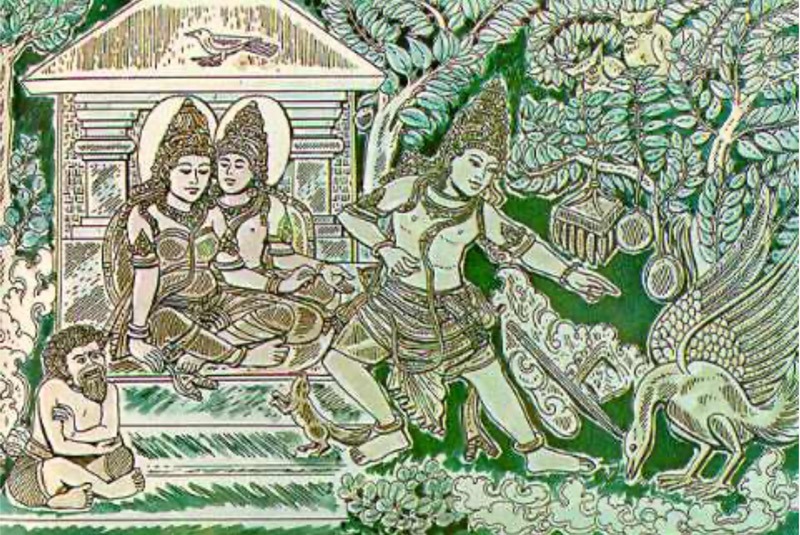
When Hindu scholars and priests arrived in Java, they brought their sacred texts, including the Mahabharata, the Ramayana, and the Puranas. These epics, rich in drama and moral complexity, struck deep roots in Javanese soil. They were translated and retold in local idioms.
Under King Jayabaya of Kediri in the twelfth century, the court poet Penuelooh rendered portions of the Mahabharata into Old Javanese verse. In doing so, he transformed the region’s literature. The stories of Rama and Krishna became part of Javanese identity, fusing with native folklore and animist tradition.
From these reinterpretations emerged one of the most enduring cultural forms of the region: the wayang puppet theatre. The word wayang means “shadow,” and in these delicate performances of leather and light, the great epics of India came alive.
The puppeteer, known as the dalang, manipulated figures of Rama, Lakshmana, Sita, and Ravana. His voice weaves narration, dialogue, and song into a seamless whole. The performances were not mere entertainment; they were acts of ritual, education, and communal gathering.
Each puppet was an art object; its size, colour, and ornamentation were governed by convention and symbolism. Heroes gleamed in gold and white; villains were painted in dark hues. The moral order of the Ramayana was preserved, yet the characters spoke with Javanese accents, their gestures mirrored local sensibilities. The performance space became a metaphor for the cosmos, with the dalang as its creator and storyteller, guiding the audience through the eternal dance of good and evil.
When Islam arrived in Java around the thirteenth century, the old religions began to recede. The new faith spread through trade, and its message blended with local customs. Many Hindu temples fell silent, and their deities were forgotten under moss and rain.
However, in the dim glow of oil lamps, the wayang managed to survive. It adapted. The stories of Rama and Krishna were retold in Islamic idioms, sometimes with moral lessons drawn from the Qur’an. The form endured because it had always been fluid, more a vessel than a doctrine.
As Dutch colonial rule deepened and Javanese courts struggled to retain cultural coherence, a quiet renaissance began. Scholars and poets turned back to the old traditions, rediscovering Sanskrit texts and forgotten epics. Translations proliferated. The Ramayana and Mahabharata were once again performed in palaces and villages; the flickering shadows of wayang puppets reminded people of a shared, layered past.
Even today, in modern Indonesia, these performances continue. The wayang kulit, a shadow play performed with leather puppets, remains a cherished art form. It is performed at weddings, births, and festivals, its appeal spanning classes and generations.
The audience may include tourists drawn by curiosity; however, for locals, the plays retain a spiritual resonance. They are, in a sense, living scripture; stories that have travelled across oceans and centuries, never losing their breath.
That a land now overwhelmingly Muslim should still find space for Hindu epics is a testament to cultural endurance. The wayang does not demand belief; it invites recognition. It tells stories of duty, loyalty, and love—virtues that transcend creed.
The dalang, often regarded as part priest, part philosopher, sits behind the screen, bringing to life the ancient quarrel between dharma and desire. His voice rises and falls, carrying echoes of Sanskrit chants long forgotten in the land where they were born.
The persistence of these traditions is not accidental. They are reminders of a time when India’s influence was not imperial but imaginative; when it spread not by conquest but by story. The temples of Java, the inscriptions at Kalasan, the wayang puppets—all testify to an exchange that was as intellectual as it was spiritual.
Ultimately, the ancient connection between India and Java was less about religion than about mutual recognition. Each saw in the other a reflection of itself. Kings and monks, poets and sailors, all participated in a dialogue that crossed waters and centuries.
When Sugriva’s messengers in the Ramayana were sent to the four corners of the world, one group was said to have ventured toward Yavadvipa—Java. It is a small line in a vast epic, but one heavy with implication.
Even in myth, India imagined a world connected by curiosity and kinship. And across that oceanic distance, Java answered—not in words, but in temples, in tales, and in shadows that still dance across the screen.
-30-
Copyright©Madras Courier, All Rights Reserved. You may share using our article tools. Please don't cut articles from madrascourier.com and redistribute by email, post to the web, mobile phone or social media.Please send in your feed back and comments to [email protected]