Long before the English arrived in India, before the East India Company laid down the iron tracks of empire, before even the Mughal courts echoed with Persian poetry and peacock-feathered diplomacy, there was another India. A quieter India. One whose memory lies buried not in the northern plains of the Indus, but in the southern arms of the Tamiraparani River. It was a memory the river itself seemed to guard—not out of spite, but out of time’s forgetfulness.
The story begins, as so many old Indian stories do, with a dream. The sage Agasthiyar, a paragon of spiritual asceticism, saw in his sleep the shimmering form of Lord Siva. A divine command was whispered: go South. Parvathi, ever the gentle consort, filled Agasthiyar’s kamandala with water from the Ganges. And when the sage descended from the Himalayas to the lush green folds of Pothigai hills, he poured it into the earth. From that sacred release flowed the Tamiraparani. It was a myth, yes, but a myth in India does not distance itself from history. It threads through it, like gold wire through silk.
In the Silappadikaram, that 2,000-year-old Tamil epic, the Tamil country—Tamilakam—is described with a geographical intimacy that would impress even a modern cartographer. “The Tamil country stretches from the hills of Vishnu to the oceans at the cape in the south,” it declares, naming the four ancient cities that lay like cardinal points across the land: “Madurai with its towers, Uraiyur, which was famous, tumultuous Kanchi, Puhar with roaring waters.” These were not mere poetic inventions. They were bustling metropolises. The poet knew it. And now, archaeology is starting to agree.
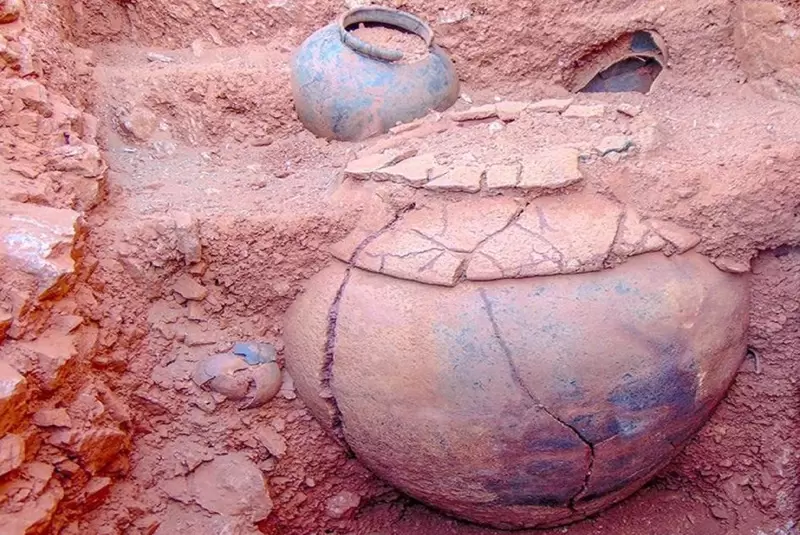
In the late monsoon of 2021, on a bank of the Tamiraparani not far from the small town of Sivaganga, a team of archaeologists brushing away centuries of silence stumbled upon a set of urns. Inside, carefully preserved by time’s patient hand, were grains of rice. Not fossilised, not petrified, but recognisably rice. They were sent, perhaps ironically, to Miami, to a lab used to analysing ancient Mayan corn. The verdict? 1155 BCE. That’s over three thousand years ago. Older than Homer. Older than the Rig Veda in its written form. And crucially, contemporaneous with the Indus Valley Civilisation, that great beacon of India’s ancient urbanity which has until now stood unchallenged.
The Tamiraparani discovery didn’t appear in Time magazine. There was no international splash. But among a quiet circle of scholars, it shifted something. Because it told a different story — not of northern pride, but of southern persistence. This was not a civilisation lurking in the shadow of the North; this was one that had risen on its own terms, on the banks of a river that had watched in silence as the centuries slipped by.
Three kilometres from this site lies Korkai, the ancient port town that the Tamil Sangam literature remembers with fondness. Once the capital of the Pandya dynasty, Korkai’s fame had reached so far that the Greek mariner’s manual, Periplus of the Erythraean Sea, written in the first century, mentions it—calling it Colchis.
Ptolemy, that erudite geographer of the second century, refers to it as “Kolkhoi,” situating it in the global maritime map long before Vasco da Gama ever dreamed of the Indian Ocean. Korkai was famed for its pearls. Divers plunged into the sea not for fish, but for those white drops of moonlight. Trade, culture, language—they flowed from Korkai like spice-scented breezes.
Then came Keezhadi.
In 2017, the Archaeological Survey of India began excavations at Keezhadi, near the Vaigai river. What they found—urban brick structures, black-and-red pottery, graffiti that hinted at proto-Tamil scripts—disrupted the North-centric textbook narratives that generations of Indian schoolchildren had memorised.
Carbon dating of charcoal unearthed at the site pushed its antiquity back to 200 BCE. But more compelling than the dates was the story the earth was telling. Here, in the far South, was an urban civilisation with architecture, writing, industrial activity, and trade. It was not a sleepy village in a cultural backwater. It was, as one archaeologist noted, “as big as Mohenjodaro.”
Historians are cautious. They must be. But in hushed tones, they began to speak of something bold—the Porunai civilisation. Named after the ancient Tamil name for the Tamiraparani, this was no longer a fringe theory. Adichanallur, Korkai, Keezhadi—each excavation acted like a constellation dot, and together they formed a sky map pointing to a forgotten world. And in that world, the past was plural.
The dominant civilisational narrative in India, shaped largely after independence, has leaned heavily on the Indus Valley as the cradle of Indian urban life. It makes for a neat story: one river (Indus), one script (undeciphered), one identity (proto-Hindu). The trouble with neat stories is that they rarely survive complexity. And complexity, as it turns out, is precisely what India’s ancient past has in abundance.
The rise of Hindutva politics in recent decades has only further sharpened the stakes of historical memory. Some of its most zealous adherents insist on a monolithic past—where upper-caste Brahmanism, Sanskrit, vegetarianism, and temple-worship form the bedrock of ancient Indian society.
In this version of history, the North is not just older—it is purer. Civilisation is measured by proximity to the Ganges, and all deviations are either dismissed or assimilated. WhatsApp forwards, university syllabi, and even television serials have all contributed to this mythology of cultural centrality.
But the rice grains in the urn say otherwise.
They say there lived a people here in the deep South, speaking a Dravidian tongue, building cities, worshipping gods whose names do not appear in the Vedas, trading across seas, burying their dead in urns marked with symbols no Sanskritist can decipher. They were not outposts of a greater northern empire. They were not refugees of a collapsing Harappa. They were themselves—rooted, vibrant, complex.
The historian Romila Thapar has long argued that Indian history cannot be told through a singular lens. In her words, “the past was not a uniform experience.” And yet, for most of modern India, the past has been flattened. The discoveries along the Tamiraparani represent more than an academic correction. They are a challenge to cultural memory—a demand that India see itself not as a linear story, but as a mosaic.
Of course, no archaeological dig can overturn ideology overnight. Narratives, especially nationalist ones, are stubborn. They linger in textbooks and linger longer in belief. But something has shifted. For the first time, a child in Tamil Nadu might learn not just of Harappa and Mohenjodaro, but of Porunai and Korkai. Not just of Saraswati and Yamuna, but of Tamiraparani.
The civilisational compass is slowly reorienting.
In the broader arc of Indian identity, this matters. Because it contests the lazy logic that ancient equals North, and modern equals West. It undermines the cultural hegemony that has allowed the cow belt to claim ownership of what it means to be Indian. And perhaps, most importantly, it reminds us that a river in the South—flowing gently from the hills of Pothigai to the Bay of Bengal—has its own stories to tell.
One might ask why it took so long. The answer is as bureaucratic as it is ideological. Funding for southern excavations has historically lagged behind. The ASI’s resources were funnelled disproportionately to sites that supported dominant narratives. And politics, ever eager to mine history for present power, encouraged the myths that served its ends.
But the soil doesn’t lie. The hills don’t hide.
A civilisation that brewed rice, traded pearls, and etched symbols into pottery three thousand two hundred years ago cannot be silenced by a syllabus alone. The stones speak. The urns open. The river remembers.
And slowly, so do we.
-30-
Copyright©Madras Courier, All Rights Reserved. You may share using our article tools. Please don't cut articles from madrascourier.com and redistribute by email, post to the web, mobile phone or social media.Please send in your feed back and comments to [email protected]