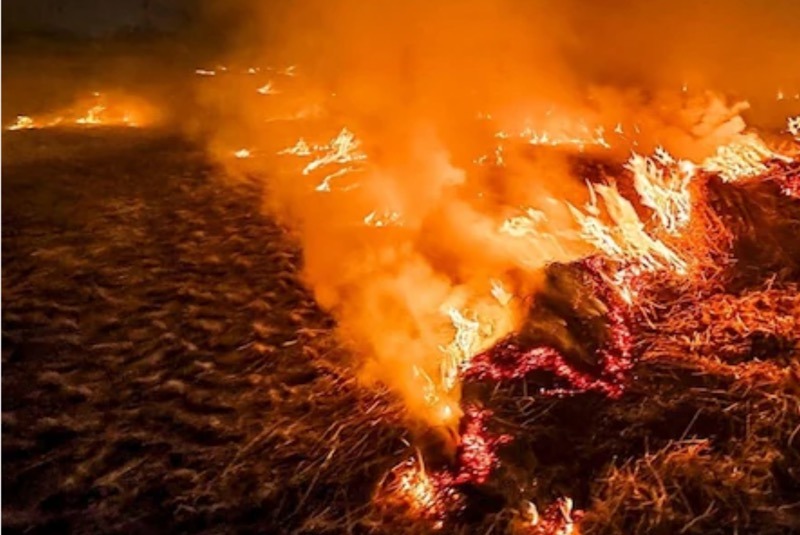
As the post-harvest winds sweep across the northern plains, the landscape begins to transform. For years, the burning of crop residue has been a familiar sight, leaving cities choking on smoke. Yet, behind this haze lies a quieter truth: farmers burn their crops not by choice but by necessity. The narrow window between paddy harvest and wheat sowing often leaves farmers with few options, and burning remains the quickest method to clear fields.
However, a shift is taking place. Increasingly, stubble is recognised not as waste but as a valuable resource. Once discarded, it is now being reimagined as a potential raw material for energy, industry, fodder, soil improvement, and rural enterprises. With technological innovation, new market models, and the rise in green-energy demand, what was once an environmental hazard is now seen as an opportunity for farmers to turn a profit. If embraced on a larger scale, these alternatives could not only help farmers earn more but also significantly reduce winter pollution.
One of the most promising alternatives for stubble use is the growing trend of biomass power plants that are now purchasing paddy straw as a renewable fuel. Instead of going up in smoke, this agricultural residue is being used in boilers to generate electricity. According to the Ministry of New & Renewable Energy, India has a biomass power potential of 28,000 megawatts, of which approximately 10,000 megawatts come from agricultural residues such as paddy straw, wheat straw, and sugarcane trash. Biomass plants prefer paddy straw due to its high calorific value, wide availability, and relatively lower emissions than coal, making it an attractive alternative for power generation.
Another innovation is the Pusa Decomposer, developed by Indian scientists to address stubble burning. This fungi-based solution accelerates the decomposition of stubble, turning it into nutrient-rich compost within 20-25 days. By providing a cost-effective and scientifically sound method for managing crop residue, the Pusa Decomposer offers farmers a viable alternative to burning. Beyond its environmental benefits, it also improves soil health, reduces input costs, and provides farmers with a financial benefit.
While crop residue is often underutilised, it also represents an untapped resource in India’s cattle feed market. The country generates 500-600 million tonnes of crop residue annually, much of which is burned. Simultaneously, India faces significant deficits in both green and dry fodder, putting pressure on dairy farmers who rely heavily on roughage to maintain milk production.
Contrary to past beliefs, treated paddy straw can now serve as a viable source of roughage for livestock. By treating the straw with urea, chopping and baling it, and adding molasses or mineral fortification, it becomes digestible and more nutritious. Veterinary experts suggest that this treated straw, when mixed with green fodder and concentrated feed, can support healthy weight gain and milk production in dairy animals.
Among the most innovative uses of stubble is the conversion of straw into biochar, a carbon-rich material produced through controlled pyrolysis. Unlike open burning, which releases carbon into the atmosphere, biochar traps most of the carbon and minerals in the straw, providing long-term storage of carbon in a stable form. Biochar has several benefits, including improving soil health by enhancing soil structure, increasing nutrient efficiency, and increasing water-holding capacity, particularly in sandy soils. When enriched with compost, fertilisers, or microorganisms, biochar also acts as a slow-release nutrient carrier, supporting sustainable farming practices.
From waste fibre to marketable products, the potential applications of stubble are diverse. Start-ups in India are already converting paddy straw into biodegradable packaging materials such as plates, containers, and sheets, offering an eco-friendly alternative to plastic. Researchers at IIT are developing straw-based composites, fibre boards, and insulation panels for eco-construction that are lighter and more sustainable than traditional cement- or gypsum-based materials.
Additionally, paddy straw is being used as a substrate for growing oyster and button mushrooms. After the mushrooms are harvested, the spent straw, enriched with fungal biomass, becomes a valuable soil amendment. Straw is also being fermented with jaggery, beneficial microbes, or cow dung slurry to produce liquid manure, bio-enzymes, fermented plant tonics, and organic pesticides.
For decades, stubble burning has been a painful reality for farmers with few options. However, advances in technology, new market opportunities, and growing environmental concerns have come together to enable farmers to profit from what was once seen as waste.
While the shift is not without challenges — including the need for a trustworthy stubble procurement network, financial assistance for rural machinery, private sector collaboration, and greater farmer awareness — the direction is clear. What once symbolised seasonal pollution can now become a pillar of rural economic opportunity, providing farmers with new sources of income while advancing environmental sustainability.
-30-
Copyright©Madras Courier, All Rights Reserved. You may share using our article tools. Please don't cut articles from madrascourier.com and redistribute by email, post to the web, mobile phone or social media.Please send in your feed back and comments to [email protected]