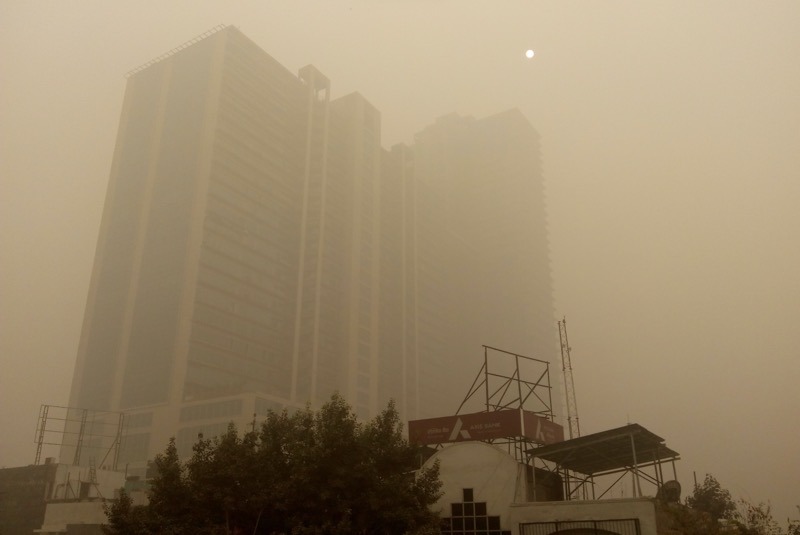
Every winter, Delhi’s sky turns dark grey. Buildings disappear behind a curtain of smog. The capital’s familiar landmarks become indistinct silhouettes, and the morning sun struggles to penetrate an atmosphere as thick as dirty wool.
Eyes sting, throats burn, and Lungs feel heavy. People cough incessantly. Children are kept indoors. Joggers abandon their morning runs. Pharmacies sell out of inhalers, while air purifiers become the most coveted household appliance.
A routine administrative ritual follows. The government announces restrictions, officials convene meetings, news networks beep, and the city waits for the wind to change. Eventually, the sky clears, the emergency recedes, and Delhi resumes its business until the next winter.
Delhi, India’s capital city, with more than 30 million people, has accepted that inhaling poisonous air is an annual inconvenience. Its residents routinely check the Air Quality Index (AQI); a reading of 200 is no longer alarming; 300 invites caution; and 400 resembles a public-health emergency.
Delhi’s predicament is hardly new. In the 1990s, India’s Supreme Court was confronting the capital’s dangerous concentrations of suspended particulate matter. A public-interest litigation brought by environmental lawyer M.C. Mehta highlighted polluting industries and vehicular emissions.
In 1996, the court ordered the relocation of more than 1,300 polluting industries from residential areas. Subsequent judicial interventions helped force the conversion of the city’s public transport fleet to compressed natural gas (CNG), a reform implemented around the turn of the century. Briefly, Delhi demonstrated that determined intervention could make a difference. Its air improved, and the CNG transition became an example of environmental regulation working against powerful vested interests.
However, as the city continued to expand, its population grew, private vehicle ownership accelerated, and construction transformed its outskirts into a concrete jungle. Industrial activity migrated beyond municipal boundaries; roads became congested, public transport failed to keep pace with urban expansion, and construction dust settled over neighbourhoods already burdened by exhaust fumes.
The problem was no longer confined to Delhi’s administrative borders. It had become a regional crisis involving Haryana, Uttar Pradesh, Punjab and Rajasthan, requiring governments with different political interests to work together.
Winter makes this worse. Lower temperatures, weak winds and temperature inversions prevent pollutants from dispersing, trapping them close to the ground. Farm fires in Punjab and Haryana add to particulate matter concentrations in October and November. But blaming farmers has become a convenient way of simplifying a much larger problem.
The Centre for Science and Environment’s analysis of Delhi’s pollution in the weeks preceding Diwali in 2024 found that transport accounted for more than half of the pollution attributable to local sources. Residential burning, industry and construction were also significant contributors. Farm fires were responsible for an average of only about 4.4 per cent of Delhi’s PM2.5 during the period examined. Put simply, the capital cannot blame its neighbours for everything it generates itself.
The political response has repeatedly favoured the spectacular. Water is sprayed on roads, construction is temporarily halted, vehicle restrictions are announced, and ‘emergency measures’ are activated under the ‘Graded Response Action Plan.’
These interventions provide temporary relief, but they cannot substitute for cleaner industrial fuel, effective public transport, reliable waste management, enforceable vehicle-emission standards and coordinated regional planning. Nevertheless, it is an admission that prevention has failed.
The human consequences are insidious. Fine particulate matter, particularly PM2.5, penetrates deep into the lungs and enters the bloodstream. Prolonged exposure causes asthma, chronic pulmonary disease, lung cancer, cardiovascular disease and strokes. Children, older people, pregnant women and those with existing respiratory conditions are especially vulnerable.
In December 2025, The Indian Express documented the experience of Sharmishtha, a young woman whose bronchitis repeatedly worsens during Delhi’s polluted months. Her parents, both security guards, have to rearrange their household finances to pay for medicines, consultations and respiratory treatment. Her mother’s account of cutting other expenses to meet medical bills illustrates an economic burden that rarely appears in government pollution statistics. For affluent households, the answer might be an air purifier, a second home or a temporary escape to another city. For families living on modest incomes, there is no such luxury.
The scale of the public-health burden is alarming. Government figures reported in December 2025 showed that six major Delhi hospitals recorded 204,758 emergency visits for acute respiratory illnesses between 2022 and 2024. Nearly 30,420 patients required hospitalisation.
The economic damage—even before the cost of human suffering is considered—is substantial. A study published in The Lancet Planetary Health, which examined the health and economic consequences of air pollution across Indian states in 2019, estimated that premature deaths and illness attributable to pollution cost India $36.8bn in lost output, equivalent to 1.36 per cent of GDP. Delhi recorded the country’s highest per-capita economic loss in that year.
These estimates measure the economic consequences of a man-made environmental catastrophe. The wider costs include medical expenditure, absenteeism, reduced worker productivity, missed schooling, lower outdoor activity and the expense of private protection. Pollution is, in effect, an additional tax levied for living in the capital, collected disproportionately from those who can least afford to pay it.
Yet, the political vocabulary remains reassuring. Governments emphasise the number of days on which air quality was classified as satisfactory, point to falling farm-fire counts or attribute sudden deterioration to unfavourable meteorological conditions. Some of these observations are technically correct. Weather does influence pollution concentrations, and improvements during particular periods deserve recognition. But an annual average or a count of cleaner days obscures exposure intensity during the worst months.
The Associated Press reported in 2025 that environmental campaigners and experts questioned official presentations of Delhi’s air-quality performance, citing inadequate monitoring coverage, weaknesses in pollution data, and political statements that appeared to minimise the problem. The government’s emphasis on 200 days of good air, for instance, drew criticism for overlooking the months when the city’s pollution becomes most dangerous.
There is fundamentally an institutional problem. Responsibility is divided among municipal authorities, state governments, the Centre, neighbouring states, transport agencies and pollution-control boards. Each identifies another institution’s failure, while the atmosphere recognises no jurisdictional boundaries. The Comptroller and Auditor General’s findings, reported by The Indian Express in February 2025, raised questions about faulty monitoring stations and fraudulent pollution-control certificates. Such findings suggest that the problem is not a shortage of policies, but the gap between announced policies and implemented policies.
Political leaders routinely downplay the crisis because acknowledging its full scale requires accepting responsibility for decisions that span electoral cycles. Cleaning the air means confronting motorists, builders, industries, farmers, waste contractors and the political economy of cheap, polluting energy. It requires investments whose benefits are dispersed across years, while their immediate costs are concentrated among identifiable constituencies. Spraying water offers a photograph. Reorganising urban transport requires patience, money and the willingness to inconvenience powerful interests. Emergency restrictions are politically easier than structural reform.
The city is developing an informal hierarchy of breathable spaces, determined by income: those who can afford sealed apartments, filtration systems and temporary relocation are better protected than street vendors, construction workers, traffic police officers and domestic workers who spend their days outdoors.
It’s a shame that India’s capital city, which boasts of being an engine of economic growth, can not guarantee clean air that does not make its inhabitants ill. The government has known the causes of pollution for decades. It has issued court orders, formed committees, created action plans, set emission standards, and imposed emergency restrictions. What it has not produced is sustained political accountability for the results.
The haze will eventually lift—at least temporarily. But the particles already inhaled will not disappear with the smog. They will remain in damaged lungs, in medical bills, in lost working days and in the childhoods of children who have learned that playing outside can be dangerous.
A city that treats the right to breathe as a seasonal privilege cannot call itself a global capital. Delhi’s air pollution is not an act of nature. It is a man-made crisis, and its persistence is an indication of political failure.
Copyright©Madras Courier, All Rights Reserved. You may share using our article tools. Please don't cut articles from madrascourier.com and redistribute by email, post to the web, mobile phone or social media.Please send in your feed back and comments to editor@madrascourier.com