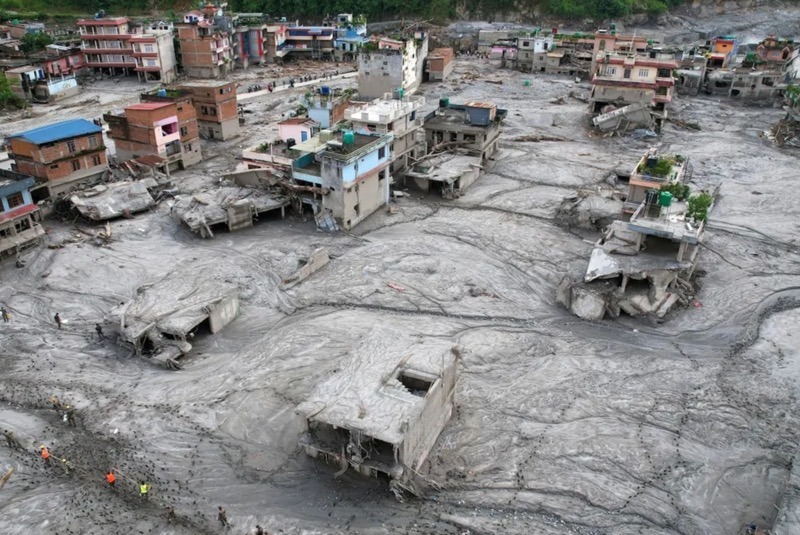
On August 26, a large section of glacier and rock collapsed in Nepal’s Langtang region, sending an avalanche of ice and rock down a steep valley and into the Lhende Khola, a tributary of the Bhote Koshi. The debris of water and sediment travelled downstream, causing catastrophic flooding over 100 kilometres. As of September 1, more than 1,000 people had been reported dead in Nepal, and thousands remain missing.
The footage is a glimpse of a danger that is becoming harder to dismiss. The Himalayas are warming, glaciers are retreating, and frozen ground at high altitude is becoming less reliable. The precise chain of events is still being reconstructed. However, a warming climate is changing the conditions in which such disasters occur.
The first reports described the disaster in different ways. Some suggested that an earthquake had triggered an avalanche; others spoke of a glacial lake outburst flood, or GLOF. Early seismic readings added to the confusion. The collapse generated seismic energy strong enough to be detected as an earthquake-like signal; initial reports put it at magnitude 4.4, and later analyses indicated a magnitude 5.2 equivalent signal. However, the evidence now points towards a different explanation: the seismic signal was generated by the sudden movement of enormous quantities of rock and ice, rather than by a conventional tectonic earthquake.
Satellite imagery has been useful in reconstructing how the catastrophe unfolded. The emerging picture shows that the lower part of a glacier near Langtang Lirung collapsed, carrying ice and rock. The material plunged more than 1,000 metres, fragmented violently and transformed as it moved down the valley. Rather than remaining a dry rockfall, the avalanche became fluid—the ice melted into water. The moving mass eroded the valley floor and sides and picked up more rock, soil, vegetation and water. By the time it reached lower elevations, it had become a moving wall of debris. Reuters estimates that parts of the flow travelled at roughly 50 metres a second.
A rock avalanche that becomes a long-running debris flow can travel farther and cause far greater destruction. The material scours the landscape, adding water and sediment as it moves. The river becomes a pathway and a source of additional destructive power. In the Nepal disaster, the flow reached the Gyirong border area in Tibet and then continued downstream, destroying settlements and infrastructure along the way.
The event, therefore, fits poorly into a single familiar category. It was not, from the evidence available so far, a conventional GLOF, as there was no large glacial lake waiting to burst. Nor was it simply a landslide or an ice avalanche. It was a cascade of hazards: a failure of rock and ice that generated an avalanche, which became a debris flow and then a destructive flood. A lake outburst flood can often be modelled, as scientists can identify the lake, estimate its volume and calculate possible flood paths. A mountain slope containing an uncertain mixture of ice, rock and frozen ground is harder to predict.
That is one reason the disaster is so difficult to prevent. The Himalayas contain thousands of steep slopes and glaciers, many of them in remote terrain. It is impossible to monitor every potentially unstable slope. There may be no obvious warning before a collapse. An earthquake, heavy rainfall, a rockfall or a change in the structure of a glacier may start a chain reaction. However, scientists cannot say which unstable slopes will actually fail.
Climate change complicates the problem. Glaciers around the world are losing mass, and the Himalayas are no exception. The region is sometimes described as the world’s “third pole” because of its enormous stores of snow and ice outside the polar regions. They feed rivers on which hundreds of millions of people depend. They are also part of the machinery that holds mountain landscapes together.
One important component is permafrost: ground that remains frozen for at least two consecutive years, often for centuries or longer. At high elevations, it can contain a mixture of rock, soil and ice. When that ice thaws, it can weaken the bonds holding a steep slope together, making the mountain susceptible to rockfalls and slope failures. Scientists have observed similar concerns in other high mountain regions.
Recent disasters elsewhere illustrate the point without proving a direct connection to Nepal. In 2025, a glacier collapse above the Swiss village of Blatten sent enormous quantities of ice, rock and debris into the valley; residents had been evacuated beforehand, and nobody was killed. Monitoring and early action gave people time to leave. In Nepal, by contrast, the speed and complexity of the August disaster left much less room for intervention.
Nepal has nevertheless been investing in warning systems. In 2025, the Green Climate Fund approved $36.1m for a seven-year programme designed to strengthen monitoring and early-warning systems for glacial and climate-related floods, to protect more than two million people. The programme includes monitoring, work on high-risk glacial lakes and improvements to local preparedness.
Such systems cannot stop a glacier from collapsing. However, they can shorten the distance between detection and action. River gauges detect an abrupt rise in water levels; seismic instruments detect unusual signals; satellites can provide a broad view of remote valleys before and after an event. Together, these tools can help authorities distinguish a conventional earthquake from a landslide, identify secondary blockages and warn communities.
The challenge, however, is that a warning is useful only if people know what to do with it. For a GLOF, the basic instruction may be relatively simple: move to higher ground. A debris flow generated by a landslide is more complicated. In some places the safest option may be a nearby strong building; in others, moving uphill or away from the valley floor may be essential. The available time may range from hours to minutes. There is no universal equivalent of “drop, cover and hold on.”
Therefore, Nepal and other Himalayan countries will need to devote as much effort to people as to instruments. Warning systems have to reach villages, roads, border crossings and tourist routes. Communities need to know what an alert means before it arrives. Governments also need to identify places where the risk is high to justify further settlement or infrastructure. That is politically difficult in valleys where land is scarce, and hydropower and tourism are important sources of income.
There is a wider problem, too. The same glaciers that can trigger sudden disasters are also water stores. Warming can initially increase meltwater and, in some places, increase flood risks. But continued glacier loss reduces the amount of ice available to feed rivers, particularly during dry periods. A region can therefore face both too much and too little water, depending on the time of year.
There will be other collapses in the future. However, scientists cannot always predict exactly where or when. But such uncertainty makes it essential to do more of what is possible. Better satellites, denser monitoring, faster interpretation of seismic signals, reliable river gauges, stronger communications and well-practised evacuation plans can buy precious minutes.
Cutting greenhouse-gas emissions remains the only way to address the underlying warming rather than merely its consequences. The Himalayas cannot be made risk-free. However, the communities should not be left to discover, valley by valley, what a warming mountain can do.
-30-
Copyright©Madras Courier, All Rights Reserved. You may share using our article tools. Please don't cut articles from madrascourier.com and redistribute by email, post to the web, mobile phone or social media.Please send in your feed back and comments to [email protected]