
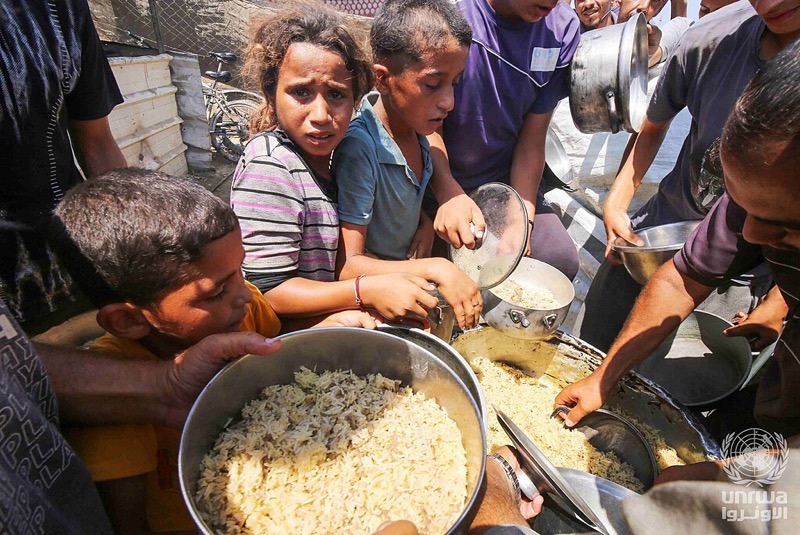
On January 20, 2026, the world’s political and financial elite gathered in Davos for the World Economic Forum’s fifty-sixth annual meeting. Heads of state, central bankers and celebrities attended an invitation-only dinner hosted by BlackRock CEO and interim WEF co-chair Larry Fink, raising glasses over a multi-course feast as millions edged closer to famine far beyond the banquet hall. Barely three months later, the Integrated Food Security Phase Classification (IPC), the global benchmark for famine, confirmed that the thresholds for IPC Phase 5 — its most severe designation — had been reached in Sudan and Gaza. It was the first time since IPC reporting began that famine was declared in two countries simultaneously. While dignitaries debated “improving the state of the world” in a Swiss ski resort, a quarter of a billion people faced starvation. In Gaza, nearly one in three people confront catastrophic food insecurity; in Sudan, well over nineteen million share that fate.
The tenth Global Report on Food Crises, released April 24, 2026, found that 266 million people across 47 countries — 22.9 per cent of those analysed — experienced acute food insecurity in 2025, nearly double the 2016 share. The 2024 tally was higher, at 296 million across 53 countries, but five countries, including Burkina Faso and Ethiopia, were omitted because data were unavailable; together, they accounted for more than 27 millionpeople previously facing high food insecurity. The apparent plateau therefore reflects declining data availability, not improvement. As fragile states collapse, hunger statistics become incomplete and monitoring weakens. FAO Director-General Qu Dongyu called hunger “persistent and recurring”, warning it has become a structural problem rather than a temporary emergency.
Famine is rarely the product of weather alone. It is the consequence of policy choices, the byproduct of war, and a warning of what a hotter, more fractured world holds. Its shadow falls across future generations, who will inherit this century’s broken promises and lopsided policies.
Food insecurity has no single cause, but conflict sits atop its hierarchy. Of the 266 million people facing hunger, over 75 per cent live in countries experiencing protracted crises driven by conflict, compounded by extreme weather and economic shocks. Ten countries — Afghanistan, Bangladesh, the DRC, Myanmar, Nigeria, Pakistan, South Sudan, Sudan, Syria, and Yemen — account for two-thirds of those afflicted with extreme hunger. This is state failure mapped onto empty stomachs. More than 85 million people were displaced last year, carrying hunger into places struggling to feed themselves. War destroys farms, harvests, granaries and irrigation canals, and uproots the people whose labour turns land into food.
The year 2026 provided a case study in economic siege. On February 28, the United States and Israel launched coordinated strikes against Iran, which retaliated against Gulf shipping and closed the Strait of Hormuz. Tanker traffic through the strait, carrying roughly a third of the world’s seaborne fertiliser trade, fell to near zero within days. The World Bank’s fertiliser price index rose more than 12 per cent quarter-on-quarter, its highest since October 2022; urea doubled from $400 a metric ton to over $850 in April before easing by June as trade rerouted overland. The effects do not appear on dinner plates immediately but surface over successive harvests in thinner yields from under-fertilised land. A looming El Niño, forecast with a 61 to 87 per cent probability of persisting through 2027, could cut rice output by 20 to 50 per cent across South Asia, Southern Africa and East Asia — threatening the caloric backbone of roughly half of humanity.
None of this occurred in a market vacuum. Four firms — Cargill, ADM, Bunge and Louis Dreyfus — control 50-60 per cent of the grain traded, giving them leverage when supply chains are strained. Fertiliser producers showed a comparable pattern during the 2021–22 crisis triggered by Russia’s invasion of Ukraine, with margins risingfrom roughly a fifth of sales to over a third as producers capitalised on scarcity. A 2026 IPES-Food assessment similarly argued that agrifood corporations raised prices beyond production costs. The agrifood system is increasingly oligopolistic: four companies control more than 40 per cent of global seed, pesticide and farm-machinery markets. War and weather create scarcity, but markets can deepen it. Firms positioned to profit from disruption monetise it, with every incentive to let a shortage run rather than shorten it.
Since the 2007-08 global food crisis, successive food-price shocks have revived concerns about commodity index funds and hedge funds piling into wheat, corn and soybean futures as inflation hedges or bets on scarcity, irrespective of harvests or stockpiles. Research on the 2007–08 and 2021–22 spikes found price swings that exceeded what physical supply and demand alone could explain, while large trading firms profited by storing and trading grain amid heightened volatility rather than smoothing it. Concentrated supply chains monetise scarcity; financial markets exacerbate it. High food prices do not always signal shortage. In this age of financialised economies, they signal a wager.
Government mandates amplify private incentives. Roughly 40 per cent of the U.S. corn crop and more than 40 per cent of soybean oil are used to produce ethanol and biodiesel rather than food or feed, with demand guaranteed by law rather than left entirely to market forces. The 2026 Hormuz shock exposed the contradiction: the oil-price spike that raised fertiliser and shipping costs also pushed governments toward higher biofuel-blending targets,adding demand to grain and vegetable-oil markets already strained by the closure. A policy designed to reduce dependence on imported oil ended up intensifying food insecurity.
In the Sahel, the Horn of Africa and South Asia, climate change multiplies existing vulnerability rather than creating food insecurity from nothing. Ironically, these vulnerable regions contribute least to the greenhouse gas emissions driving these disruptions but absorb the sharpest agricultural shocks. The familiar claim that a third of all food is wasted combines two UN measurements: FAO estimates post-harvest losses at approximately 14 per cent of production, worth nearly $400 billion annually, while UNEP found another 19 per cent — 1.05 billion tonnes in 2022, 60 per cent from households — wasted at the retail and consumer levels. Neither measure includes crops left unharvested; estimates that do put the total closer to 40 per cent. The average person wastes roughly 79 kilograms of food a year, equivalent to a billion meals discarded daily while a third of humanity goes to bed hungry. Food insecurity is as much about distribution and political priorities as it is about production. It is an egregious failure to treat food as an existential necessity for a quarter of the world’s population.
The institutional architecture built to fight hunger — FAO, WFP, IFAD and the Global Network Against Food Crises — remains a functional artefact of the postwar order. Yet humanitarian funding for food crises has collapsed by 59 per cent. FAO estimates that time-sensitive emergency agricultural interventions cost five to ten times less than providing year-long food assistance to rural families, underscoring the value of supporting local food production alongside emergency relief. As Amartya Sen demonstrated, people starve not because food is absent, but because access to it is denied. Hunger follows power, not the monsoon. The world already possesses the means to end mass hunger. But what is missing is the will to fund and protect them, particularly in war zones where combatants weaponise food. In Gaza, UN agencies have identified repeated Israeli restrictions on humanitarian access, including food, fuel and aid, as major drivers of catastrophic food insecurity.
The fault line between environmental shocks and political collapse is as old as civilisation itself. The Late Bronze Age collapse around 1200 BCE, which brought down the Hittite Empire and marked the beginning of the Greek Dark Age, remains the archetype. Historians continue to debate the causes: Eric Cline’s influential “perfect storm”thesis gives a prominent role to prolonged drought, while other scholars emphasise fragile trade networks and cascading political failures. Most accounts agree that severe crop failure across Anatolia, the Levant, and the Aegean coincided with rebellion, mass migration, and the breakdown of trade and diplomatic networks that bound the Bronze Age world together. Correspondence from Ugarit, an ancient Syrian port city, preserves the “famine letters” — desperate pleas for grain from a kingdom living through its final years. The historical lesson is not that environmental catastrophe destroys societies, but that they expose the fragility of political and economic orders.
Hunger’s harm persists long after food returns. In 2025, surveys of displaced people in Gaza found near-universal symptoms of depression, anxiety, and stress, while food-insecure households in Lebanon reported significantly higher rates of depression, anxiety, and PTSD, along with parental shame over being unable to feed their children. Though hunger alone does not cause radicalisation, it creates the desperation that armed groups exploit. ISIS and Boko Haram have recruited displaced people with cash, meals, and loans, and former militants in Nigeria’s Borno State cite lost livelihoods as a key driver. In the Lake Chad Basin, more than a third of children in armed groups reported lacking food when conflict began, illustrating how hunger magnifies organised violence where states fail to provide food, protection, or order.
The most damning indictment of the current order is what acute hunger does to children for life. In 2025, 35.5 million children were acutely malnourished and nearly 10 million cases of severe acute malnutrition (SAM), leaving weakened immune systems unable to withstand ordinary childhood illness. Survivors do not simply recover. A landmark study of Ghana’s 1983 famine found that children exposed before age two carried measurable IQ deficits into adulthood and lost roughly half a year of schooling on average. A Democratic Republic of Congo cohort study found that survivors of severe malnutrition were less likely to enter better-paid professions decades later. Neuroimaging reveals the consequences: early malnutrition leaves lasting structural and functional brain deficits, consistent with evidence that undernutrition impairs myelination and disrupts serotonin and dopamine signalling during critical periods of neurodevelopment.
Malnutrition does more than delay a child’s development; before age two, some of its effects cannot be reversed by a decent meal later. A seemingly technical fertiliser price spike or a budget cut can become a lifelong ceiling on that child’s opportunities, earnings, and contributions to society. Multiply those consequences across 35.5 million children, and the result is not only a humanitarian crisis but the industrial production of multigenerational poverty.
Access to adequate food is recognised as a fundamental human right under the Universal Declaration of Human Rights, codified decades before artificial intelligence, precision agriculture and biotechnology transformed humanity’s capacity to produce food. That hundreds of millions are still denied this right in a century wealthy enough to build machines that write poetry and engineer crops capable of feeding billions is not an ordinary policy failure but moral turpitude — a judgment on the indifference of the powerful. Governments readily subsidise chip plants, underwrite space programmes and bail out banks, yet remain unwilling to fund interventions their own agencies have empirically validated, forfeit the moral and political leadership they claim at the G7, in climate negotiations and in lectures to poorer nations about governance and rights. A state with abundant resources that will not feed the hungry has no ethical standing to instruct others how to govern.
No one in Ugarit, writing desperate letters for grain, knew they were writing the final pages of their civilisation — they had no data, no warning system, no way to see collapse coming. The modern world has all three, and something Ugarit never did: the means to feed the world. That is what makes 2026 a harder verdict than 1200 BCE. The same year that produced famine conditions in Sudan and Gaza also produced trillion-dollar investments in artificial intelligence and autonomous weapons capable of precision strikes thousands of kilometres away. A species that can manufacture killer robots but not put a meal in front of a starving child has not run out of ability. It has run out of excuses. History will remember this betrayal of our common humanity as the defining shame of a century of abundance without conscience.
-30-
Copyright©Madras Courier, All Rights Reserved. You may share using our article tools. Please don't cut articles from madrascourier.com and redistribute by email, post to the web, mobile phone or social media.Please send in your feed back and comments to [email protected]