
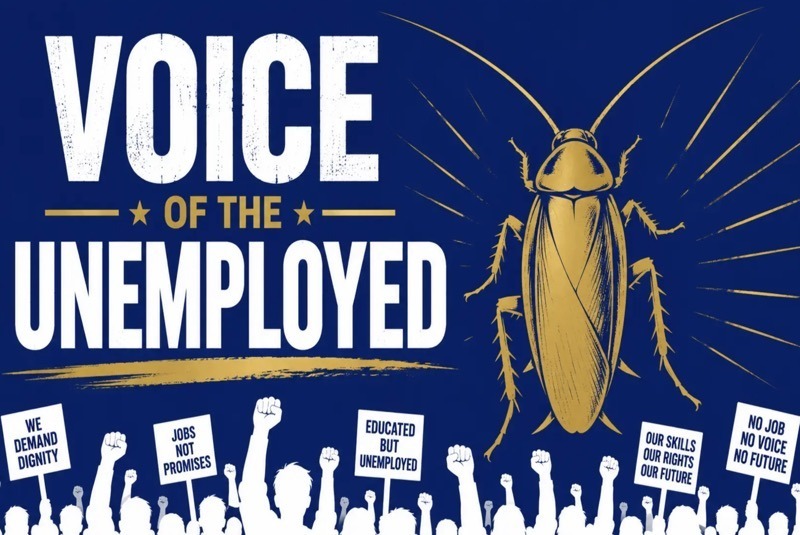
India’s youth are currently showing that they are far from ‘cockroaches’. Triggered by the egregious corruption of the education sector, the Cockroach Janata Party (CJP) has been fuelled by the political and social marginalisation of the mass of young people.
A grassroots movement, not a party, the ‘cockroaches’ are also agitating for proper state accountability for food security, inflation control and solutions for unemployment. These are certainly economic demands, but they don’t yet add up to an economic project, and constructing such a project should excite economists of every kind – macro as well as micro, feminist economists and political economists.
Any economic vision in support of the demonstrators has to confront the lack of ‘jobs’ – generally understood to be professional and/or secure employment in the state and in corporate/incorporated capitalist combines. But for ages it has been obvious that there is no way these sectors can be made to supply jobs on the scale needed. At the same time there is a poorly understood growing crisis of patriarchal joint family businesses; and unregistered wage-work is notoriously insecure, poorly paid and often involves oppressive and hazardous work-conditions. Prospects for collective action are poor, and those that have some prospect of success are limited to economic niches. What is left? What is left is self-employment.
Here, some serious attention to other countries with similar problems is needed, including the always-sensitive case of China. India and China are similarly sized countries demographically. But while self-employment in China has grown from 34m in 2010 to around 132m about now, the estimated corresponding figures for India involve a rise from about 58m to some 63m. This is not to ignore the still severe problems of productive absorption faced by China’s youth.
The Chinese approach to the structural challenge of absorbing labour — whether formally or informally, whether rural or urban in origin, whether highly or poorly educated, whether in capitalist corporations or in the state — has aimed at reducing the red tape of self-employment, making it easier to get finance and digital support, providing technical knowledge for all stages of the management of small enterprise, and extending social protection and security, which enables risk-taking. ‘Fenxing fenlei’ (roughly meaning ‘well-tailored support’) is being transformed from its origin as a concept in Chinese medicine to being a generic approach to supporting the many different kinds of self-employment that are springing up with differing specific needs — from hi-tech start-ups to gig-work.
In India, self-employment — sometimes involving small partnerships and often involving invisible family labour — has long been the most common form of livelihood. As the backbone of the informal economy, it has been supported by an evolving mass of piecemeal schemes to upgrade and formalise it through credit, skill development and the provision of social security. But much operates very far below the threshold of micro-industry and is not industry at all.
In its attempt at state regulation, India does not have the same co-ordinated bureaucratic architecture as China, nor has it invested the same resources and pursued the same policies. India is not helped by the web of self-interested informal practices that pervade policy implementation and rule-enforcement, or by cultures of patriarchy and casteism that suffuse bureaucracies and markets. Nor has it addressed significant class-caste differences in contractual relations in markets. Nor has it resolved the sharp debate among economists as to whether self-employment is distress-driven or entrepreneurial, disguised wage-labour or autonomous-enough, when clearly it is both and needs fenxing fenlei.
There is an extra challenge for cockroach economics. All the countries in the world today that provide a relatively satisfactory level of human development are breaching the safe boundaries of Earth’s biogeochemical subsystems. As cockroaches scuttle around the entire Earth’s surface, they bear witness to their degradation.
Cockroach economics could develop provisioning systems for self-employment that streamline resource and energy-use and acknowledge the practical implications of the precautionary principle for planetary survival. Along with India’s own version of fenxing fenlei, technical and environmental education and training (and their infrastructure and procurement systems) would need to be seriously scaled up. And without comprehensive social security, the cockroach generation would not be able to take the risks that distinguish small productive business from the safe ‘jobs’ for which they yearn.
Cockroaches might even aspire to change colour from brown to green and to lead the way! Economists need to be part of it!
-30-
Copyright©Madras Courier, All Rights Reserved. You may share using our article tools. Please don't cut articles from madrascourier.com and redistribute by email, post to the web, mobile phone or social media.Please send in your feed back and comments to [email protected]