People usually discuss paintings in terms of pigment, composition, technique or the lives of the artists who created them. Yet every work of art also possesses another set of layers, less visible but often more compelling than the painted surface.
Like successive glazes applied by a master painter, these hidden layers reveal stories of ownership, politics, deception and loss. In many cases, the most revealing story is not what appears on the canvas, but what history has painted over—or concealed behind—it. The visible image is only the beginning; the unseen history frequently proves the more enduring masterpiece.
Few periods illustrate this more starkly than the Third Reich. The Nazi regime sought not merely to control artistic expression but also to appropriate culture itself, confiscating, looting and redistributing artworks across Europe on an industrial scale. The broad outlines of this history are well known.
Less familiar, however, are the individual stories that expose the many ways in which art became entangled with ideology, law, fraud and memory. Maria Altmann’s campaign to recover her family’s Klimts became a landmark in Holocaust restitution. Han van Meegeren deceived connoisseurs and Nazi leaders alike with forged Vermeers. Camille Pissarro’s Rue Saint-Honoré in the Afternoon, Rain Effect became the subject of decades of litigation over competing legal principles.
Francisco de Goya’s The Marquise of Santa Cruz was drawn into disputes over national heritage and illicit export. Lucas Cranach the Elder’s Cupid Complaining to Venus acquired a mysterious provenance that continued to evolve long after the Second World War. Taken together, these episodes demonstrate that paintings can become battlegrounds where questions of history, justice and identity are contested long after the paint has dried.
Maria Altmann’s struggle possesses all the ingredients of a courtroom drama, and indeed inspired the film Woman in Gold, starring Helen Mirren. But the enduring significance of her case lies not in its cinematic qualities but in its challenge to a nation’s historical memory. Altmann sought the return of five Gustav Klimt paintings once owned by her family, including the celebrated portraits of her aunt, Adele Bloch-Bauer.
Following the Nazi annexation of Austria, the works entered Austrian state collections and eventually became centrepieces of Vienna’s Belvedere Museum. Austria maintained that the United States’ Foreign Sovereign Immunities Act of 1976 could not be applied to events that had occurred during the 1940s. In 2004, however, the United States Supreme Court ruled that the statute could indeed apply retrospectively, allowing Altmann’s claim to proceed.
Rather than continue protracted litigation, Austria and Altmann agreed to binding arbitration in Vienna. In 2006, the arbitration panel ruled that all five Klimt paintings should be returned to the family, including Adele Bloch-Bauer I and Adele Bloch-Bauer II.
The decision became one of the defining milestones of Holocaust-era restitution. It reaffirmed that the prestige of a public museum cannot erase the circumstances through which an artwork was acquired.
The paintings were subsequently sold for more than $320m in total, but their financial value was secondary. Altmann’s victory demonstrated that legal ownership and historical justice are not always synonymous, and that museums can sometimes preserve unresolved histories as much as they preserve masterpieces. The gallery wall, in this case, marked not the conclusion of a painting’s story but the beginning of a long-overdue reckoning.
If Altmann’s campaign centred on recovering historical truth, Han van Meegeren’s extraordinary career revolved around manufacturing it. Early in his artistic life, critics dismissed him as a technically gifted imitator rather than an original painter. Resentful of this judgement, he conceived an audacious revenge. He would create entirely new paintings that experts would confidently attribute to Johannes Vermeer.
Employing authentic seventeenth-century canvases, pigments based on historical recipes and a carefully devised ageing process involving synthetic resins, he produced works that appeared centuries old. His most famous forgery, The Supper at Emmaus, was enthusiastically hailed as an authentic Vermeer. The Rembrandt Society purchased the painting and donated it to the Museum Boijmans Van Beuningen in Rotterdam, convinced it had acquired one of the Dutch master’s greatest lost works.
Van Meegeren’s deception acquired a remarkable twist after the Second World War. Investigators discovered that one of his supposed Vermeers had been sold to Hermann Göring, placing the artist under suspicion of collaborating with senior Nazi officials by transferring a Dutch national treasure to the enemy. Facing potentially severe punishment, van Meegeren adopted an extraordinary legal defence.
He admitted that the painting was not a Vermeer at all but one of his own forgeries. To convince sceptical authorities, he demonstrated his techniques and even painted another counterfeit under official supervision. The confession transformed public opinion almost overnight. Instead of being remembered primarily as a collaborator, he became celebrated as the man who had deceived both Europe’s foremost art experts and one of the Third Reich’s most powerful figures. His success exposed not merely technical brilliance but the willingness of scholars and collectors to believe what they wished to discover. Expertise, he showed, is not immune to vanity.
Camille Pissarro’s Rue Saint-Honoré in the Afternoon, Rain Effect offers a different lesson. At first glance it appears to be an elegant Impressionist study of Parisian life: rain-soaked streets, umbrellas, horse-drawn traffic and the restless movement of a modern city. Forced by recurring eye problems to work from hotel windows rather than open landscapes, Pissarro painted several celebrated urban scenes during the 1890s.
Today the painting hangs in Madrid’s Thyssen-Bornemisza Museum, inviting viewers to lose themselves in its atmospheric depiction of a rainy boulevard. However, behind this tranquil scene lies one of the most significant legal disputes in the history of Holocaust-era restitution.
The painting belonged to Lilly Cassirer, who inherited it in 1926 from her father-in-law. In 1939, while attempting to escape Nazi Germany, she was compelled to surrender it to the authorities for a fraction of its value in exchange for an exit visa. After passing through dealers, collectors and galleries over subsequent decades, the work entered the Thyssen-Bornemisza Collection in 1976.
Lilly Cassirer’s grandson and heir, Claude Cassirer, sought its return through litigation in the United States. By the time the dispute reached the United States Supreme Court in 2022, the central issue was no longer the injustice of the original dispossession, which all parties acknowledged, but the legal framework governing ownership.
The Court held that ordinary choice-of-law principles required the application of the relevant state law rather than a special federal rule, sending the case back to lower courts. Subsequent proceedings applied Spanish law, under which the museum’s claim ultimately prevailed on the basis of good-faith acquisition.
The outcome illustrates the uneasy relationship between moral certainty and legal complexity. Most observers would regard the forced surrender of property under Nazi persecution as an obvious injustice. The law, however, must also grapple with questions of limitation periods, good-faith purchasers, conflicting national legal systems and the consequences of transactions that span several jurisdictions and generations.
As artworks move through dealers, collectors and museums, they accumulate legal as well as artistic histories. Pissarro’s rain-soaked Parisian street, therefore, raises questions that extend far beyond Impressionism. It reminds us that justice may depend not only on moral conviction but also on the technical architecture of private international law.
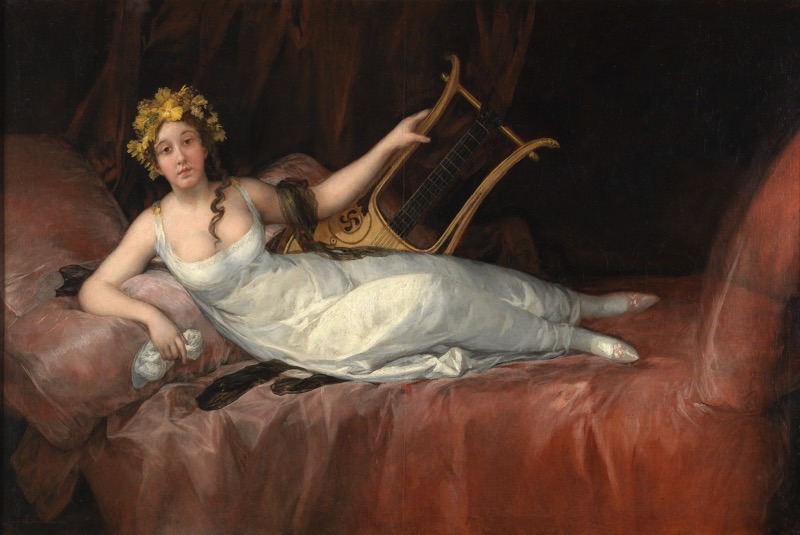
Francisco de Goya’s The Marquise of Santa Cruz presents another illustration of art’s complicated afterlife. Painted in 1805, it portrays Joaquina Téllez-Girón reclining elegantly on a divan, dressed in white and crowned with leaves while holding a lyre. Widely regarded as one of Goya’s finest female portraits, it now occupies a prominent place in Madrid’s Museo del Prado. But its twentieth-century history became almost as remarkable as the image itself.
A curious misunderstanding lay at the centre of its wartime story. The lyre depicted in the portrait bears a decorative lauburu, a traditional Basque symbol that was mistaken for a swastika. According to widely repeated accounts, General Francisco Franco acquired the painting with the intention of presenting it to Adolf Hitler. However, the proposed gift was never made, and the work remained in Spain.
Decades after its 1983 sale, the painting was exported with fraudulent documentation. It travelled through Los Angeles and Zurich before appearing for sale at Christie’s in London. The Spanish government intervened through the English courts, and in 1986 the painting was returned to Spain, where it has remained ever since.
Unlike many restitution disputes, this controversy did not centre upon wartime looting but upon cultural patrimony: the principle that certain works possess such national significance that they cannot simply be treated as commodities circulating through international markets.
Lucas Cranach the Elder’s Cupid Complaining to Venus, painted around 1526-27 and now in London’s National Gallery, demonstrates how provenance can continue to evolve long after scholars believe the historical record is complete. For many years, researchers recognised a significant gap between the painting’s sale at a Berlin auction in 1909 and its appearance on the New York art market before its acquisition by the National Gallery in 1963.
The missing years remained stubbornly obscure until an unexpected discovery transformed the picture’s history. In 1978, a German furniture auction catalogue reproduced an old photograph showing the painting hanging on the wall of Adolf Hitler’s private apartment in Munich. The image was identified by the art historian Birgit Schwarz, reopening questions that had seemed permanently closed.
How the painting reached Hitler’s residence remains unknown. It may have been acquired through a forced sale, confiscation or another transaction linked to Nazi persecution, but no definitive evidence has emerged. The photograph nevertheless altered scholarly understanding by demonstrating that provenance is never entirely settled. New evidence can surface in the most unlikely places, forcing historians to reconsider long-established assumptions. A seemingly routine furniture catalogue succeeded where decades of archival research had not.
The painting’s post-war history is no less remarkable. In 1945, Patricia Lochridge, an American journalist temporarily appointed by the United States military administration to oversee the Bavarian town of Berchtesgaden, was shown a warehouse containing artworks recovered from former Nazi repositories. According to contemporary accounts, she was invited to choose a painting as a souvenir and selected the Cranach, taking it back to the United States.
The work later entered the New York art market before being sold to London’s National Gallery. The dealer involved provided an incomplete and inaccurate account of its ownership history, leaving significant gaps in the museum’s records. Unlike the Klimts or the Pissarro, no restitution claim has yet succeeded or even fully materialised. Nevertheless, the Cranach serves as a reminder that unresolved questions often remain dormant for decades, awaiting only the chance discovery of fresh evidence.
Viewed together, these stories reveal a striking pattern. Once art becomes entangled with political power, war and law, it ceases to be merely an aesthetic object. Altmann’s Klimts demonstrate that a family’s claim to justice can endure across generations through the paintings themselves. Van Meegeren’s forged Vermeers expose the susceptibility of expertise to ambition, prestige and wishful thinking.
The Pissarro litigation illustrates how powerful moral claims may depend upon the technical operation of legal systems. Goya’s portrait affirms that nations may defend cultural heritage with as much determination as individuals defend private property. Cranach’s Cupid Complaining to Venus reminds us that provenance is rarely a neat chronology; it is more often a fragmented narrative assembled from incomplete evidence and unexpected discoveries.
Great paintings do more than survive history—they absorb it. Visitors enter museums expecting beauty, craftsmanship and inspiration. They often encounter something more demanding: evidence of persecution, opportunism, deception and resilience preserved in oil and canvas. The aesthetic experience cannot always be separated from the human experience that surrounds it. Indeed, the deeper one looks, the more difficult that separation becomes.
The lesson extends beyond museums. Every person carries a history that is invisible to strangers: layers of joy and grief, decisions freely made and choices imposed by circumstance. Like great works of art, people are frequently judged by what first appears on the surface, even though the most important parts of their stories often remain concealed. Recognising that hidden histories shape both paintings and people encourages patience, humility and empathy. In the end, those qualities may be as valuable as any masterpiece hanging on a gallery wall.
-30-
Copyright©Madras Courier, All Rights Reserved. You may share using our article tools. Please don't cut articles from madrascourier.com and redistribute by email, post to the web, mobile phone or social media.Please send in your feed back and comments to [email protected]