Why South Asian Art Is Going Global

gond_art_madras_courier
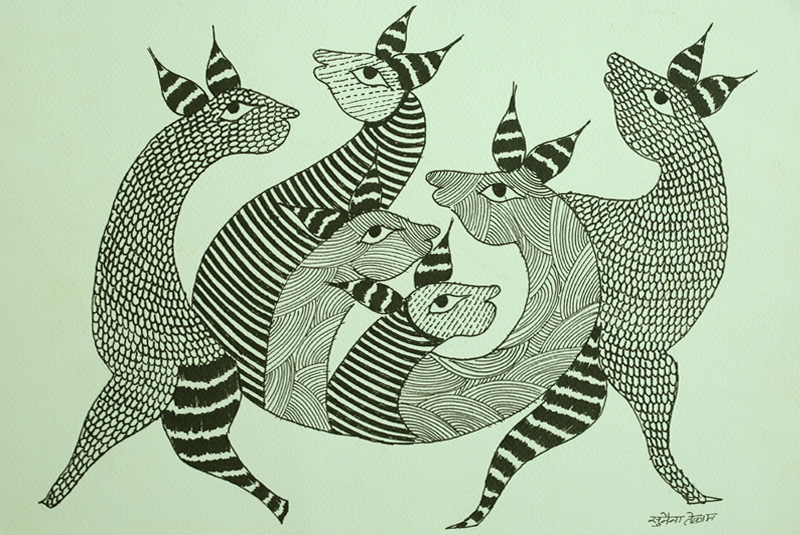
Representational image: From the art collection of Mr Shrenik Rao
For years, the international art world acknowledged South Asia while keeping it at the periphery. It is now becoming much harder to tell the story of global modernism without placing the region near its centre.

For much of the last century, the international art world treated South Asian art as a category apart. Museums mounted occasional exhibitions, auction houses staged specialist sales and collectors pursued a relatively small canon of modern masters. Recognition existed, but it was compartmentalised. Works by artists such as M.F. Husain, F.N. Souza and S.H. Raza were admired without being fully integrated into the broader history of modern and contemporary art.

That distinction is beginning to disappear. South Asian art is no longer being presented merely as a regional tradition deserving periodic attention. Instead, it is increasingly entering the mainstream institutions, commercial markets and scholarly debates that shape global culture. London’s unusually crowded programme of South Asian exhibitions this summer illustrates the shift, but the forces driving it are international. Museums from New York to Singapore are expanding their collections, collectors across the Gulf and East Asia are becoming more influential, and curators are increasingly treating South Asia as an essential part of the story of twentieth- and twenty-first-century art.

The change reflects more than rising prices. It marks a reassessment of artistic history.

For decades, Western institutions approached South Asian modernism through a narrow lens. Exhibitions often introduced Indian artists as representatives of a national school rather than as participants in wider artistic movements. The emphasis lay on explaining India to Western audiences instead of examining how artists from the subcontinent responded to many of the same forces that shaped modernism elsewhere: decolonisation, industrialisation, migration, urban growth and political upheaval.

Today’s curators are taking a different approach. Instead of organising exhibitions according to nationality or chronology, they increasingly focus on ideas that transcend borders. Themes such as memory, labour, ecology, identity and displacement have become common organising principles, placing South Asian artists alongside their counterparts from Africa, Latin America, Europe and North America rather than in separate cultural compartments.

London offers an unusually concentrated example of this transition. Within days of one another, Christie’s and Sotheby’s opened ambitious exhibitions devoted to South Asian art, while the Victoria and Albert Museum unveiled a major installation by Bharti Kher. Taken together, the exhibitions suggest a confidence that would have been difficult to imagine a generation ago. They are aimed not at a niche audience of specialist collectors but at a broader public already familiar with the idea that South Asian art belongs within the international canon.

Christie’s exhibition, The Meeting Ground, demonstrates how dramatically the field has expanded. Bringing together 180 works by 67 artists created since 1950, it is arguably the largest survey of South Asian modern and contemporary art yet staged in Britain. Its significance lies not simply in its size but in its conception.

The inevitable comparison is with the Royal Academy’s Contemporary Indian Art exhibition of 1982, presented during the Festival of India. That landmark show introduced many British visitors to Indian modernism for the first time. Yet it also reflected an older institutional mindset, presenting Indian art largely as a national tradition requiring explanation.

Christie’s adopts a different premise. Rather than defining South Asia through political boundaries, it presents the region as an interconnected artistic geography whose concerns resonate far beyond the subcontinent. Paintings, sculpture, photography and works on paper are arranged around shared questions rather than passports.

The selection reflects that wider outlook. Alongside established figures such as Husain and Souza are artists whose reputations have grown steadily through scholarly reassessment. Sudhir Patwardhan’s The Clearing examines the relentless expansion of Mumbai into surrounding landscapes. Gauri Gill’s collaborations with the Warli artist Rajesh C. Vangad explore industrial development and its effects on indigenous communities. Gond painting, represented by Jangarh Singh Shyam, and Warli traditions appear not as ethnographic curiosities but as integral parts of contemporary artistic practice.

Equally notable is the prominence given to Pakistani artists, underscoring an important institutional shift. South Asian art is increasingly understood as a regional conversation shaped by shared histories rather than as a collection of isolated national schools. Political borders have rarely defined artistic exchange; museums are becoming more willing to acknowledge that reality.

If Christie’s reflects changing scholarship, Sotheby’s illustrates the market’s evolution.

Its exhibition, The South Asia Edit, dispenses with the theatre of competitive auctions in favour of a curated selling exhibition. The format reflects changing patterns of collecting. Buyers with established collections increasingly seek museum-quality works with exceptional provenance instead of pursuing headline-grabbing auction records. Estates, meanwhile, are becoming more selective about how important works reach the market.

Several pieces have come directly from artists’ families and have never previously been offered commercially. Bhupen Khakhar is represented by paintings and previously unseen drawings that reveal the breadth of an artist now recognised internationally for exploring queer identity in Indian painting decades before such themes became commonplace in contemporary art. Works by Mohan Samant, Zarina and Sheherezade Alam illustrate the expanding range of media attracting serious collectors, from layered abstraction to works on paper and ceramics.

The inclusion of rarely exhibited works from the Alkazi Collection points to another important development. Commercial exhibitions increasingly function as vehicles for research and historical reassessment as much as for sales. Souza’s monumental Crucifixion, for example, now attracts attention not solely because of its market value but because it speaks to larger debates about religion, identity and post-colonial modernism. Prices still matter, but they are no longer the only measure of significance.

Indeed, the maturation of the market depends less on record-breaking auction results than on the institutions surrounding it. Deeper academic research, stronger museum collections and sophisticated collecting habits have created a more resilient ecosystem than the speculative cycles that occasionally characterised earlier decades.

That ecosystem is no longer centred exclusively on Europe and North America. The geography of influence has broadened considerably. Private museums across Asia continue to expand, collectors in the Gulf have become increasingly important patrons and cultural philanthropy throughout the region has grown. International museums are responding by collaborating more closely with scholars, collectors and institutions based in South Asia itself rather than treating expertise as something generated primarily in the West.

Public museums also reveal changing attitudes.

Bharti Kher’s installation at the Victoria and Albert Museum demonstrates how institutional display has evolved. Her four-metre sculpture Gaia, inspired by the clay Golu figures displayed in South Indian homes during religious festivals, occupies one of the museum’s most visible outdoor spaces. Three additional sculptures have been placed inside the museum among historic European works rather than within a geographically defined section devoted to Asian art.

The placement is as significant as the sculpture itself. Works such as Animus Mundi, with its female body surmounted by a buffalo’s head, and Ghost engage with mythology, transformation and femininity—subjects that resonate across artistic traditions. By presenting Kher in conversation with centuries of European sculpture, the museum signals that South Asian artists no longer need separate interpretative frameworks. Their work is part of a wider artistic dialogue.

This integration reflects broader shifts in cultural authority. As scholarship becomes increasingly international and museums diversify both their collections and curatorial leadership, the traditional flow of cultural influence is becoming less one-directional. Institutions in London, New York and Paris are no longer simply introducing South Asian art to Western audiences. They are participating in conversations shaped equally by academics, collectors and artists from Delhi, Mumbai, Lahore, Dhaka, Singapore and beyond.

The reasons for this growing prominence extend beyond questions of representation. South Asian artists are attracting international attention because many have addressed issues that have become central to contemporary life everywhere. Urbanisation, environmental degradation, migration, identity, memory and displacement are no longer regional subjects. They define political and cultural debate across the world. Artists from the subcontinent approach these themes through distinctive local histories, yet the questions themselves are universal.

London’s crowded summer season therefore represents more than an unusually successful run of exhibitions. It captures a wider realignment in the global art world. South Asian artists are no longer being added to museum programmes to broaden geographical representation. Increasingly, they are recognised because their work changes how the story of modern and contemporary art is understood.

That may prove to be the lasting transformation. Markets rise and fall, and exhibitions eventually close. What endures is institutional acceptance: permanent acquisitions, sustained scholarship and inclusion within the narratives through which art history is written. South Asian art is moving beyond specialist departments and dedicated sales into the mainstream structures that confer lasting significance.

The result is not the emergence of a new artistic fashion but the correction of an old omission. For years, the international art world acknowledged South Asia while keeping it at the periphery. It is now becoming much harder to tell the story of global modernism without placing the region near its centre.

-30-

Copyright©Madras Courier, All Rights Reserved. You may share using our article tools. Please don't cut articles from madrascourier.com and redistribute by email, post to the web, mobile phone or social media.
Please send in your feed back and comments to [email protected]

0 replies on “Why South Asian Art Is Going Global”