
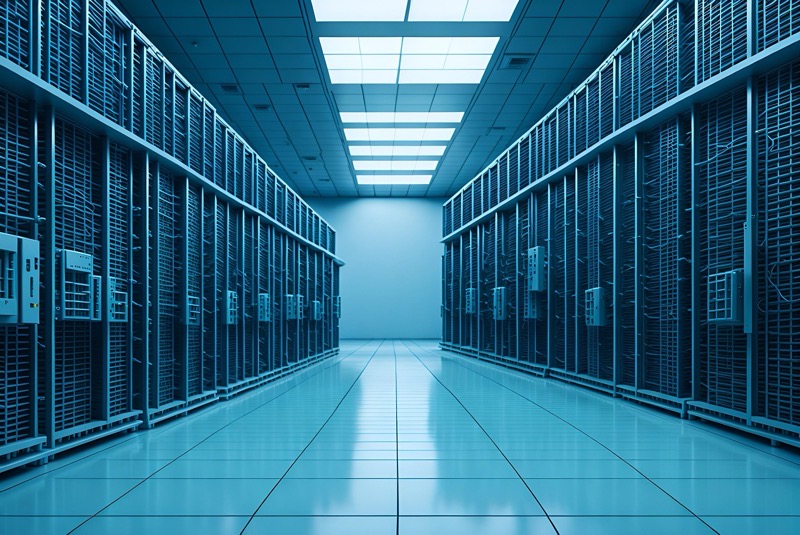
Two developments reported independently illuminate an important but underexplored policy contradiction. First, Amazon Web Services (AWS) announced an additional USD 13 billion between 2026 and 2030 to expand its data centre footprint by nearly 2 GW in cities such as Hyderabad and Mumbai. On the other hand, the world’s leading credit rating agency, Moody’s, published a report warning that India’s fragmented water management framework could exacerbate water shortages and disrupt the economy.
Reading together, these developments point to an emerging challenge: the rapid expansion of AI data centres is colliding with a governance framework already struggling to manage. This concern is no longer hypothetical. Multiple studies show that hyperscale AI data centres consume significant amounts of water to cool high-performance computing systems. It is no longer hidden that hyperscale AI data centres require a massive amount of water to cool high-performance computing infrastructure.
These developments raise an obvious question: is India prepared for the water demands of AI infrastructure before it becomes a governance crisis, or will regulation follow only after resource conflicts begin to emerge?
The government has already offered its answer in its replies to parliamentary questions, which give a fair impression of how prepared our government actually is. From February to April 2026, three separate questions were raised in Parliament, directed at the Ministry of Electronics and Information Technology, the Ministry of Environment, Forest and Climate Change, and the Ministry of Jal Shakti.
Responding to Unstarred Question No. 866 on 6 February 2026, Jitin Prasada, Minister of State for Electronics and Information Technology, stated that AI data centres are required to comply with existing Bureau of Energy Efficiency frameworks, including the voluntary Star Rating Programme based on Power Usage Effectiveness, the Energy Conservation Building Code under the Energy Conservation Act, 2001, and statutory water-related regulations governing abstraction, recycling, reuse and discharge. He further stated that sustainability considerations are being advanced through the Resilience, Innovation & Efficiency Working Group of the IndiaAI Impact Summit.
While the response prima facie shows regulatory preparedness, it amounts to more than a recitation of existing frameworks that were never designed with AI infrastructure in mind. Moreover, the Bureau of Energy Efficiency’s Star Rating Programme, which the minister invokes as a primary compliance mechanism, is voluntary, meaning a data centre operator faces no legal consequences whatsoever for energy inefficiency, and the government has no enforcement lever to compel compliance.
Even where operators comply, Power Usage Effectiveness, the metric on which the Star Rating is based, measures only the ratio of total facility energy to IT equipment energy. It says nothing about water consumed, which is the actual point of debate.
Responding to Unstarred Question No. 4074, Raj Bhushan Choudhary, Minister of State for Jal Shakti, stated that no concerns had been received regarding water consumption by data centres. He further noted that the Government’s priority is to facilitate the establishment of data centres to strengthen India’s digital infrastructure, while asserting that improvements in cooling technologies—including direct-to-chip liquid cooling, adiabatic cooling and immersion cooling—along with the deployment of high-density racks are enhancing water-use efficiency and reducing overall power and water consumption. The Minister also stated that groundwater extraction by data centres continues to be governed by the Ministry of Jal Shakti’s existing groundwater regulation guidelines issued in 2020 and amended in 2023.
Mr Choudhary primarily relied on advanced cooling technologies, such as direct-to-chip liquid cooling and closed-loop cooling. However, this approach has significant limitations. To date, there is no publicly available, independently verified evidence of a hyperscale AI data centre operating at zero water evaporation for cooling over a sustained period. The one data centre, built by Microsoft in Phoenix, USA, is still a pilot project. Also, the model is only theoretical, with lab-scale validation; there is no peer-reviewed, third-party, audited operational study showing a full hyperscale AI data centre running at WUE=0 over a meaningful period.
Responding to Unstarred Question No. 4396 on 2 April 2026, Kirti Vardhan Singh, Minister of State for Environment, Forest and Climate Change, stated that data centres and AI facilities are not per se covered under the Environment Impact Assessment Notification, 2006. However, building and construction projects housing such facilities with a built-up area exceeding 20,000 square metres are covered under Item 8(a) of its Schedule and require prior Environmental Clearance, with conditions stipulating measures for energy efficiency, water conservation, and reuse of treated wastewater.
This response is perhaps the most problematic, as it not only shows unpreparedness but also an obsolete view, treating AI infrastructure through the lens of conventional building regulation. The environmental footprint of these centres is determined far more by the building’s dimensions. The capacity of these centres depends on factors like the density of GPUs and AI accelerators deployed, Rack power density, etc.
The distinction becomes even more crucial when viewed through the lens of water consumption. AI centres consume between 1 and 1.5 Litres of water for every kWh of electricity consumed. A modest 1 MW facility operating round the clock uses about 24,000 kWh of electricity each day, resulting in 24,000–36,000 litres of water per day.
Despite this substantial environmental footprint, such facilities often occupy 5,000–20,000 square metres, meaning that many can remain outside the EIA regime simply because they fall below the 20,000-square-metre built-up area threshold. The law, therefore, measures the size of the building rather than the scale of its environmental impact.
India’s ambition to become a global AI hub need not come at the expense of water security. Yet the parliamentary responses reveal a common regulatory assumption that existing legal frameworks are sufficient to govern AI infrastructure. They are not. AI data centres are defined not by the size of the buildings they occupy but by their computational intensity and the enormous quantities of electricity and water they consume.
The solution is not to regulate AI through an industrial framework but to recognise it as a distinct category of environmentally significant infrastructure. India should introduce AI-specific environmental standards that account for operational metrics such as electricity demand and water consumption, mandate public disclosure of resource use, and require stricter environmental scrutiny for facilities proposed in water-stressed regions. Without such reforms, the country risks discovering the environmental cost of its AI ambitions only after local water conflicts begin to emerge.
-30-
Copyright©Madras Courier, All Rights Reserved. You may share using our article tools. Please don't cut articles from madrascourier.com and redistribute by email, post to the web, mobile phone or social media.Please send in your feed back and comments to [email protected]