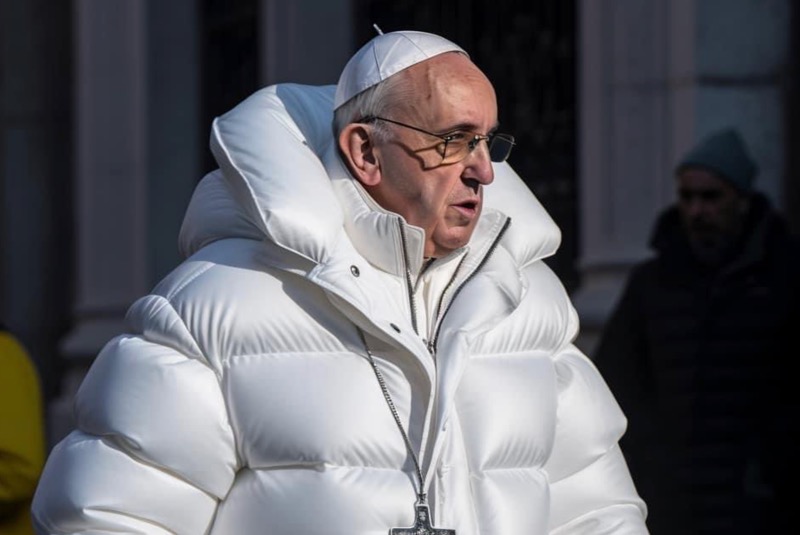
There was something odd about the photographs of Pope Francis in a white Balenciaga-style puffer jacket. When the images began circulating online in 2023, many people accepted them as authentic. Others quickly discovered that artificial intelligence had generated them. What lingered, though, was not embarrassment at being fooled. It was a subtler realisation.
The images felt plausible not because they perfectly reproduced reality, but because they captured the visual logic of the internet. The jacket was stylish, the composition cinematic, and the Pope looked unexpectedly cool. The pictures seemed engineered for virality. Strangely, they looked more like the internet than reality itself.
For most of modern history, photographs occupied a privileged place in public life. People disputed words. Memories faded. Witnesses lied. However, a photograph appeared to offer a direct connection to the world. However imperfectly, it suggested that a camera had been present, that light had struck film or a sensor, and that whatever appeared within the frame had existed at a particular moment. A photograph did more than represent reality. It testified to it.
Generative artificial intelligence has weakened that connection. With a few lines of text, image models can produce people who never existed, events that never occurred, and scenes assembled entirely inside a machine-learning system. What once required a camera now requires only computation.
Most discussion of this shift has focused on deception. Commentators warn about ‘deepfakes,’ ‘fabricated evidence,’ and ‘synthetic misinformation.’ The concern is real. People tend to trust what they see. Images often feel immediate in a way that arguments do not. They seem to place reality directly before our eyes.
Yet deception may not prove the most important consequence of synthetic media. A more significant change is taking place in perception. As people learn that convincing images can be generated on demand, they are not simply becoming easier to fool. They are becoming harder to convince.
That distinction matters. A society in which people occasionally believe false images faces one problem. A society in which people doubt every image faces another. The first threatens accuracy. The second threatens trust.
You can already see the shift online. When a remarkable photograph appears, many viewers no longer ask what it shows. They first ask whether it is real. Was it generated? Edited? Manipulated? Even authentic images now arrive under suspicion.
The existence of synthetic media creates what researchers call the “liar’s dividend”: people confronted with genuine evidence can dismiss it as fake. But the effect reaches far beyond politics. Once people know that almost anything can be fabricated, uncertainty begins to attach itself to visual media as a category. Every image carries a faint question mark.
Human beings cannot live indefinitely in that state. Courts need evidence. Journalists need sources. Historians need records. Citizens need shared facts. Scepticism can be healthy, but universal scepticism becomes exhausting.
So people are building new ways to establish trust. Technology companies, standards bodies, and researchers have begun developing systems to track the origins of digital content and how it has been altered. These tools do not prevent manipulation. Instead, they document it. They create a chain of custody for information.
That effort points to a surprising conclusion. We may soon place less trust in images themselves and more trust in the records that accompany them.
For nearly two centuries, inventors improved cameras by making them faithful to reality. Images became sharper and clearer. The assumption seemed obvious: the closer a photograph came to reality, the more people would trust it.
Artificial intelligence has turned that assumption upside down. Today, the most convincing images may be entirely synthetic.
As a result, trust is shifting away from appearance and toward provenance.
There is a historical irony in this. Photography once seemed powerful because it reduced our dependence on intermediaries. The image appeared to speak for itself. Now images increasingly require authentication. Metadata, cryptographic signatures, and provenance records have begun to serve as the new guarantors of credibility.
The more sophisticated visual technologies become, the less willing we are to trust what they show us. And the less willing we are to trust what we see, the more we depend on systems that remain invisible.
The age of generative AI has exposed something photography long encouraged us to forget: seeing and believing were never the same thing. We trusted photographs not simply because they looked real, but because they existed within institutions, norms, and practices that helped establish their credibility.
Artificial intelligence has not destroyed those foundations. It has made them visible again.
The defining technology of the AI era may not be the model that generates synthetic images. It may be the infrastructure that verifies them. The central question is no longer “What does this picture show?” but “Where did it come from, and why should we trust it?”
The story of artificial intelligence is often framed as a struggle between truth and falsehood. However, fundamentally, it is a story about trust — about how societies build it, lose it, and reinvent it when old certainties no longer hold.
-30-
Copyright©Madras Courier, All Rights Reserved. You may share using our article tools. Please don't cut articles from madrascourier.com and redistribute by email, post to the web, mobile phone or social media.Please send in your feed back and comments to editor@madrascourier.com