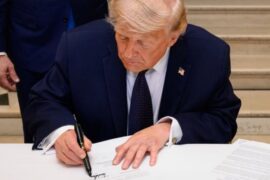
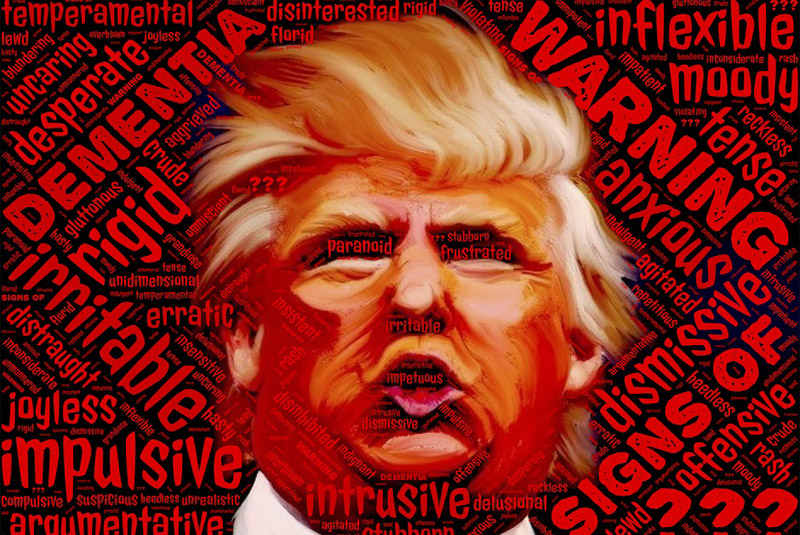
“A whole civilization will die tonight, never to be brought back again,’ wrote Donald Trump, on his social media platform. Indeed, the language of annihilation has a long and ignoble pedigree in international affairs. But even by the standards of wartime rhetoric, Donald Trump’s statement marks a disturbing departure.
His crass rhetoric normalises an idea that international law has spent decades attempting to banish: that entire societies can be treated as legitimate targets. Such rhetoric erodes the fragile restraints that govern modern warfare.
The U.S-Israel war on Iran is rapidly escalating; its effect radiates across the Gulf. For thirty-nine days, strikes and counter-strikes have reverberated across the region, drawing in multiple actors and unsettling global energy markets.
Trump has imposed a deadline demanding the full reopening of the Strait of Hormuz, through which roughly a fifth of the world’s oil supply passes. Tehran, under sustained bombardment, responded with missile and drone attacks against Israel and American-linked targets, while threatening to disrupt energy flows far beyond the region.
The military dimension of this confrontation is grave. Reports of strikes on railways, bridges, and energy infrastructure—alongside universities and hospitals—suggest that Israel and the United States are deliberately targeting civilians. Preliminary casualty figures point to thousands dead in Iran and dozens elsewhere. However, it is the rhetoric that is proving most corrosive.
International humanitarian law, codified in the Geneva Conventions, rests on a few core principles: distinction, proportionality, and necessity. Combatants must distinguish between military and civilian targets; attacks must not cause excessive civilian harm relative to anticipated military advantage; and force must be necessary to achieve a legitimate aim. Within this framework, hospitals, educational institutions, and infrastructure indispensable to civilian survival enjoy special protection. To threaten the destruction of an entire “civilisation” is, by definition, to discard these distinctions.
Those who defend Trump’s crass rhetoric argue that such language is intended as deterrence. By raising the spectre of overwhelming force, leaders hope to compel adversaries to back down. There is some historical precedent for this logic. Nuclear brinkmanship during the Cold War relied on threats of catastrophic retaliation. But even at the height of that rivalry, leaders on both sides were careful, at least in public, to frame their doctrines in strategic terms. The language of mutually assured destruction was chilling, but it was also abstract and impersonal. It did not explicitly license the obliteration of a civilisation.
Today’s discourse is crude. It collapses the distinction between state and society, between regime and people. In doing so, it legitimises actions that would otherwise be unthinkable. If a civilisation is the target, then any component of it—its infrastructure, its institutions, its citizens—can be construed as fair game. This is precisely the logic that international law seeks to prevent.
The strategic consequences are troubling. Iran’s leadership has signalled that it would respond asymmetrically to anyone crossing its “red lines.” Threats to “deprive” the United States and its allies of oil and gas for years point to consequences that could extend well beyond the Middle East. Cyberattacks on energy infrastructure, disruptions to shipping lanes, and strikes on allied facilities are plausible scenarios. Framing the war in existential terms increases the likelihood of such escalatory dynamics.
The Gulf states are in an unenviable position. Qatar, the United Arab Emirates, Kuwait, and Bahrain have intercepted missiles or activated their civil defence measures. Their priority is to protect sovereignty and maintain internal stability. However, their geographic proximity to the conflict makes them vulnerable to spillover effects, whether in the form of stray projectiles or deliberate targeting of energy assets. The result: diminishing room for diplomatic manoeuvre.
Economic repercussions are already visible. Oil prices have surged, with spot cargoes reaching record levels before retreating slightly on signs of possible diplomatic engagement. The volatility reflects not only supply concerns but also the premium attached to uncertainty. Markets are attempting to price in scenarios that range from limited disruption to a full-scale closure of the Strait of Hormuz. In this sense, rhetoric again plays a role. Statements suggesting imminent, large-scale destruction amplify uncertainty and, by extension, market instability.
There are, however, glimmers of diplomacy. Shehbaz Sharif has urged a two-week extension of Trump’s deadline and called on Iran to reopen the Strait of Hormuz. Such interventions underscore the continued relevance of third-party mediation, even in highly polarised conflicts. The responsiveness of financial markets to Sharif’s appeal suggests that investors, at least, are eager for any sign of de-escalation.
But diplomacy cannot flourish in an environment saturated with apocalyptic language. Negotiations require a minimum level of mutual recognition: an acknowledgement that the adversary, however hostile, is a legitimate interlocutor. Rhetoric that casts the opponent as a civilisation to be erased undermines this foundation. It signals not only a willingness to use force but a denial of the other’s right to exist in its current form.
The ethical dimension is stark. The modern international order, though imperfect, rests on the premise that certain acts are beyond the pale. Genocide, collective punishment, and the deliberate targeting of civilians fall into this category. While words are not deeds, they shape the moral climate in which deeds occur. When leaders casually speak of destroying an entire civilisation, they lower the threshold for actions that might otherwise provoke universal condemnation.
There is also a domestic audience to consider. Leaders often use strong language to project resolve and rally support at home. In times of crisis, such signalling can be politically expedient. But it carries risks. Populations primed to expect decisive or catastrophic action may react poorly to compromise. This will narrow the political space for de-escalation, locking governments into trajectories that are difficult to reverse.
The current crisis in West Asia will reveal not only the resilience of regional security arrangements but also the durability of the norms that have, for decades, constrained the worst excesses of war. The stakes are high, not just for those directly involved but for the entire international system.
To speak of wiping out a civilisation is to flirt with a world in which such outcomes are conceivable. That is a world most would prefer not to inhabit. The task, therefore, is not merely to manage the present conflict but to ensure that the language used to describe it does not make future conflicts even more dangerous.
-30-
Copyright©Madras Courier, All Rights Reserved. You may share using our article tools. Please don't cut articles from madrascourier.com and redistribute by email, post to the web, mobile phone or social media.Please send in your feed back and comments to editor@madrascourier.com