In the calculus of deterrence, distance has long been considered an insurance policy. The farther a military installation lies from an adversary’s reach, the more it is presumed to exist in a zone of strategic comfort. That assumption has been tested, and perhaps unsettled, by recent claims that Iran has targeted nearly every American military base in the Gulf, rendering several of them, in operational terms, uninhabitable.
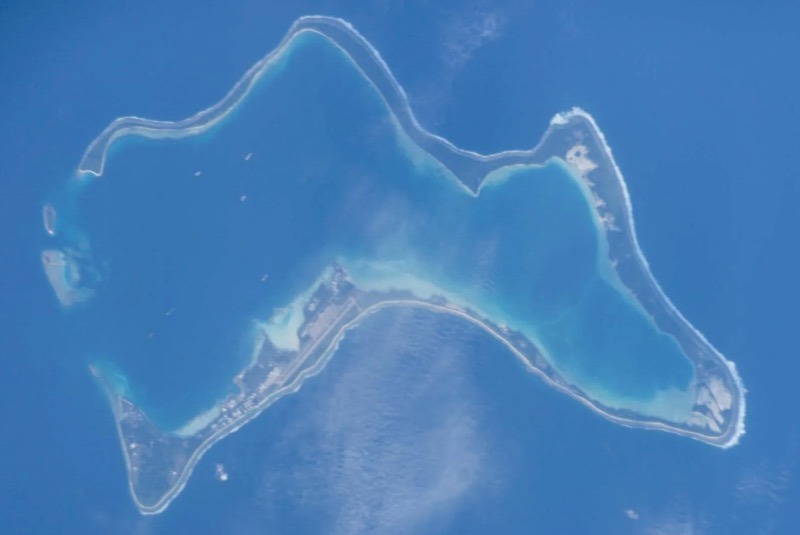
The suggestion that even the remote atoll of Diego Garcia—a joint U.S.-U.K. installation situated roughly 2,500 miles (or 4000 Kilometres) from Iran—may have been the object of attempted missile strikes introduces an uncomfortable dimension; geography is becoming less decisive in the calculus of conflict.
Reports indicate that two ballistic missiles were directed toward Diego Garcia. One reportedly failed mid-flight; the second was intercepted before it could pose a threat to the base. Even if the attack did not succeed, its implications ripple outward.
The question it raises is not only technical—whether Iran possesses the capability to strike such a distant target—but strategic: whether it would choose to do so, and at what cost. In a region saturated with geopolitical power struggles, the symbolism of targeting a distant base could outweigh any limited tactical gain.
The United States maintains a network of more than 700 military bases across 80 countries, a lattice of power projection that has defined its global posture since the mid-twentieth century. These installations are instruments of influence, a reassurance to allies, and warnings to adversaries.
But the recent wave of Iranian strikes on bases in the Gulf has exposed the vulnerabilities inherent in such dispersion. Fixed installations, no matter how fortified, remain susceptible to increasingly sophisticated missile and drone technologies. The spectacle of multiple bases being degraded in rapid succession underscores a paradox: the visibility that makes these bases effective deterrents also makes them attractive targets.
For years, Iran’s missile program, it is understood, has operated within an approximate range of 2,000 kilometres. This limitation, while significant, has been treated as a boundary condition in strategic planning.
Iran’s development of satellite launch vehicles—rockets capable of placing payloads into orbit—has occasionally been cited as evidence of latent long-range capability. However, there is no credible public evidence that these systems have been adapted for use as intercontinental ballistic missiles.
The technological leap from launching satellites to delivering precise, weaponised payloads over thousands of miles is not trivial. It requires not only propulsion but guidance systems, re-entry vehicles, and reliable targeting mechanisms.
In the absence of such capabilities, the notion that Iran could strike Diego Garcia directly with conventional missiles appears unlikely. This does not preclude the existence of clandestine or unconventional delivery methods, but it does suggest that any such attack would involve considerable risk and uncertainty.
Military planners, by necessity, distinguish between theoretical possibility and operational probability. In this case, the balance tilts toward scepticism.
Moreover, Iran’s navy, often described as a “green-water” force, is designed primarily for operations within the Persian Gulf and the Arabian Sea. Also, Iran does possess submarines. However, it has demonstrated a capacity for asymmetric maritime tactics; extending its reach into the central Indian Ocean would require traversing heavily monitored waters. The likelihood of detection, interception, or preemptive engagement by U.S. or allied forces would be high. A failed naval operation, particularly one targeting a high-value installation like Diego Garcia, could result in significant material losses and strategic embarrassment.
Moreover, Diego Garcia is not only an American base. Situated within the British Indian Ocean Territory, it is a joint U.S.-U.K. asset. An attack on the installation would carry implications beyond bilateral confrontation. It would raise the spectre of collective defence under the North Atlantic Treaty Organisation, specifically Article 5, which stipulates that an attack on one member is considered an attack on all. This provision has been invoked only once, in the aftermath of the September 11 attacks, yet its symbolic weight is considerable.
The prospect of triggering such a response complicates Iran’s strategic calculus. While Donald Trump has urged a unified NATO stance against Iran, the alliance has been cautious in extending its commitments beyond the Euro-Atlantic sphere. Nevertheless, an attack on a jointly held base could alter that posture. The current British government, led by Keir Starmer, would face intense pressure to respond as the incident would be considered a direct assault on British sovereignty.
This political dimension intersects with an unresolved question: the sovereignty of the Chagos Archipelago. The islands, including Diego Garcia, were originally charted by Portuguese explorers in the sixteenth century before passing through French and British hands.
In 1965, as part of the decolonisation process, the United Kingdom separated the archipelago from Mauritius, retaining it as an overseas territory. This arrangement facilitated a 1966 agreement with the United States to develop Diego Garcia as a military hub, a decision that would have profound human consequences.
Between 1967 and 1973, approximately two thousand Chagossians were forcibly removed to make way for the base. They were relocated primarily to Mauritius and the Seychelles, often with minimal compensation and limited support. Their displacement remains a contentious legacy of Cold War geopolitics, and their ongoing legal and political struggle for the right of return has kept the issue alive in international forums.
In 2019, the International Court of Justice declared that the United Kingdom’s continued administration of the Chagos Archipelago was unlawful and that sovereignty should be returned to Mauritius. Though non-binding, the opinion carried significant moral and diplomatic weight.
In October 2024, the Starmer government signalled its willingness to cede sovereignty, proposing a framework in which the United Kingdom would lease Diego Garcia from Mauritius for ninety-nine years. The United States, through its State Department, initially appeared supportive of this arrangement, recognising the strategic value of continuity.
A treaty formalising this transition was signed in May 2025, marking a potential resolution to decades of dispute. However, the political landscape shifted again in early 2026, when Trump criticised the agreement, framing it as a relinquishment of strategic control.
In a public statement, Trump suggested that Diego Garcia, along with other installations such as Fairford Airfield, might be essential to countering threats posed by what he described as unstable regimes. This rhetorical pivot coincided with a broader escalation, including reported joint U.S.-Israeli strikes on Iran in late February 2026, further entangling the base in contemporary conflict dynamics.
In the United Kingdom, the Chagos issue has become a domestic political flashpoint. Debates over sovereignty, defence policy, and historical responsibility intersect in ways that resist easy resolution. For some, the archipelago’s return to Mauritius represents a necessary correction of colonial-era injustices. For others, it raises concerns about strategic vulnerability amid heightened global tensions. Diego Garcia’s presence at the centre of these debates ensures that any external threat to the base reverberates through British political discourse.
The broader regional context adds another layer of complexity. During the Cold War, the United States sought a foothold in South Asia, considering locations in Pakistan and even Portuguese-controlled Goa. India, under the leadership of Jawaharlal Nehru, resisted the establishment of foreign military bases in its vicinity, advocating instead for a non-aligned posture. That stance has softened over time. Today, India engages in a range of logistical and communications agreements with the United States, driven in part by concerns about China’s presence in the Indian Ocean.
Diego Garcia, situated less than 1,800 kilometres from India, occupies a strategic position within this evolving landscape. Its utility extends beyond immediate military operations; it serves as a node in a broader network of surveillance, logistics, and power projection. Any threat to the base, whether real or perceived, therefore has implications not only for U.S.-U.K. relations but for the balance of power across the Indo-Pacific.
Whether Iran possesses the means to strike Diego Garcia remains an open question, but the mere suggestion that it might aspire to do so alters the strategic conversation. It forces a reconsideration of assumptions about vulnerability and the interconnectedness of global security.
If deterrence is a dialogue, it seems the margins of that dialogue are expanding, encompassing not only the proximate theatres of conflict but the distant outposts that sustain them. In that expansion lies risk and revelation: the recognition that in an era of accelerating technology and deepening geopolitical rivalry, no place is quite as remote as it once seemed.
-30-
Copyright©Madras Courier, All Rights Reserved. You may share using our article tools. Please don't cut articles from madrascourier.com and redistribute by email, post to the web, mobile phone or social media.Please send in your feed back and comments to editor@madrascourier.com