The war that began before dawn on February 28 has fundamentally altered the strategic grammar of West Asia. The illegal war, launched by the United States and Israel, targeted Iranian cities, including Tehran, Isfahan, and Qom and eliminated several senior leaders. Among the dead was Iran’s supreme leader, Ayatollah Ali Khamenei, killed in the opening phase of the assault.
The so-called ‘military operation’—known as “Operation Lion’s Roar” in Israel and “Operation Epic Fury” in Washington—violates international law. Ostensibly, it was a ‘preemptive’ measure against Iran’s nuclear and missile programs. Whatever the stated intentions, the consequences of this brazen attack go far beyond the battlefield, altering the foundations of regional peace and stability.
For decades, the ‘Middle East’—better described, geographically and historically, as West Asia—existed within a tense but recognisable strategic equilibrium. Rival powers manoeuvred through proxy wars, covert operations, sanctions, and periodic skirmishes, but direct war between the region’s most powerful states remained rare.
Even in moments of acute crisis, diplomacy offered a scaffolding that prevented full-scale interstate conflict. The 2015 nuclear agreement between Iran and world powers, though imperfect, represented one such attempt to stabilise that balance by placing limits on Iran’s nuclear program in exchange for sanctions relief. The agreement slowed Tehran’s path toward a nuclear weapon and created a diplomatic channel that restrained escalation.
That scaffolding began to erode when the United States unilaterally withdrew from the nuclear deal in 2018, unleashing a cycle of sanctions, retaliation, and deepening mistrust. Iran gradually resumed aspects of its nuclear program while expanding its regional influence through allied groups across Iraq, Lebanon, Syria, and Yemen.
Ironically, Israel—a country which possesses nuclear weapons and refuses to sign the Nuclear Non-Proliferation Treaty—believes Iran poses an ‘existential threat’ and unleashed a series of covert strikes and assassinations.
Even amid these hostilities, the two states largely avoided direct war. The confrontation unfolded through shadow conflict—airstrikes in Syria, cyberattacks, and sabotage operations—rather than open battle between national militaries.
The events of 2025 began to puncture that restraint. In June of that year, Israel launched major strikes on Iranian nuclear facilities and military installations, triggering a brief but intense exchange of missile and drone attacks between the two countries. The fighting lasted less than two weeks before a ceasefire was announced under U.S. pressure, leaving the underlying tensions unresolved. That ‘twelve-day war’ demonstrated that the barrier against direct war between Israel and Iran had cracked.
The February 2026 strikes shattered that barrier completely. The objectives of the ‘military operation’ were vague and unclear. One day, it was regime change, with Trump urging Iranians to ‘take over’ their government. Another day, it was to deter Iran’s ‘radical Islamic terrorist leadership.’ Now, it is ostensibly a religious war, a divine ordination anointed by Jesus Christ.
But the fundamental truth, if history is a lesson, is that wars that begin cannot be contained. By targeting Iran’s top leadership and openly encouraging a change of government, the United States and Israel crossed a threshold that the region’s geopolitical order had previously avoided. The result was predictable: Iran responded with missile and drone attacks not only against Israel but against American bases and infrastructure across the region.
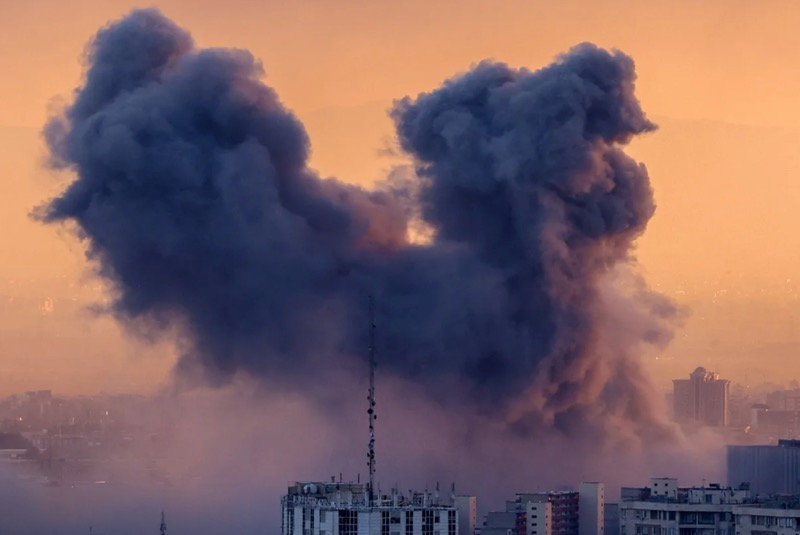
The ripple effects spread quickly beyond Iran and Israel. Hezbollah, the powerful Lebanese movement aligned with Tehran, launched rockets and drones toward northern Israel, drawing retaliatory airstrikes on Beirut and southern Lebanon. Shipping in the Strait of Hormuz—one of the world’s most vital energy corridors—was disrupted as Iran threatened vessels and retaliatory attacks damaged tankers. Oil markets shuddered, and Gulf states suddenly found themselves within the expanding perimeter of the conflict.
It became very clear that America and Israel’s attack was a monumental misadventure. What distinguishes this war from earlier crises is not simply its scale but its strategic implications. For decades, the regional order rested on an uneasy assumption: that even bitter enemies recognised the catastrophic costs of direct interstate war.
That assumption functioned as a kind of negative peace, maintained through deterrence. America’s misadventure has punctured that logic. If major powers are now willing to strike one another’s territory directly, kill senior leaders, and pursue regime change, the restraints that once limited escalation may prove far weaker than previously believed.
This shift carries profound consequences for the future. One is the accelerating erosion of diplomatic mechanisms that once moderated conflict. The collapse of nuclear negotiations between Washington and Tehran was not merely a casualty of the war but also one of its causes. Diplomacy, already fragile, has been replaced by the language of military solutions. The longer the war continues, the more difficult it will become to rebuild even minimal channels of negotiation.
Another consequence is the likely proliferation of asymmetric retaliation. Iran’s regional strategy has long relied on allied non-state actors—from Hezbollah in Lebanon to militias in Iraq and Syria. Those networks are now positioned to transform the war into a dispersed and prolonged confrontation. The attacks already spreading across the region suggest a conflict that may not remain confined to two or three countries but instead bleed across borders in unpredictable ways.
The war also raises a deeper question about nuclear proliferation. Military strikes aimed at preventing nuclear weapons have historically produced the opposite incentive: persuading targeted states that nuclear deterrence is their only reliable protection. If Iran’s leadership—or whatever political system eventually emerges from the current upheaval—draws that conclusion, the strategic outcome of the war may be precisely the one its architects sought to avoid.
In Washington and Jerusalem, supporters of the operation argue that decisive force was necessary to confront a growing threat. Iran’s missile arsenal, its enrichment of uranium, and its network of allied militias were all cited as reasons for action. Yet even if one accepts those concerns, the central problem remains: wars do not end when the first missiles land. They reshape political landscapes in ways that no strategist can fully predict.
History offers sobering parallels. The invasion of Iraq in 2003 was justified as a preventive war intended to eliminate ‘weapons of mass destruction’ and reshape the Middle East in a stable direction. Instead, it shattered the Iraqi state, unleashed sectarian conflict, and altered the region’s balance of power for a generation. The current war risks producing a similar pattern of unintended consequences—destabilising the wider region.
The humanitarian costs are mounting. Civilian casualties have climbed into the hundreds, including children killed in missile strikes and air raids. Entire neighbourhoods in Iran, Lebanon, and Israel have been damaged or evacuated as the fighting spreads. For the millions of people living in the shadow of this conflict, the geopolitical debates of capitals translate into something far more immediate: the fear of the next explosion
However, the most enduring transformation may lie not in the destruction visible today, but in the region’s strategic psychology. Once a precedent has been set—that major states can directly attack one another’s territory and leadership without pursuing diplomatic challenges—future crises will unfold under a different set of expectations. The threshold for war has been lowered. Deterrence, once rooted in caution, will give way to a volatile environment in which preemptive strikes become the policy.
West Asia has experienced many wars over the past century, but the regional order that emerged after the Cold War depended on the idea that large-scale interstate war was unlikely. The conflict now underway has shattered that assumption.
Whether it ends in weeks or drags on for years, its legacy will persist: a region in which the old boundaries between shadow conflict and open war have been erased.
Peace in the Middle East has always been fragile, sometimes illusory. But the current war has done something more profound than merely disturb that fragile equilibrium. It has altered the underlying rules of the game. And once those rules change—once the logic of confrontation replaces the logic of caution—restoring the old order will prove impossible.
-30-
Copyright©Madras Courier, All Rights Reserved. You may share using our article tools. Please don't cut articles from madrascourier.com and redistribute by email, post to the web, mobile phone or social media.Please send in your feed back and comments to [email protected]