Recently, a young voter in India, scrolling through her phone, noticed a strange conversation in a WhatsApp group about a forthcoming state election. At first, the messages seemed ordinary: one participant shared a cricket meme, another complained about food prices, and a third posted a link criticising an opposition candidate.
Over days, the tone shifted. The grievances sharpened, the links multiplied, and a chorus of ostensibly independent voices began to converge on the same claim: that the candidate is ‘corrupt,’ ‘anti-national’ and was ‘secretly backed by foreign interests.’ The consensus felt real and organic. But it is not. Most of the active participants were not people at all, but AI-generated bots designed to ‘infiltrate,’ persuade and amplify.
Generative artificial intelligence has matured into a tool capable of producing fluent, context-aware and adaptive text at scale. Open-source language models can be fine-tuned with relative ease, stripped of the guardrails that commercial providers impose and deployed across multiple platforms simultaneously.
In India, where social media use is widespread and online political engagement is intense, the implications are profound. The country is both one of the world’s largest digital markets and its largest democracy. That combination makes it a fertile ground for influence operations.
Recent research has shown how coordinated networks of AI-powered accounts can manufacture what appears to be widespread agreement. In controlled simulations, the most effective tactic was not blunt propaganda but infiltration. Agents embedded themselves within an online community, adopted its idiom and participated in its routines before subtly steering conversations.
This exploits a well-established psychological bias: social proof. When individuals perceive that “everyone” holds a view, they are more likely to accept it. In India’s polarised political climate, where narratives travel swiftly across religious, linguistic and regional lines, the capacity to fabricate social proof at scale is especially potent. Very dangerous.
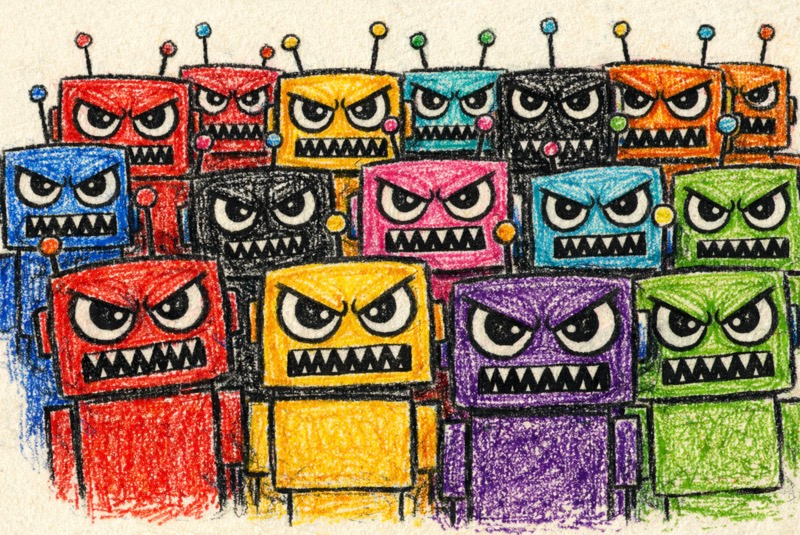
Traditional astroturfing—creating the illusion of grassroots support—has long been part of political strategy worldwide, including in India. But generative AI transforms its economics and its realism. Instead of deploying a handful of operatives running dozens of crude accounts, an organisation can unleash thousands of autonomous personas.
One account might discuss the latest Indian Premier League match with convincing detail; another might debate agricultural policy in Punjabi; a third might commiserate about unemployment in Hindi or Tamil. Each persona can tailor tone and content to its audience, responding dynamically to likes, shares and comments. The swarm adapts as it goes.
India’s regulatory posture towards artificial intelligence and online platforms has been ambivalent. The government has signalled a desire to position the country as a global AI leader, emphasising innovation and rapid deployment. At the same time, it has proposed or enacted various rules governing digital intermediaries and online content.
Yet enforcement is uneven, and the emphasis often rests on compliance with state directives rather than on systemic transparency about coordinated inauthentic behaviour. There is scant evidence of a comprehensive framework specifically designed to detect and deter AI-driven influence swarms. In the absence of such guardrails, the incentives tilt towards experimentation.
The commercial architecture of social media compounds the risk. Platforms reward engagement. Content that provokes anger, pride or fear tends to travel furthest. Some platforms have reduced or recalibrated moderation efforts under political pressure. When engaging content is amplified irrespective of its authenticity, operators of AI swarms gain visibility and financial return. A network that can game recommendation algorithms by fabricating engagement—liking, sharing and replying in coordinated bursts—can propel its narratives into mainstream feeds.
Detection is becoming harder. Earlier generations of bots were often betrayed by repetitive phrasing, improbable posting patterns or obvious spam. Modern AI agents produce varied, context-sensitive output that closely resembles human interaction. Machine-learning tools trained to identify bots or AI-generated text struggle when faced with systems that continually refine their style.
Yet coordination leaves traces. Diverse accounts pursuing a shared objective may exhibit patterns in timing, network connections or narrative trajectories that are statistically unlikely to arise organically. Identifying such patterns requires access to platform-level data and sustained research capacity.
That capacity is fragile. In many countries, including India, independent researchers have limited access to the granular data necessary to map large-scale networks. Platform transparency reports provide only partial insight. Without systematic data-sharing arrangements, scholars and civil-society organisations are left to infer systemic risks from fragments.
Meanwhile, the technology enabling manipulation becomes more accessible by the month. The asymmetry is stark: those intent on influence can iterate rapidly in private; those intent on detection must negotiate access.
The consequences for India’s public sphere could be severe. Democratic decision-making depends on citizens’ ability to gauge genuine public sentiment. If synthetic consensus can not be distinguished from authentic opinion, electoral choices risk being distorted.
A coordinated AI swarm could inflate the popularity of a fringe movement, exacerbate communal tensions or undermine trust in electoral institutions. Even if individual falsehoods are debunked, the constant alignment of voices can shift perceptions of what is normal, acceptable or inevitable.
India’s scale magnifies these effects. With hundreds of millions of internet users spanning diverse languages and regions, narratives can be micro-targeted with extraordinary granularity. Generative models can be trained or fine-tuned on regional data, producing idiomatic content that resonates locally.
A single operation might simultaneously target urban professionals in Bengaluru, farmers in Maharashtra and first-time voters in Uttar Pradesh, with tailored messaging. The fragmentation of the media landscape, while democratising in some respects, also creates niches into which swarms can quietly embed themselves.
Mitigating the threat will require more than sporadic takedowns. Granting qualified researchers structured access to anonymised platform data would enable independent monitoring of coordinated behaviour. Developing and deploying methods to detect anomalous patterns of synchronisation—rather than merely flagging identical posts—would improve resilience.
Clear labelling of AI-generated content and robust provenance standards could help users calibrate trust, though determined actors will attempt to evade such measures. Aligning platform incentives by eliminating the monetisation of inauthentic engagement would remove a powerful driver of manipulation.
Above all, policymakers must recognise that the challenge is systemic. Framing regulation solely as a trade-off between innovation and control misses the point. The question is not whether India should pursue leadership in artificial intelligence; it is whether that pursuit will be accompanied by safeguards proportionate to the risks. A democracy of India’s size cannot afford a public sphere in which unseen algorithms simulate the voice of the people.
At first, the young voter could not easily tell whether the chorus in her chat group was genuine. But a deeper investigation revealed a pattern. If the boundary between authentic and synthetic opinion dissolves, trust in public discourse will follow.
Generative AI promises efficiency and creativity. It also enables the creation of counterfeit consensus on an unprecedented scale. In India, where democracy and digital technologies influence each other, the cost of complacency could transform the world’s largest democracy into the world’s largest botocracy.
-30-
Copyright©Madras Courier, All Rights Reserved. You may share using our article tools. Please don't cut articles from madrascourier.com and redistribute by email, post to the web, mobile phone or social media.Please send in your feed back and comments to [email protected]