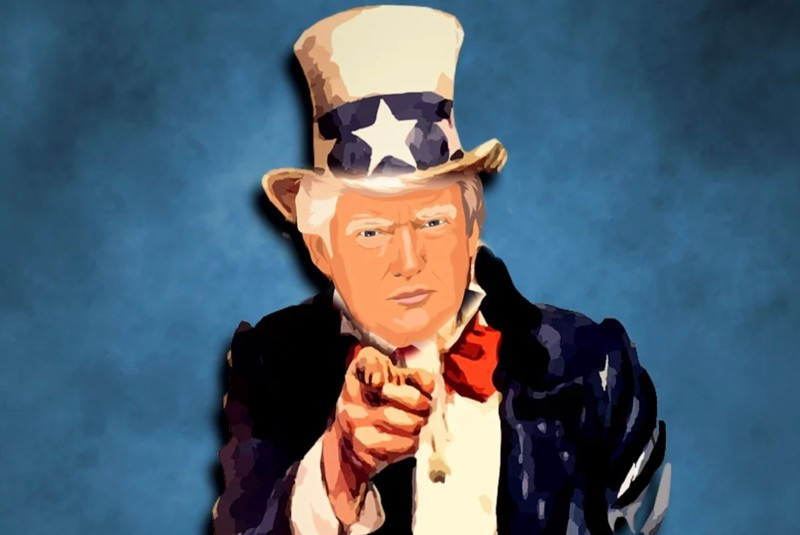
The world owes Donald Trump a note of gratitude. For years, global leaders indulged the fiction that they were partners in a noble alliance system, co-authors of a rules-based international order, respected adults at the table of history.
Trump, with his gift for demagoguery, has performed a public service by stripping away the euphemisms. He has reminded Canada, Europe, India, and a host of other so-called “middle powers” that they were not “allies” so much as vassals, competing anxiously to be the most agreeable subordinate in an empire that preferred the term “leadership” to “domination.” If humiliation is clarifying, Trump has been a great educator.
For decades, this arrangement worked because it was comfortable. Countries that deferred to Washington told themselves that submission was really cooperation, that obedience was really shared values. They supported American interventions, sanctions regimes, trade wars, and covert destabilisations with the serene confidence that the blowback would land somewhere else.
When economies were wrecked, it was always another region that suffered. The hegemon, they assumed, would never turn its tools inward on the obedient. Trump’s singular achievement has been to demonstrate how stupid that assumption was.
Once the tariffs, threats, and transactional ultimatums began landing on “allies” rather than adversaries, the mood shifted. Suddenly, words like “resilience,” “strategic autonomy,” and even “resistance” crept into diplomatic conversation.
The shock was not that American power could be coercive—this was obvious to anyone outside the charmed circle—but that it could be applied without apology to those who had spent decades applauding it. Trump did not invent American dominance; he removed its velvet glove.
Nowhere was this more grotesquely theatrical than at the 2026 World Economic Forum in Davos, an event that prides itself on sober technocratic gravitas and delivers little more than pompous platitudes. Trump arrived like a mafia boss, and promptly turned the summit into a geopolitical jamboree.
He recommitted, with characteristic crassness, to the idea that the United States should acquire Greenland. Do not partner with it or guarantee its security, but own it. The justification was less strategy than instinct: if America didn’t take it, Russia or China would, as though sovereign peoples were unclaimed lots in a global game of Monopoly.
This was offered not as satire but as policy. Trump assured the audience that force was not his first choice. But he maintained that American ownership of 2.1 million square kilometres of Arctic territory, inhabited by fewer than sixty thousand people, was not only reasonable but urgent.
Denmark and Greenland have said for years that the island is not for sale and that its future belongs to its inhabitants. A Greenland politician also tried to explain it in a language that Trump understands: “Mr President, Fuck Off.” But this detail barely registered. In Trump’s worldview, sovereignty is negotiable if the square footage is tempting enough.
The spectacle was revealing. It was hard not to notice the colonial echo: a powerful country deciding that a smaller, strategically located place would be better off under its ownership. The only novelty was the candour. Trump said aloud what the empire usually mutters behind closed doors.
The contrast could not have been sharper. Mark Carney, Canada’s Prime Minister, delivered what may go down as one of the bluntest diagnoses of the post–Cold War order ever uttered from a Davos stage. The “rules-based international order,” he said, is not merely fraying; it is largely fictitious, a story that made American dominance palatable and everyone else complacent. Middle powers, Carney warned, face a simple reality: “if they are not at the table, they are on the menu.”
What made Carney’s rhetoric so shocking was not its content—many diplomats privately agree—but its plainness. He described bilateral negotiations with a hegemon as “the performance of sovereignty while accepting subordination.”
For years, countries had acted as though institutions and norms could restrain raw power. For a while, this faith was rewarded. But as Carney noted, that world is gone, and it is not coming back through nostalgia.
The audience—European ministers and corporate executives considered masters of the universe in better decades—looked on as the implications settled. Trump had just argued that Greenland should be American because America wanted it. Carney was explaining that this logic was not an aberration but the system, now finally unvarnished.
Economic integration, once sold as a pill for mutual enrichment, has become a mechanism of punishment. Supply chains, tariffs, and financial access are no longer neutral tools; they are levers, pulled to reward obedience and punish deviation.
Europe, in particular, was forced into an uncomfortable self-recognition. For years, Brussels has spoken earnestly of “strategic autonomy” while doubling down on NATO dependence and U.S. military guarantees. This was never autonomy; it was submission.
The continent outsourced hard power to Washington and convinced itself that procedural influence counted as leverage. It took an American president casually musing about absorbing Danish territory for this illusion to crack. The comedy lay in how obvious it all suddenly seemed.
The United Kingdom’s predicament is even more pitiable. Having exited the European Union in pursuit of a swashbuckling “Global Britain,” it now finds itself clinging ever tighter to Washington, mistaking proximity for influence. Manufacturing has declined, diplomatic weight has thinned, and strategic imagination appears to have narrowed to hoping the White House remains in a good mood. Once an empire, now a vassal.
Nor is this dynamic confined to the Atlantic world. India, often celebrated as a rising power, has shown similar susceptibility to Washington’s gravitational pull. When Prime Minister Narendra Modi echoed Trump’s campaign slogan—“Ab ki baar, Trump Sarkar”—it was less a diplomatic manoeuvre than a flirtation with celebrity power. The gesture was striking precisely because it blurred the line between strategic alignment and personal brand endorsement, suggesting a misreading of American politics as something to be courted rather than managed.
This is the trap Carney identified: confusing access with agency, deference with influence. Middle powers told themselves that closeness to Washington grants leverage, when in fact it often signals dispensability. Negotiating from a position of weakness while insisting you are “negotiating” at all is a comforting illusion, right up until the terms are dictated.
Seen in this light, the Greenland episode is not an outlier but a symptom. Trump’s threatening rhetoric belongs to an imperial tradition, one that assumes that might is right. Greenlandic and Danish leaders have been unequivocal that their autonomy is non-negotiable. That this has barely slowed the conversation says more about the speaker than the subject.
Trump’s broader Davos performance—laced with tariff threats, NATO ultimatums, and boasts of American primacy—had less to do with collective security than with Trump’s ego. It was politics as dominance display. Carney’s speech, by contrast, was an appeal to realism, grounded in economics and history. Together, they formed an accidental duet: one articulating power as impulse, the other diagnosing its consequences.
Ironically, Trump’s approach accelerates the decline he claims to resist. By treating allies as assets and agreements as inconveniences, he forces other countries to reconsider the wisdom of reliance on an unpredictable hegemon. Europe, Canada, and even India are nudged—pushed, really—towards diversification, not out of idealism but out of necessity.
In this sense, Trump will be remembered as an unwitting catalyst. Not a strategist, but a stress test. By pushing the logic of American dominance to its blunt conclusion, he has made denial impossible. The world is not governed by shared rules so much as by tolerated asymmetries. Consent was always part of the bargain, and that consent is fraying.
This awakening is not the product of enlightened multilateralism. It has arrived courtesy of a president who talks about foreign territory the way developers talk about waterfront views. It is crude, vulgar, destabilising, and deeply uncomfortable. But it also offers clarity.
In the end, this is not really about Greenland, or even about Trump. It is about an international system that functioned because most participants agreed not to openly acknowledge that they were subordinates, mere vassals. One “superpower” set the terms; everyone else smiled, nodded, and called it a partnership. Mark Carney named that reality. And the rest of the world, having spent decades perfecting the art of acquiescence, is finally confronting the price of its long, willing subordination.
-30-
Copyright©Madras Courier, All Rights Reserved. You may share using our article tools. Please don't cut articles from madrascourier.com and redistribute by email, post to the web, mobile phone or social media.Please send in your feed back and comments to [email protected]