
In the half-light of late afternoon, as the amber hue of the sun flattens itself against the edge of the horizon, a certain stillness overtakes the air. It is a moment that feels remarkably like Shakespeare’s Summer’s Day, a moment that teases out a paradox: a day of such undeniable beauty that, in its very finitude, it begins to suggest the permanence of a love greater than any fleeting season.
Shakespeare’s sonnet, the quintessential meditation on beauty and mortality, promises a kind of immortality for its subject. And yet, as he reaches the final couplet, his words seem to carry the weight of an entire legacy, a vision of human achievement reaching out toward eternity.
This sonnet, written somewhere in the late sixteenth century, not only embodies the vibrancy of its moment but also echoes across centuries to shape our understanding of poetic form. It is part of the vast tradition of the sonnet—a form that has bent and reshaped itself countless times over the years, defying expectations, unearthing contradictions.
Paul Oppenheimer, in his reflections on the sonnet, notes that the sonnet is “highly dialectical,” offering a problem and resolving it, an argument that works itself through both structure and sound. Shakespeare himself, in his dazzling lyricism, is solving something profound: the question of how beauty, which seems so impermanent, might endure. The sonnet’s fourteenth line, “So long lives this, and this gives life to thee,” suggests that language itself, when wielded with sufficient artifice, has the power to transcend time and death.
Yet, in a way, Shakespeare was part of a much longer history, an evolution of sorts, wherein poets of every nationality and culture would embrace the sonnet form, creating their own versions, testing its boundaries. Ed Simon, writing about the origins of the sonnet, traces the form’s development from its Italian roots to its various mutations.
The sonnet is a form that, in its strictness, offers a remarkable degree of freedom—a paradoxical flexibility that has allowed it to thrive across languages and time periods. From the Italian Petrarchan sonnet to the English Shakespearean variant, it is a form that has been “reinvented and remade,” according to Simon, each time it passes from one poet to another, across national boundaries and cultural contexts.
The question of who can lay claim to the invention of the sonnet is itself a complex one. While Francesco Petrarch is often credited with its creation, his role is not entirely unchallenged. It is true that Petrarch did much to refine and popularise the sonnet, but scholars like Earnest Hatch Wilkins have suggested that the form may have been invented earlier by Giacomo da Lentini, a member of the Sicilian School of poetry.
Wilkins, in his 1915 essay, “The Invention of Sonnet,” contends that the earliest sonnets can be traced to Lentini, whose work would eventually influence poets across Europe. Oppenheimer concurs, noting that Lentini’s poems did not directly borrow from the French troubadours or the Provencal traditions, but from an entirely different Sicilian tradition, one that was distinctly local.
Lentini’s influence, according to Wilkins, cannot be overstated. In fact, the sonnet as we know it today may have been shaped less by a singular poet than by a confluence of creative energies, stretching from Sicily to the courts of the Holy Roman Empire, and, eventually, to the literary capitals of Europe.
But the story of the sonnet’s evolution doesn’t end in the West. In India, under British colonial rule, the sonnet would take root in an entirely different soil, one where the very notion of imitation, adaptation, and cultural exchange was fraught with complexity.
During the British Raj, many Indians began to see English as a means to advancement, a vehicle for achieving status within the colonial framework. English poetry, with its rigid forms and refined language, was particularly attractive to those seeking to prove their intellectual and cultural worth.
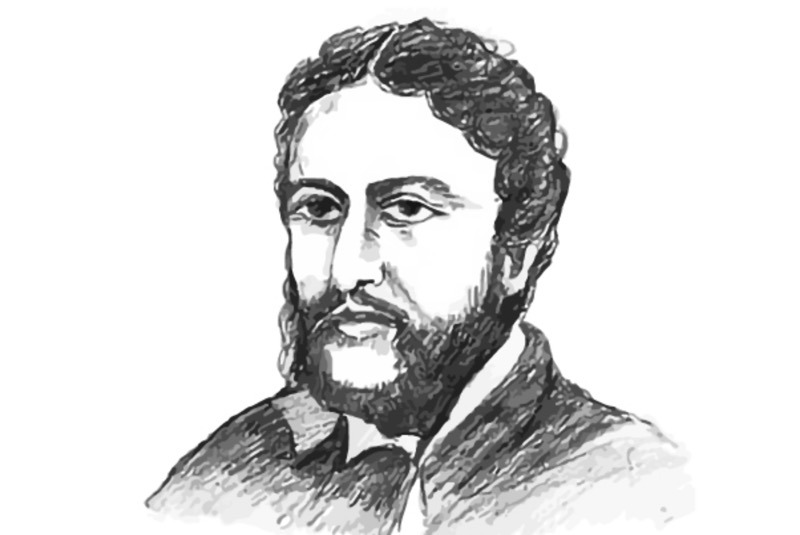
Among these was Michael Madhusudan Dutta, a young man from a wealthy Bengali family who, much like the poets before him, became an enthusiastic devotee of English literature. His father, Rajnarayan Dutta, had hoped that his son would enter the ranks of the colonial bureaucracy, perhaps becoming a barrister. To that end, Madhusudan studied at the Hindu College in Calcutta, where he encountered the works of Shakespeare, Byron, and other English poets.
It was there, amid his education in the English literary canon, that Madhusudan Dutta began experimenting with the sonnet form, despite his growing estrangement from traditional Bengali culture. It is often said that he found the rigid structures of English poetry particularly liberating—allowing him to channel his feelings of alienation into verse.
Dutta’s first Bengali sonnet, “Kapotakkhyo Nodi” or “The Kapatakkha River,” was a remarkable innovation. It married the strict form of the English sonnet with the melancholic and lyrical qualities of Bengali poetry, thus marking a significant moment in the history of literature.
In his sonnet, Dutta invokes the river as a personal and national symbol, expressing the longing for a home he could never fully return to. The river becomes a kind of intimate companion, its flowing waters mirroring the emotions he cannot express:
Always, o river, you peep in my mind. / Always I think you in this loneliness.
The river, both local and universal, is transformed into a metaphor for displacement, a constant reminder of home, even as it carries the poet’s name into the wider world, into the ear of Bengal. The river’s journey becomes symbolic of Dutta’s own path, as he charts his course between the entrenched traditions of his homeland and the foreign influence of English colonialism. In this sense, the sonnet becomes not merely a poetic form but a battleground of cultural exchange, a site where old worlds collide with new ones.
Dutta’s embrace of the sonnet form is an early example of how literary traditions cross-pollinate, even in the most unlikely places. With its highly structured, almost mathematical precision, the sonnet becomes a space for expressing the most personal of emotions—an irony that has existed since the form’s inception.
Whether in Italy, where it was shaped by the Petrarchans, in England, where it took on a distinctly Elizabethan hue, or in Bengal, where it was reborn as a symbol of both colonial resistance and cultural fusion, the sonnet, paradoxically, holds a kind of universality that transcends time and space. It is, in essence, a form that says, “Even as the world changes around us, these words will endure.”
And so, from Shakespeare’s immortal “eternal lines” to Dutta’s river that “sings his name,” the sonnet stretches across time, speaking of the very things that make us human: love, loss, identity, and the longing for continuity in the face of inevitable change.
The poet who chooses to write in a sonnet is, in a sense, committing to a dialogue that spans centuries—speaking both to the moment and to the eternal. It is a commitment to speak the language of beauty and loss, to capture fleeting moments in a form that resists time, even as it acknowledges that time itself is the very thing that makes those moments precious.
The sonnet, it turns out, is not just a form; it is a vehicle for immortality—a way to say, like Shakespeare before us, that love, in all its forms, will endure, even when the summer day is over.
-30-
Copyright©Madras Courier, All Rights Reserved. You may share using our article tools. Please don't cut articles from madrascourier.com and redistribute by email, post to the web, mobile phone or social media.Please send in your feed back and comments to [email protected]