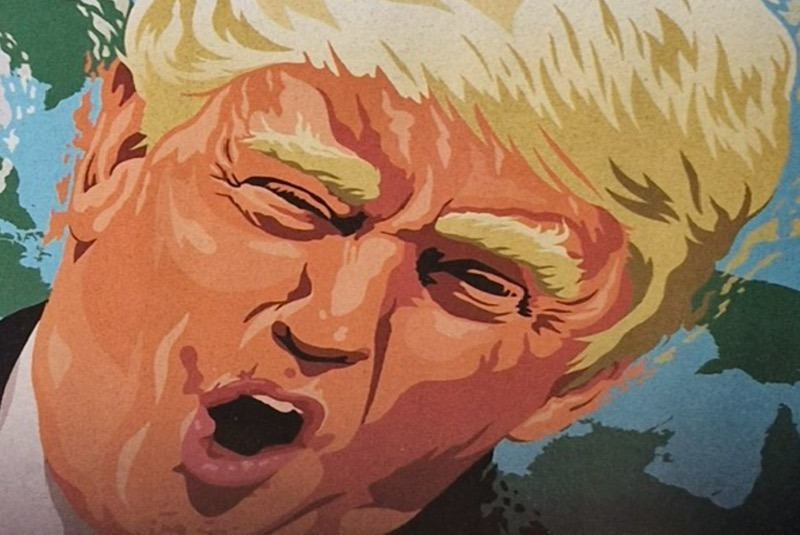
To Trump, or not to Trump: that is the cacophony. The Bard’s Juliet famously queried what’s in a name, but she never had to scroll through Truth Social. The noun “trump” is a veritable Russian nesting doll of meanings. It signifies a card that is superior to all others, something he has embodied with the subtlety of a golden sledgehammer. To trump is to achieve victory, to outclass one’s rivals, a verb he performs with the linguistic panache of a maestro, his vocabulary a curious patchwork of “bigly,” “covfefe,” and apocalyptic superlatives, making him the Jackson Pollock of political discourse. And yes, archaically, a trump can be a helpful person; one must admit he has been enormously helpful to late-night comedians, cable news bookers, and the global lexicon of satire. The world has watched in awe as this one person has repeatedly decided to brandish the entire deck as a weapon, a prop, and a proof of life, instead of just playing the cards that were given to him.
He has fashioned a new political lexicon, one part casual braggadocio, one part street-corner insult, and wholly lethal in its impact. This is not the carefully worded legalese of the politician, nor the misleading silk of the diplomat. It is a language of pure, unfiltered id, a linguistic cannonball that dispenses with duality in favour of a glorious, often terrifying, unambiguousness. His anger is deployed with the theatrical flair of a WWE heel, treating global geopolitics, White House correspondents’ dinners, and obituary speeches for allies with the same casual, pugilistic passion. He speaks of tariffs and tragedies with the same pitch he uses to review a cable news host’s ratings or feud with a celebrity; it is all one sprawling, chaotic season of The Apprentice, and the world is his unwilling boardroom.
Much like Volodymyr Zelensky’s iconic olive-green attire, a sartorial middle finger to stuffy formality that announced, “We are at war, and your suit and tie are irrelevant”, Trump’s linguistic dress code is a purposeful, premeditated informality. Whether addressing the UN General Assembly or honouring an ally like the assassinated Charlie Kirk, the rhetoric remains unrelentingly consistent: the world is full of “haters and losers,” accomplishments are “the greatest,” and criticisms are “witch hunts.” His casual treatment of other leaders, nicknaming, interrupting, and gloating over them, is not a misstep; it’s the entire point. It essentially redefines what power can sound like, and it is the verbal equivalent of wearing a red cap and golf shirt to a black-tie gala. The mark is made not in spite of the chaos, but because of it.
In a perverse way, this very lexicon undermines the traditional lexicon used by the political elite. When held against the political lexicon of his predecessors, Trump’s verbal sandblasting reveals an almost brutalist honesty. The Presidents before him, the Ciceronian elegance of an Obama, the folksy, mispronounced resolve of a Bush, the saxophone-cool empathy of a Clinton, were all maestros of a certain art: the art of making macabre politics beautiful. They gilded the machinery of dominance with rhetorical filigree, made loot sound like liberation, and delivered strikes with the poetic cadence of a eulogy. Their language was a soft-focus filter on the hard edges of power.
In comparison, Trump is the political equivalent of an unscripted, brutally honest confession cam from a reality show. He tears the filter off. He portrays the business of empire as a dirty, transactional street fight rather than as a noble burden. His ugliness is an ostentatious, neon-lit candour, not a deception. And in this way, his lexicon holds up a cracked mirror to a segment of the modern American psyche. It reflects a social mindset jangled by niceties, furious with the constraints of political correctness, and leaning with a thrilling, terrifying recklessness into the id. It is the language of a nation that, for a moment, decided it was sick of the elegantly wrapped empty box and opted instead for the loudly, proudly shouting one.
This linguistic disjunction is, of course, merely the vocal cords of a temperament that is fundamentally, and often spectacularly, incongruous with the office it holds. He presides not as a public servant, but as an elected boss, a CEO-President who sees the vast, disorganised democratic machinery as a badly run subsidiary in need of a hostile takeover. His ideal constituency is not a citizenry of critical thinkers, but a base of loyalists whose admiration mirrors the performative, absolute submission demanded by a Kim Jong-un, albeit with more red caps and fewer military parades. This was never more chillingly illustrated than in his recent sinister speech to military generals, where the Commander-in-Chief role seemed to morph into that of a Mob boss, suggesting they should be physically intimidating, ready to stomp on American cities, and owe their primary allegiance not to the Constitution, but to his personal will. Rules, norms, and decorum are not guiding principles but pesky speed bumps on his highway of self-expression, to be ignored, dismantled, or run over. And therein lies the dark, paradoxical allure: after decades of what his supporters see as the cunning of democratic politics, the polished smiles masking calculated moves, this brash, inward-out authenticity, for all its terrifying implications, feels like a jolt of adrenaline to a system many believe has been on life support. America, in a fit of pique against the established order, seems perennially tempted to press the button for the man who promises to break it, even if he has to use the country itself as his hammer.
And what drives this extraordinary political force? A staggering imperviousness to the unknown. Trump negotiates the confusing world of global affairs with the unshakable confidence of a teenager who has just discovered a talking point on a meme page, armed not with briefings but with gut feelings and a conviction that the world’s leaders exist by his divine, if mercurial, mercy. He is unsure if he has truly succeeded in making America “great again”, a vague yet powerful slogan, but he has certainly succeeded in one unintended, yet glaringly obvious, diplomatic mission: holding a mirror to the nation’s id and showing the world the unrestrained, swaggering bully that has long been suspected beneath the veneer of liberal internationalism. The doctrine of the “adult in the room” has been replaced by the spirit of the brawler in the bar. While great powers have historically played the reluctant referee, using their heft to prevent smaller conflicts from spiralling, Trump’s approach is less peacemaker and more pyromaniac fireman, one who proudly claims to have stopped blazes, all while gleefully dousing the flames in gasoline. The world watches, aghast and mesmerised, as the arsenal of democracy is retrofitted with an X (Twitter) account and a new attitude.
At the heart of this political phenomenon lies the man’s own origin story, not as a public servant, but as a mogul from the shaded, funhouse-mirror world of New York real estate and reality television. This is the crucial substratum of his presidential behaviour. He is a product of a realm where hyperbole is the native tongue, bankruptcy is a strategic tool rather than a failure, and truth is a negotiable asset, subservient to the brand. It is, therefore, both utterly predictable and yet profoundly astonishing that the electorate, after being serenaded with a campaign symphony of fire, misinformation, and reckless adjectives, would choose to install this particular maestro in the Oval Office. One is left to ponder the collective curiosity, or perhaps the calculated despair, that leads a nation to hire a man whose primary qualifications were a catchphrase and a proven capacity for theatrical conflict, then express shock when he proceeds to run the country not like a nation, but like one of his famously litigious and debt-leveraged casinos. The boardroom buccaneer had finally been given the keys to the Situation Room, and the situation was about to get very, very situational.
Long after the final tweet has faded from the server and the red caps have faded in the sun, the legacy of Donald J. Trump will likely undergo a peculiar alchemy. His policies will be analysed by historians, his administration a Rorschach test for the nation’s divisions. But his immortality will be secured not in the sober annals of statecraft, but in the garish, relentless reel of popular culture. He will be remembered as the first President who was also a prime-time character, a maestro of tantrums and comedian’s antics, a showman who treated the global stage as his personal vaudeville hall. Future generations will scroll past him in digital archives with a chuckle or a gasp, a figure so larger-than-life he resists serious contemplation and instead becomes a meme, a punchline, a cautionary tale wrapped in a reality show. The man will leave, but the character, in all its gaudy, unforgettable infamy, will never die. Trump, the brand, will continue to haunt the American psyche, a testament to the day the circus decided it no longer needed a ringmaster, just a star.
-30-
Copyright©Madras Courier, All Rights Reserved. You may share using our article tools. Please don't cut articles from madrascourier.com and redistribute by email, post to the web, mobile phone or social media.Please send in your feed back and comments to [email protected]