
Human activity has long been the driver of climate change. However, the environmental repercussions of industrialisation and agricultural expansion extend beyond global warming. They pose a direct threat to wildlife.
Birds are among the most vulnerable. Every year, thousands of species are classified as critically endangered or extinct. One such bird is the Bengal Florican, a species so rare that it has earned a place on the International Union for Conservation of Nature’s (IUCN) Red List as “critically endangered.”
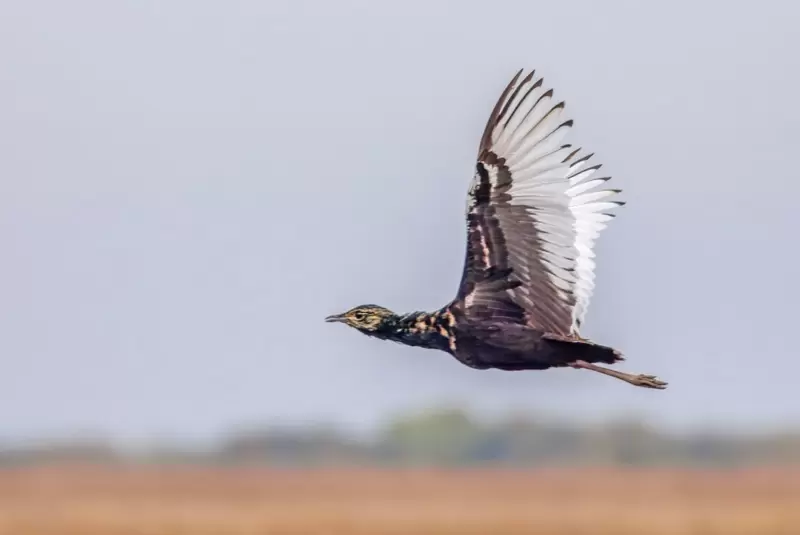
The Bengal Florican, or the Bengal Bustard, is a striking bird, recognisable by its large, stout body and long neck. These birds are native to the grasslands of India, Nepal, and Cambodia, with populations found in parts of Vietnam.
They inhabit open landscapes such as grasslands, wetlands, agricultural fields, and shrubby regions. The birds are classified as grassland bustards because they prefer lowland areas during their mating season.
In recent years, their population has plummeted; fewer than 1,300 Bengal Floricans remain worldwide. In India, the numbers are even more alarming, with estimates suggesting only 350 to 400 individuals survive.
Historically, the grasslands were a perfect habitat for the Bengal Florican. The region’s rich biodiversity provided the birds with an abundance of food: grasshoppers, beetles, ants, small snakes, and lizards. Yet the rapid expansion of agriculture and industry has encroached on these habitats.
Wetlands, once abundant in the areas where these birds thrived, have been drained to make way for farming. As the land has transformed into cultivable fields, the very environment the Bengal Florican depends on has disappeared.
The threats to the Bengal Florican are many. In countries like India, Nepal, and Cambodia, agriculture remains the backbone of the economy, providing livelihoods for millions. However, the widespread use of land for cultivation has brought human presence into constant proximity with the birds.
This intrusion is especially damaging during the breeding season. As humans and livestock graze nearby, the birds become highly disturbed, often abandoning nests or failing to reproduce successfully.
In Cambodia, commercial rice cultivation during the dry season has compounded this problem. The encroachment on Bengal Florican breeding areas has intensified in recent years, particularly as the cultivation period coincides with the bird’s critical breeding period.
“Dry season rice cultivation increasingly encroaches on Bengal Florican breeding areas, disturbing the birds during key breeding periods,” said Harriet Ibbett, a researcher from Imperial College London, who has studied the effects of agricultural practices on these birds.
In Cambodia, the overlap between rice fields and Bengal Florican habitat is significant. Over 20 per cent of dry-season rice cultivation areas coincide with protected Florican territories, further diminishing the space available for the birds to breed undisturbed. The conversion of grasslands into farmlands has thus drastically reduced the bird’s chances of successful reproduction, a situation compounded by the ever-increasing demand for agricultural land.
In addition to human-induced threats, the Bengal Florican faces dangers from modern infrastructure. The bird’s flight patterns, which often involve soaring at low altitudes, put them at risk of colliding with power lines. Such collisions are common among bustard species that inhabit areas with high tension power lines or supply lines. These accidents further exacerbate the risks to their dwindling numbers.
Despite the growing awareness of these threats, it remains uncertain whether conservation efforts will be enough to save the Bengal Florican from extinction. In India, the birds are found in several protected areas such as Manas National Park, Kaziranga National Park, and the Baruchapori Wildlife Sanctuary in Assam, as well as in the Jaldapara and Gorumara Wildlife Sanctuaries of West Bengal.
These protected zones offer a measure of safety for the birds, but they can only go so far in ensuring the species’ long-term survival. Conservation efforts are also bolstered by the involvement of local communities, who are educated and trained by non-governmental organisations (NGOs) to understand the ecological value of preserving these birds.
Through community-driven conservation initiatives, locals can engage in bird tourism—an increasingly popular activity that helps raise awareness while providing economic opportunities. In Kokabari, a region known for its bird-watching tourism, local people work as guides for tourists, creating a sense of shared responsibility between the local population and conservationists.
Yet while such initiatives are encouraging, they are still not enough to reverse the Florican’s decline. The primary obstacle to more effective conservation is the lack of research. The Bengal Florican is a solitary bird, well-camouflaged in its natural habitat, making it difficult to study.
Its preferred landscapes, such as the floodplains of the Ganga and the Brahmaputra delta, are vast and challenging to navigate. Floricans are often hard to track, especially during their non-breeding seasons when they move across fragmented territories.
A study conducted from 2013 to 2016, which used satellite transmitters to monitor the birds’ movements, revealed that Bengal Floricans tend to avoid highly populated areas, migrating instead to agricultural regions with low human density. The distribution of the bird is highly fragmented, and there are fewer suitable habitats left for the species to occupy.
As the situation stands, the conservation of the Bengal Florican is interwoven with the preservation of grassland ecosystems. Grasslands are vital not only for the Florican’s survival but also for the entire ecological web of which they are a part.
By protecting the Bengal Florican, we are also safeguarding these rapidly disappearing ecosystems. Governments in India, Cambodia, and Nepal have collaborated on conservation projects, but such initiatives will need to expand, both in scope and funding, to have a real impact. The challenge is not merely to protect the Bengal Florican, but to ensure its survival does not come at the expense of broader agricultural and industrial development.
In the face of such challenges, one must wonder if these collaborative efforts will be enough to stave off the decline of the Bengal Florican. Time is running out, and while local conservation projects provide a glimmer of hope, they are no substitute for larger, systemic changes in land use practices, agricultural policies, and the prevention of habitat destruction.
The Bengal Florican’s fate is a stark reminder of the consequences of unchecked human expansion on the natural world. Its decline mirrors that of countless other species threatened by habitat loss, climate change, and human interference. Whether or not conservation will succeed in saving the Bengal Florican may ultimately come down to whether the global community can learn to balance the needs of nature with those of human progress.
-30-
Copyright©Madras Courier, All Rights Reserved. You may share using our article tools. Please don't cut articles from madrascourier.com and redistribute by email, post to the web, mobile phone or social media.Please send in your feed back and comments to [email protected]