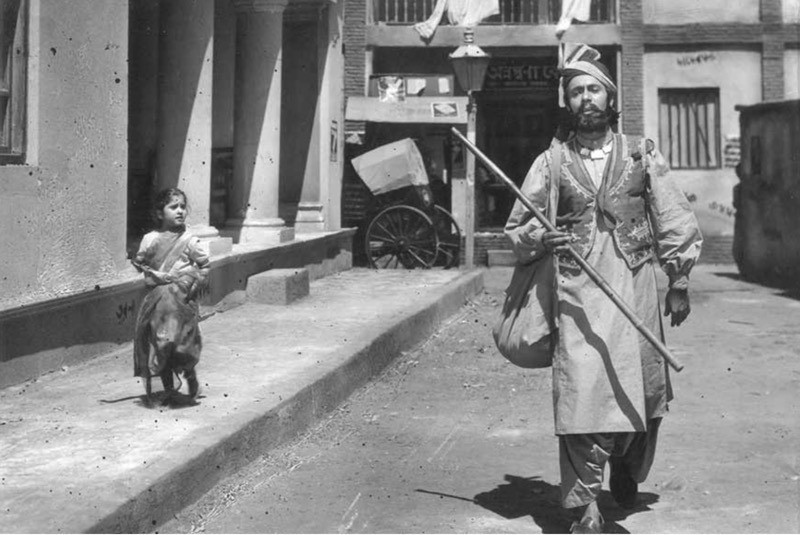
Rabindranath Tagore’s short story “Kabuliwala,” written in 1892, presents a poignant and heart-wrenching portrayal of the bond between a Kabul-born merchant and a young Kolkata girl, Mini. The etymological roots of the term “Kabuliwala” lie in the ethnic heritage of the immigrants themselves—Pathans from Kabul—who made their way to India, particularly Kolkata, driven by the opportunities offered by colonial commerce.
Tagore’s story, steeped in the complexities of human connection, invites us to picture these tall, burly figures wandering the crowded streets of Kolkata, peddling their wares of cashews, pistachios, and walnuts. But behind the simple act of selling dry fruits was a deeper story of migration, alienation, and, most importantly, identity.
Even before the 1947 partition carved India into two nations, traders from Afghanistan had begun making their way to the subcontinent, seeking fortune in the bustling markets of colonial India. Kolkata, as the capital of British India, presented a lucrative arena for these merchants.
From carpets and attar to dry fruits, they would roam from door to door, peddling their goods with an enduring resilience. Yet, while it is widely assumed that these traders hailed from Afghanistan, they were, in fact, largely from the region known as Pashtunistan, a cultural and ethnic territory divided between modern-day Afghanistan and Pakistan. For these traders, Kolkata was not just a stop on a business journey but, in many cases, a new home—an accidental homeland forged through trade, perseverance, and survival.
As Tagore’s Kabuliwala reflects, many of these Afghan traders, who left their families behind, had no immediate means of staying in touch. In the early twentieth century, there were few options for communication; telephones were expensive luxuries that only the affluent could afford, and letters took weeks, sometimes months, to reach their destination.
For the average Kabuliwala, the severance from their home was absolute. There was a profound emotional distance, punctuated by only fleeting memories and the hope that one day they would return to their native lands. Tagore’s portrayal of Rahamat, the Kabuliwala, underscores this tragic disconnection. In his relationship with Mini, Rahamat is reminded of his own daughter back in Kabul, a stark reminder of what has been lost.
Many of the early Kabuliwalas in Kolkata were businessmen who could afford to travel frequently between India and Afghanistan. But for most, the journey was far less comfortable. Travelling in groups, often on horseback and as nomads, they moved from town to town in search of opportunity, hoping to find a place where they could earn a living.
Eventually, a large number of these traders settled in Kolkata, finding not just a market for their goods but a sense of belonging. Many of them married local Muslim women, integrating themselves into the fabric of the city and establishing families. Today, their descendants, some fourth or fifth-generation Kolkata-born, continue to live in the city, maintaining a tenuous yet undeniable connection to a homeland they may never have seen but still revere.
Amidst the chaos and clamour of modern-day Kolkata, it is easy to overlook the quiet resilience of the Afghan community that has made this city their home. One would be surprised, however, to find that many of them have managed to preserve their traditional customs with remarkable fidelity.
Their homes, though nestled in the urban sprawl of Kolkata, are distinctly Afghan in character. Carpeted floors, cushions for seating, and elaborate meal settings evoke the cultural warmth and hospitality of their homeland, a stark contrast to the bustling streets outside.
Even after more than a century of living away from their ancestral land, they continue to adhere to practices and customs passed down from generation to generation. It is a testament to their enduring pride in their cultural identity.
Today, most of the Afghan community in Kolkata is composed of small businessmen. Whether in Burrabazar, a commercial hub of the city, or Park Circus, their shops and eateries are a familiar part of the city’s landscape. There are around 5,000 Afghan families living in the city today, each contributing to the cultural diversity that defines Kolkata.
They have maintained their sense of brotherhood not only with their fellow Afghans but also with the broader Kolkata community. Their relationships with other groups in the city are characterised by mutual respect and cordiality, and a deep sense of belonging prevails, recognising that, despite their foreign roots, this city is home.
The Kabuliwalas of Kolkata continue to hold onto cherished heirlooms, such as traditional jewellery or garments passed down through generations. Sultan Khan, a man from this community, still keeps his mother’s traditional attire from Afghanistan, a silent reminder of his ancestral past. These small objects represent much more than familial affection; they symbolise a long-held connection to a land that remains, for many, only a memory.
Kolkata, the City of Joy, is a mosaic of immigrant communities, each contributing its unique cultural traditions. The Afghan community is no different. In addition to their businesses, they have maintained strong ties to their customs. Moreover, the Afghan influence on Kolkata’s culinary scene is undeniable. Eateries serving pukhtay, a traditional Pashtun dish, and naray ghwakha, a spiced snack, have become popular with locals and visitors alike.
Though many of the older generation of Kabuliwalas in Kolkata were born in India, some of them lack the documentation that would prove their citizenship. Yet, Kolkata has a peculiar way of accepting these displaced individuals.
When their time comes, the city ensures that they have a place to rest, with a six-foot plot in the graveyard marking their final resting place. This final gesture is emblematic of the city’s embrace of its diverse inhabitants, a city that has always been a crossroads of cultures, identities, and histories.
The Kabuliwalas of Kolkata are an embodiment of India’s cultural diversity and its beauty. When they, with their distinct accents, refer to India as Mulk—the land—they speak not just of geography, but of a profound sense of belonging.
Their story is one of survival, adaptation, and the preservation of identity in the face of displacement. In the modern era, the lives of the Kabuliwalas have captured the attention of photographers and journalists, such as Mozka Najib and Najesh Afroz, who have sought to trace the origins of this community, uncovering layers of history that are often forgotten.
The Kabuliwalas, in all their simplicity and resilience, remain a vital thread in the cultural tapestry of Kolkata, a city that continues to be shaped by the lives of its immigrant communities.
-30-
Copyright©Madras Courier, All Rights Reserved. You may share using our article tools. Please don't cut articles from madrascourier.com and redistribute by email, post to the web, mobile phone or social media.Please send in your feed back and comments to [email protected]