Why Is Trump Courting Islamist Radicals Like Al-Sharaa?

Trump-al-sharaa-Islamic-radical-madras-courier
Representational Image: Public domain.
For the United States, courting al-Sharaa could turn out to be a costly gamble.

“He died like a dog. He died like a coward,” remarked US President Donald Trump in 2019, when US Special Operations forces hunted down Abu Bakr al-Baghdadi, the leader of the dreaded terrorist group ISIS, in a daring nighttime raid in Northwestern Syria. In 2025, Donald Trump welcomed Ahmed al-Sharaa, the interim President of Syria, to the Oval Office.

If gruesome and dastardly acts of terrorism gave Donald Trump, the moral imperative to eliminate al-Baghdadi—upon his orders—it baffles sane minds as to how he could conduct a diplomatic and political volte face by inviting Ahmed al-Sharaa, a wanted terrorist who had a $10 million bounty on his head, and went under the nom de guerre Abu Mohammed al-Joulani in one of the sensational overtures in US’s political history. It also raises profound questions about the consistency and direction of U.S. foreign policy.

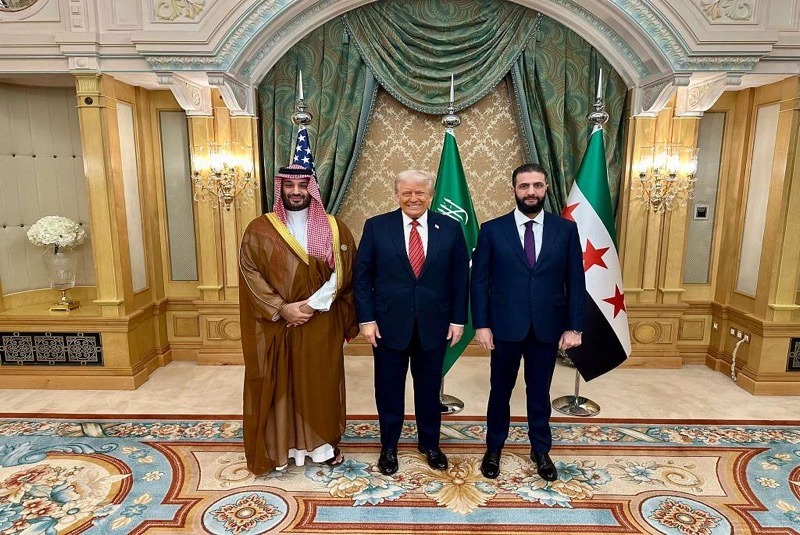
In May 2025, Ahmed al-Sharaa was formally introduced to then-President Donald Trump by Crown Prince Mohammed bin Salman (MBS) during Trump’s visit to Riyadh. This high-profile meeting took place in the opulent Saudi palace and was further notable for the participation of Turkish President Recep Tayyip Erdogan, who joined the discussion via phone. The following month, Trump issued an Executive Order terminating US sanctions on Syria.

Following this encounter, President Trump publicly praised al-Sharaa, describing him as “a young, attractive, tough guy” with a “powerful past.” Trump reiterated references to al-Sharaa’s “rough past” even during subsequent appearances at the Oval Office. However, this so-called “rough past” extends far beyond ordinary legal infractions of misdemeanour and felony; it involves acts of violence against innocent civilians and direct engagement in armed conflict against American soldiers, actions for which al-Sharaa had been incarcerated in the infamous Abu Ghraib prison.

This diplomatic engagement with al-Sharaa stands in stark contrast to the original objectives of the United States’ Global War on Terror (GWOT), which was launched after the September 11 attacks to eradicate terrorism and Islamic radicalism from the world.

The adoption of the “America First” doctrine under Donald Trump marked a significant departure from the United States’ long-standing commitment to supporting democracies and combating authoritarian regimes worldwide. For decades, covert CIA operations had been instrumental in targeting communist governments and dictatorships, in a plausible effort to promote American interests and democratic values abroad. This era of interventionism now appears to be taking a controversial turn, validating the failure of myopic US foreign policies globally.

This profound shift in policy also casts a shadow on the history of U.S. involvement in the Middle East. The sacrifices made by countless American soldiers—those who lost their lives fighting terrorism—now seem increasingly futile in light of recent developments. The blood, sweat, and toil invested in counterterrorism efforts are called into question as the United States reconsiders its approach to regional conflicts and the groups involved.

Congruent with Trump’s authoritarian governance, is he scouting for authoritarian confederates globally, rendering commitment to democracy and human rights non-existent? Is he sanctifying tyranny, a heritage of the Arab states, which erstwhile US administrations sought to reform? Or has US foreign policy been relegated to Trump’s “personal liking” as the only prerequisite, abandoning the ideals of liberty, equality, and justice that the nation has embodied and vociferously propagated since the Declaration of Independence?

A pivotal moment illustrating this change occurred in late December 2024, when the U.S. government scrapped the $10 million reward for the arrest of Ahmed al-Sharaa. Further, in July 2025, the Trump administration revoked the “terrorist organisation” designation by the European Union, the United Nations and the United States for Hayat Tahrir al-Sham (HTS), the group founded by al-Sharaa and its harrowing former ties to al-Qaeda.

On December 8, 2024, Ahmed al-Sharaa’s militant group overthrew Bashar al-Assad in a blitzkrieg military campaign, ending decades of Assad family rule in Syria. The Assads governed Syria with an iron hand, their sledgehammer policies deceptively clothed as the torchbearer of Arab nationalism, dissociated itself from American imperialism and Zionism and aligned closely with Moscow and Tehran. Their socialist-influenced, mixed economy was mired in corruption and entrenched cronyism.

A report by the Executive Director of the IMF on the outlook for the Syrian economy, dated January 9, 2009, stated that the Syrian economy was poised for growth due to Bashar al-Assad’s modest steps in economic liberalisation policies, with non-oil exports peaking at 7 per cent. The IMF commended Assad for insulating the economy from the Great Recession of 2008 through strict capital controls on the foreign exposures of its national banks. The forex reserves were high; a declining national debt, and Syria was firmly committed to economic reforms, en route to a market-based economy and long-term sustainable growth.

The economic gains were short-lived, and the Syrian revolution erupted in 2011 as a consequence of Assad’s economic mismanagement and manifest misrule with high concentrations of wealth among the business elites, growing economic disparities, soaring poverty and unemployment rates. However, the real reasons run deep and are far more complex.

Many political analysts have highlighted what they perceive as a notable indifference on the part of the United States government regarding support for the Syrian rebels during the initial phase of the uprising. Political thinkers such as Gilbert Achcar of the University of London are of the opinion that the US failed to arm the Syrian uprising and even forbade regional allies like Turkey from supplying Stinger missiles, which they produce under US license.

Analysts often compare the U.S. response to its earlier intervention in Afghanistan during the Soviet invasion, where American support was funnelled to the Afghan Mujahedin in coordination with the Pakistani military and the Saudi government. In that instance, the CIA actively provided covert operations training and weaponry— including anti-aircraft and stinger missiles, as well as plastic explosives—to bolster the Afghan resistance.

The decline of the Middle East into a flashpoint of conflicts, insurgencies, wars, bloodshed and economic sanctions has its sordid roots in Benjamin Netanyahu assuming the office of the Israeli Prime Minister in 1996. He revived the exclusionary Zionist project of abandoning the land-for-peace policy into a balance of power strategy. This strategic departure was codified in a white paper titled “A Clean Break: A New Strategy for Securing the Realm,” created by Richard Perle, an American political advisor, and his team for Benjamin Netanyahu.

The dossier reads, “Syria challenges Israel on Lebanese soil. An effective approach, and one with which America can sympathize, would be if Israel seized the strategic initiative along its northern borders by engaging Hezbollah, Syria, and Iran, as the principal agents of aggression in Lebanon.” In terms of military strategy, the paper recommended Israel to consider, “striking Syrian military targets in Lebanon, and should that prove insufficient, striking at select targets in Syria proper.” As regarding Syria, the paper explicitly suggests Israel to abandon its “comprehensive peace” initiatives into a belligerent stance of “containing Syria.”

In fact, Netanyahu wanted to obliterate all nations that endorse the Palestinian cause with the support of the United States. This strategy was later incorporated into the US foreign policy. General Wesley Clark later corroborated this strategic offensive when he narrated a Pentagon briefing about the Bush administration’s mission of taking out seven countries in the Middle East and North Africa in a span of five years. The plan’s sequence began with Iraq, followed by Syria, Lebanon, Libya, Somalia, Sudan, and Iran—demonstrating the central role of Syria’s destruction in the broader regional agenda.

While all the nonchalance of Obama administration in arming Syrian rebels is debated and deliberated, in reality Obama tasked the CIA to overthrow Assad government through the billion-dollar clandestine program called “Operation Timbre Sycamore.” Seymour Hersh, the American journalist wrote a compelling article in the London Review of Books, titled, “The Red Line and the Rat Line,” in which, he categorically mention:

A highly classified annex to the report, not made public, described a secret agreement reached in early 2012 between the Obama and Erdoğan administrations. It pertained to the rat line. By the terms of the agreement, funding came from Turkey, as well as Saudi Arabia and Qatar; the CIA, with the support of MI6, was responsible for getting arms from Gaddafi’s arsenals into Syria.

Further evidence of the United States’ active involvement was displayed on 20 March 2013, during a joint press conference in Jerusalem. President Obama, standing alongside Prime Minister Benjamin Netanyahu, reaffirmed the U.S. commitment:

With respect to Syria, the United States continues to work with allies and friends and the Syrian opposition to hasten the end of Assad’s rule, to stop the violence against the Syrian people, and begin a transition toward a new government that respects the rights of all its people.

This official statement made clear that the United States was engaged in efforts to support the Syrian opposition in their attempt to depose Assad.

As the Syrian civil war progressed, the nature of U.S. involvement evolved. The conflict transformed into a proxy war, with the U.S. increasingly pitted against Russian and Iranian interests in Syria. This shift marked a significant escalation, turning the Syrian battleground into a focal point for broader geopolitical competition between global powers.

Bashar al-Assad’s regime has endured due to internal repression and substantial external support, particularly from Iran and Russia. In 2013, Iran, via Hezbollah, strengthened Assad’s military, followed by Russia’s direct intervention in 2015 with advanced air defences and aircraft, allowing the regime to intensify air strikes against opposition areas. It is a further rebuttal to his populist image in Syria.

The methods employed by Assad’s government to maintain its grip on power have been characterised by widespread brutality. Barrel bombings of civilian neighbourhoods and the deployment of chemical weapons became notorious hallmarks of the regime’s campaign against dissent. Alongside these attacks, Assad’s security apparatus engaged in systematic moral policing and the incarceration of dissidents and intellectuals, fostering an atmosphere of pervasive fear and repression among the Syrian population.

A glaring testimony is Yassin al-Haj Saleh, the Syrian writer and leftist intellectual who was imprisoned by the Assad regime for sixteen years; his wife was abducted in 2013 and remains missing. However, these pervasive incidents, while recounting the horrors of the lived experiences of Syrians, also serve to deftly eclipse the covert operations conducted by other state actors, such as the United States and Israel, as part of a long-standing strategy for realpolitik ends. Most notable are the crushing economic sanctions and the US seizure of Syrian oil fields.

Given the chequered past of Ahmad al-Sharaa, it is uncertain whether he can steer Syria onto a path of prolonged stability, peace, and economic prosperity. His leadership is shadowed by his radical Islamist leanings, which have been linked to violent acts against minority groups, most notably the Druze community in southern Syria, Assad’s Alawite sect and Kurds. These actions have fostered deep divisions and distrust among Syria’s diverse population, casting doubt on his ability to unify the nation.

Despite these uncertainties, al-Sharaa’s actions suggest a pragmatic approach to consolidating power and navigating Syria’s complex geopolitical landscape. He has decisively cut off Hezbollah’s supply lines, disrupting Iran’s proxy operations by severing the flow of arms and ammunition through Syrian territory. Additionally, his closure of Russian access to the strategic port of Tartus has weakened Russia’s presence in the Mediterranean. Perhaps, he is a pragmatist who uses political Islam for power rather than ideology.

He needs the goodwill of the regional powers that backed him, namely Saudi Arabia, Turkey, Qatar, and other Gulf States, for Syrian post-war reconstruction and the influx of investment. This places significant constraints on his Islamic jihadist instincts, which essentially is a retracing of the nation back to the repression of Assad.

Despite his current position, al-Sharaa remains vulnerable to assassination attempts orchestrated by his former allies, including ISIS and al-Qaeda. These groups, having once backed him, now pose a grave threat to his leadership. Should such an attempt succeed, Syria could descend into chaos reminiscent of Libya after the assassination of Muammar Gaddafi or experience the instability that followed the failed populist movements of the Arab Spring in Egypt and Tunisia.

For the United States, courting al-Sharaa could turn out to be a costly gamble. Conversely, for al-Sharaa, the astute observation of Henry Kissinger may come to pass: “It may be dangerous to be America’s enemy, but to be America’s friend is fatal.”

-30-

Copyright©Madras Courier, All Rights Reserved. You may share using our article tools. Please don't cut articles from madrascourier.com and redistribute by email, post to the web, mobile phone or social media.
Please send in your feed back and comments to [email protected]

0 replies on “Why Is Trump Courting Islamist Radicals Like Al-Sharaa?”