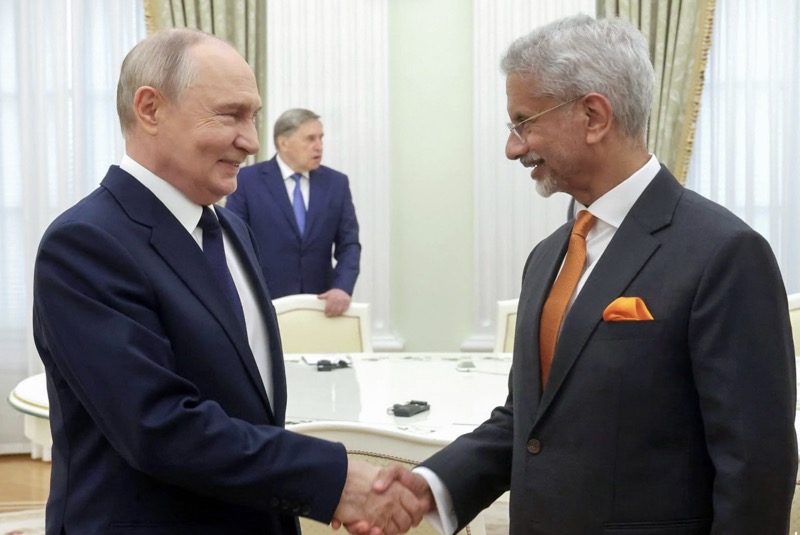
India’s foreign minister S Jaishankar’s meeting with Vladimir Putin in Moscow is bound to irritate some Western capitals. As co-chair of the 27th session of the India-Russia Inter-Governmental Commission, Jaishankar discussed trade, energy, fertilisers, nuclear power and technology, and acknowledged that economic co-operation between India and Russia had grown “very significantly.”
The meeting is a reminder that India’s relationship with Russia is not an enduring commitment to the Russian camp. It is strategic alignment—selective co-operation with Moscow where it advances India’s interests, alongside equally purposeful partnerships with Washington, Europe, Japan, Israel and the Gulf states.
Boris Johnson, Britain’s former prime minister, offered a different explanation for India’s refusal to join the West in isolating Russia. Speaking in India, Johnson recalled a conversation he said he had with Queen Elizabeth II shortly before she died in 2022. She told him that when she met Jawaharlal Nehru in 1952, the then prime minister of India had said that India would “always basically be on the side of Russia.” “Some things never change,” Johnson added.
It is a catchy anecdote, but a poor description of Indian foreign policy. India has moved dramatically closer to America, participated in the Quad, deepened relations with Europe and Japan, sourced energy from the Middle East, bought weapons from Russia, Israel, France and America, and conducted exercises with Western militaries. At the same time, it has maintained a substantial relationship with Moscow.
That is not Russian alignment. It is strategic autonomy: the attempt to ensure that India is never so dependent on one great power that its own choices become subordinate to that power’s priorities.
The roots of that approach go back to the Cold War. After independence in 1947, Jawaharlal Nehru sought to keep India outside the rival military blocs led by America and the Soviet Union. Non-alignment was never simply passive neutrality. It was an attempt by a newly independent country to preserve freedom of action in a world where the great powers had developed an appetite for deciding what other countries should do.
That freedom became harder to maintain as America’s relationship with Pakistan deepened. Pakistan joined the US-sponsored South-East Asia Treaty Organisation in 1954 and the Baghdad Pact, later CENTO, in 1955. American military assistance helped strengthen Pakistan’s armed forces.
During the Cold War, Pakistan became an important American partner, particularly in the struggle against Soviet influence in Afghanistan. From New Delhi, however, the arrangement looked rather different. The United States was arming a country with which India had already fought over Kashmir.
Moscow consequently became an increasingly important counterweight. The Soviet Union emerged as a major supplier of Indian military equipment, beginning with the MiG-21 deal in the early 1960s and expanding into licensed production and long-term defence co-operation.
Soviet assistance was not confined to weapons. It extended to steel, heavy industry, nuclear power, space technology and the development of other parts of India’s industrial base. Crucially, Moscow was prepared to supply India without demanding that it abandon its wider foreign-policy independence.
In 1971, the crisis in East Pakistan produced a humanitarian catastrophe, and millions of refugees crossed into India. The Pakistani army’s campaign against Bengali nationalism became a regional crisis. On 9 August 1971, India and the Soviet Union signed the Treaty of Peace, Friendship and Co-operation.
The treaty did not transform India into a Soviet satellite. American records indicate that New Delhi maintained relations with Washington. But it strengthened India’s position by making Soviet support more likely and raising the risks for any outside power contemplating intervention.
When war broke out in December, the Nixon administration tilted towards Pakistan, partly because Pakistan was an important Cold War partner and partly because Islamabad was helping Washington establish its opening to China. The United States supported Pakistan diplomatically and moved the USS Enterprise carrier group towards the Bay of Bengal. The Soviet relationship helped India withstand diplomatic pressure and reduced the risk of Chinese intervention.
India won the war, and Bangladesh was born. In simple terms, India conducted its diplomacy to assert its strategic autonomy and prevent other great powers from determining its choices. That logic remains visible today.
India’s purchase of Russian oil, for example, is not evidence that New Delhi has chosen Moscow over the West. It reflects the fact that India imports more than 90 per cent of the crude oil it consumes, making energy security an unusually powerful constraint on foreign policy. Russian oil became particularly attractive after Western sanctions disrupted Moscow’s traditional markets and created discounts for willing buyers.
By June and July 2026, India’s purchases of Russian crude had risen above 2.6 million barrels a day, according to the Financial Times, as disruption in Middle Eastern supplies increased the pressure on Indian refiners to secure reliable imports.
The West argues that buying Russian oil helps finance Russia’s war in Ukraine. However, the political expectation that India should absorb higher costs to advance Western strategic objectives runs directly counter to the principle that has shaped Indian foreign policy for decades.
The Western position is not entirely free of contradictions. Europe spent decades building a substantial dependence on Russian gas. Even after the invasion of Ukraine, Russian gas continued to account for a significant share of EU imports, while European governments struggled with the costs and practical difficulties of eliminating it.
There is an even broader problem with the West’s moral argument: Gaza. Russia’s invasion of Ukraine is not made less objectionable by the suffering of Palestinians, and Israel’s conduct in Gaza should not be used as a moral discount on Russia’s conduct. But Western governments cannot expect the rest of the world to ignore the apparent asymmetry in how international law is invoked.
America has remained Israel’s most important military and political supporter, while European governments have struggled to reconcile their support for Israel’s security with mounting concern over the humanitarian consequences of the war. Britain, for example, maintains elements of its defence relationship even after concluding that there were serious violations of international humanitarian law. More recently, the Trump administration has continued to provide substantial support for arrangements concerning Gaza.
Israel and Russia are not equivalent. However, it drives home the point that international relations are full of exceptions, qualifications and strategic interests. Governments invoke universal principles most forcefully when those principles align with their interests, and more cautiously when they collide with them.
Moreover, a large proportion of India’s military inventory is of Russian or Soviet origin. That relationship involves maintenance chains, ammunition, training, spare parts, technology and decades of institutional familiarity. Replacing the entire ecosystem quickly would be enormously expensive and strategically disruptive.
But even here, India has been diversifying rather than simply remaining dependent on Moscow. It has developed sophisticated defence relationships with France and the United States, strengthened security co-operation with Australia and Japan, and expanded ties with Israel and the Gulf states. It seeks Western technology and capital while remaining a member of BRICS and retaining close military ties with Russia.
That pattern is the key to understanding Indian foreign policy. India is not trying to replace dependence on America with dependence on Russia. It is trying to avoid dependence on either.
The same principle explains the contradictions that frustrate Western observers. India participates in the Quad while buying Russian weapons. It deepens strategic co-operation with Washington while purchasing Russian oil. It builds relations with Israel while maintaining ties with Iran and the Gulf. It can seek Western technology while remaining part of institutions that include Russia and China. Seen from Washington or London, this can look like inconsistency. Seen from New Delhi, it is diversification.
India’s strategic objective is not to ensure that every partner agrees with every other partner. It is to ensure that India retains relationships, capabilities, and alternatives so that no single partner can dictate Indian policy.
There is a pattern here. The post-Cold War West became accustomed to thinking that its preferred international order was universal. The rise of India, China and other powers has exposed the limits of that assumption.
India’s relationship with Russia, therefore, makes more sense when viewed through the lens of strategic autonomy instead of alignment with Russia.
Mr Johnson may be right about one thing: history does matter. But the history he should have in mind is not that India has always been “on Russia’s side.” It is that India has spent eight decades without placing its security entirely in somebody else’s hands.
That is why Jaishankar can shake Putin’s hand in Moscow and deepen strategic co-operation with Washington. The apparent contradiction is the point. India is not choosing whose side to take. It is choosing where its interests align.
-30-
Copyright©Madras Courier, All Rights Reserved. You may share using our article tools. Please don't cut articles from madrascourier.com and redistribute by email, post to the web, mobile phone or social media.Please send in your feed back and comments to [email protected]