Vote Chori & Large-Scale Manipulation Are No Longer Isolated Incidents; They Reveal A Disturbing Pattern Across States

elections_madras_courier
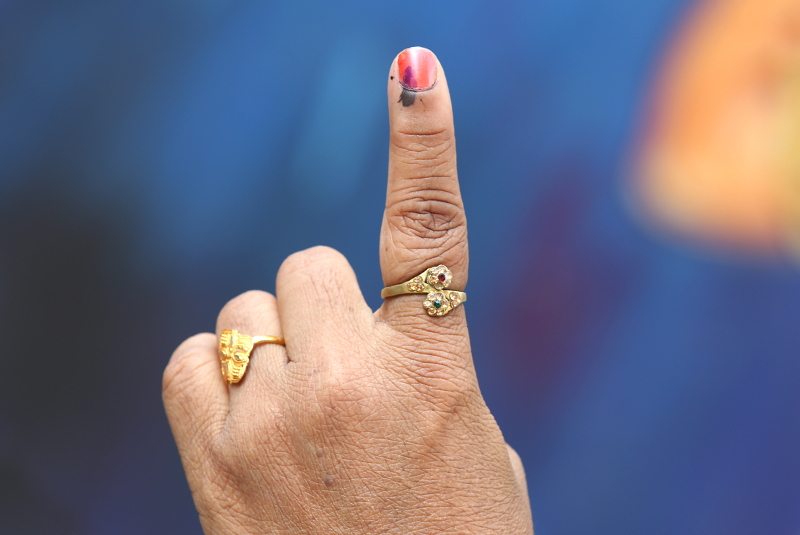
Representational image: 7MB.
Large scale voter manipulation manipulation raises troubling questions about electoral outcomes.

By parliamentary democracy we mean ‘one man, one vote.’ We also mean that every Government shall be on the anvil, both in its daily affairs and also at the end of a certain period when the voters and the electorate will be given an opportunity to assess the work done by the Government… We do not want to instal by any means whatsoever a perpetual dictatorship of any particular body of people.

These words, by Dr B.R. Ambedkar, capture the essence of India’s democratic experiment. Elections and the right to vote are not mere administrative rituals; they are the unrivalled pillars of democracy, the foundation on which political equality rests.

In a vast and diverse country like India, electoral democracy is the only viable instrument to achieve social and economic equality. Universal adult suffrage armed every citizen—irrespective of caste, class, or gender—with the power to participate politically and to change the nation’s destiny through peaceful means.

For the first time in history, millions of India’s deprived and marginalised were given a decisive voice in governance. The principle of “one man, one vote, one value” marked a radical shift in power relations. It transformed subjects into citizens, once servile into political participants, and ensured that governance reflected political equality.

Unlike older democracies, India did not stagger its enfranchisement. While the United Kingdom took nearly a century and the United States more than 140 years to achieve universal suffrage, India embraced it from the dawn of independence. Within nineteen years, the country had elected a woman Prime Minister—an achievement the so-called “oldest democracy,” the United States, has yet to realise in over two centuries. Universal franchise in India was not an incremental concession but a conscious commitment to equality and justice.

The framers of the Constitution also understood that democracy could not survive unless elections were free from manipulation. Ambedkar himself warned that the election machinery must be insulated from government control. The franchise, he argued, is fundamental to democracy, and therefore the electoral process must be safeguarded from executive interference.

This vision was embodied in Article 324, which entrusted the Election Commission of India (ECI) with the superintendence, direction, and control of elections. Independence and neutrality were built into the institution not as administrative conveniences but as moral imperatives. Yet in recent years, disturbing trends of manipulation and erosion of electoral integrity have emerged, threatening the sanctity of this cornerstone of democracy.

Allegations of large-scale manipulation are no longer isolated incidents; they reveal a disturbing pattern across states, striking at the foundations of democracy. In Madhya Pradesh, in 2018, ahead of the Assembly elections, the Congress raised alarms over more than 60 lakh fake voters. The rise in registered voters far exceeded the population growth of the preceding decade. Later, the deletion of nearly 24 lakh names from the rolls published in January 2018 exposed how inflated rolls could swing electoral outcomes.

In Maharashtra, in 2024, the irregularities became staggering. In just five months, 41 lakh names were added to the rolls, while in the previous five years, only 31 lakh new voters were added—figures that defy demographic logic. In Shirdi, 7,000 voters were found registered under a single building. Turnout manipulation was blatant: polling at 5 p.m. stood at 58.22 per cent, but by the next morning had jumped to 66.05 per cent—an overnight increase of 7.83 per cent. Across the state, turnout surged after polling closed, equivalent to nearly 76 lakh votes.

In Bihar in 2025, on 24 June, the Election Commission announced a Special Intensive Revision (SIR) of electoral rolls barely five months before the Assembly elections. Voters not listed in the 2003 rolls had to produce one of eleven documents, excluding Aadhaar, ration cards, and even EPIC voter IDs—the documents most citizens possess.

Six of the documents were practically irrelevant or negligible. In a state where birth registration was just 3.7 per cent in 2000 and only 11–17 per cent by 2004–05 (against a national average around 60 per cent), these requirements were impossible for most. The burden fell on migrant workers, Dalits, Adivasis, Minorities, women, and the rural poor. Migrants were penalised for mobility; the poor for lacking paperwork.

Instead of protecting democracy, the SIR became a weapon of exclusion. The results were devastating: 65 lakh voters were deleted. According to The Hindu data, women were struck off in greater numbers than men. Of these, 36 lakh were marked “permanently shifted,” 22 lakh as “deceased,” and 7 lakh as “enrolled at multiple places.” The absurdity was exposed when the Leader of the Opposition, Rahul Gandhi, met those declared “dead.” This was not a correction—it was systematic disenfranchisement.

In Karnataka, in 2024, in the Mahadevpura assembly segment of Bangalore Central Lok Sabha, Rahul Gandhi, after a six-month analysis of massive datasets, exposed shocking irregularities. Between the 2023 Assembly polls and the 2024 Lok Sabha elections, voter rolls swelled by 1,00,250 names.

Manipulation took five forms: duplicate voters across constituencies and even states; fake addresses with house numbers marked “0” or “#”; bulk registrations such as 80 voters in a one-room house and 68 at a brewery; invalid photographs with distorted or “micro” images; and misuse of Form 6, such as Shakun Rani being registered twice in two months.

Such manipulation raises troubling questions about electoral outcomes elsewhere—whether in Haryana, where Congress lost eight seats by a margin of just 22,779 votes, or in the 2024 Lok Sabha elections, where the BJP won 25 seats by barely 33,000 votes. From Madhya Pradesh to Maharashtra, Bihar to Bangalore, these do not appear to be administrative lapses but a deliberate assault on the franchise—engineered vote chori that silences precisely those voices the Constitution sought to empower: migrants, the marginalised, and the poor.

The credibility crisis has deepened with recent changes in law and procedure. In December 2024, the government amended Rule 93(2)(a) of the Conduct of Election Rules, 1961, restricting public access to election records that were previously open. The ECI revised guidelines on preserving video footage and photographs, reducing the retention period to just 45 days after results. This came weeks after the Punjab and Haryana High Court ordered the EC to release videography of the Haryana Assembly polls.

Changes to the appointment process of Election Commissioners have further tilted the balance in favour of the executive, replacing the Chief Justice of India on the selection panel with a Union Minister. The Commission’s refusal to share machine-readable voter lists or make CCTV footage publicly available further curtails transparency. Each of these steps undermines institutional autonomy and shields potential manipulation from scrutiny.

Taken together, these developments are reminiscent of electoral autocracy, where elections exist only as rituals devoid of fairness and credibility. A compromised ballot is not merely a procedural lapse—it is the silencing of millions, particularly Dalits, Bahujans, Minorities, and migrant workers whose enfranchisement is most fragile. Snatching the right to vote is tantamount to snatching citizens of political rights. Without genuine political participation, they revert to being subjects—bereft of dignity, voice, and agency.

Global experiences underscore the peril of undermining electoral integrity. Viktor Orbán’s Hungary, the storming of Capitol Hill in the United States, and Jair Bolsonaro’s efforts to discredit Brazil’s electoral process show how even robust democracies can be shaken by subversion.

Rigged elections place democracy in a noose: the nexus of misinformation, disenfranchisement, and institutional capture replaces genuine participation with hollow spectacles. Even more troubling is that similar exercises are being forced across the country. Consider the SIR planned in conflict-torn Manipur, where thousands remain displaced. When dignity and voice are denied, peace and political stability must precede statistical exercises.

Free and fair elections are democracy’s greatest self-correcting mechanism. They hold governments, leaders, voters, and institutional gatekeepers accountable. In a healthy democracy, the electoral process ensures that no one is absolute. Regular, transparent elections keep the democratic spirit alive—responsive, adaptable, and accountable.

Elections are reflections, a mirror of the people’s will. When this mirror is distorted, democracy itself becomes illusionary. The suppression of free and fair elections eventually results in the subjugation of freedom. The one person–one vote–one value is the lifeblood of democracy. Once the sanctity of the ballot is compromised, the dream of social justice, equality, and freedom collapses.

Guarding the ballot is therefore not just about protecting procedure—it is about preserving citizenship itself. Without the vote, democracy becomes an illusion; without electoral justice, political equality dies.

-30-

Copyright©Madras Courier, All Rights Reserved. You may share using our article tools. Please don't cut articles from madrascourier.com and redistribute by email, post to the web, mobile phone or social media.
Please send in your feed back and comments to [email protected]

0 replies on “Vote Chori & Large-Scale Manipulation Are No Longer Isolated Incidents; They Reveal A Disturbing Pattern Across States”