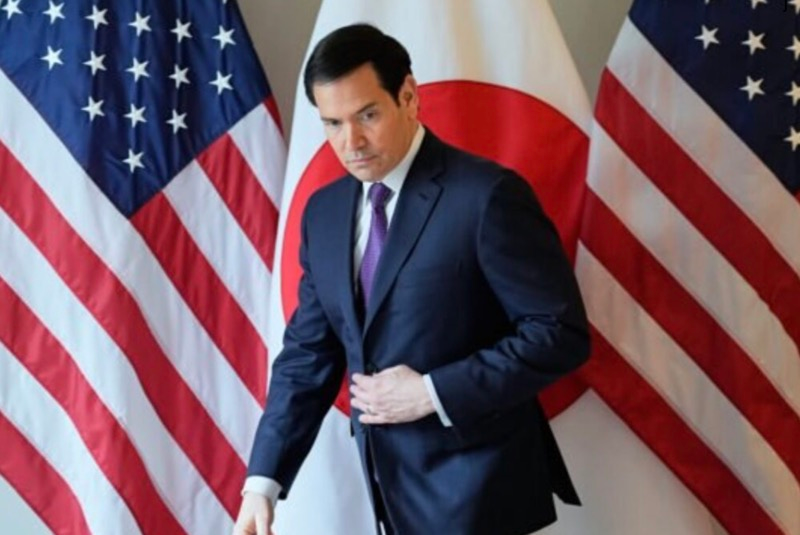
Marco Rubio isn’t an idiot; he isn’t ignorant either. He is the Secretary of State of the United States. And so, his speech at the Munich Security Conference demands scrutiny.
Rubio’s address was an explicit endorsement of colonial nostalgia—a dangerous reverence for a past steeped in violence, imperialism, and colonial exploitation. It was a call urging the ‘West’ to rally behind the United States in its renewed mission to ‘dominate’ the globe.
But Rubio’s speech wasn’t merely a historical reflection. It was a proposal for a new form of imperialism, with the United States at the helm, nudging European nations to follow. He painted a portrait of a world in which the ‘West,’ a nebulous term whose contours remain undefined, would rise again to restore its former ‘dominance.’
So, what exactly does Rubio mean by ‘the West’? Historically, the term has been inextricably linked to European imperialism, a legacy forged through centuries of cruelty, atrocities, and war. Rubio’s vision of Western civilisation is a false romanticisation of an age when European empires stretched across the globe, their brutalities justified under the banner of ‘civilisation.’
In his speech, Rubio casually invoked this era as though it were an ideal to be revived. His praise for the colonial empires of the past and his dismissal of anti-colonial uprisings seeking to dismantle them were both alarming and telling.
Undoubtedly, Rubio’s speech was a warning—not of a changing geopolitical landscape, but of an emerging, dangerous vision. His rhetoric, cloaked in the guise of diplomacy, deserves contempt, not applause.
In his warped worldview, the ‘West,’ whatever that is, is in ‘terminal decline,’ ostensibly a victim of ‘communist revolutions’ and ‘anti-colonial uprisings.’ But this decline, he suggests, was seemingly avoidable. The solution is a return to a unified ‘West,’ led by the United States, to stave off the ‘godless’ forces that threaten to dismantle the existing world order. The implications of this rhetoric are profound. This is more than political posturing. It’s a call for American hegemony, disguised as historical revivalism.
In Rubio’s vision, the United States is not merely an ally to Europe; it seeks to dominate Europe. His insistence that European allies cast off ‘guilt and shame’ is a thinly veiled message that the past must be reinterpreted to pave the way for a new, aggressive ‘West.’
Rubio’s vision sees Europe not as an equal partner but as a vassal—a subordinate entity that must align with the U.S. to pursue global supremacy. The implication is clear: Europe and Britain must fall in line with American priorities, regardless of whether those priorities align with their own.
This subtle shift in American foreign policy, under the guise of rhetorical flourishes, should not be overlooked. Rubio’s speech wasn’t merely about defending ‘Western values’ — it was about imposing a vision that places the United States firmly at the helm. It wasn’t a call for cooperation; it was a call for submission. The world Rubio envisions is one where Europe is not independent but reliant—on security, trade, technology, and everything. This isn’t a vision of equality; it’s a vision of vassalage.
Indeed, the reality of Europe and the UK becoming vassals of the United States is no longer a far-fetched notion. It’s been building for decades. NATO, for instance, has increasingly placed European countries under the umbrella of American military might. Economic hegemony, led by Silicon Valley and Wall Street, has left Europe and Britain in a state of perpetual dependence. The U.S. has also used its military and economic leverage to impose its will on sovereign nations.
Take the U.S. reaction to India’s decision to purchase oil from Russia as a case in point. Washington’s attempt to dictate foreign policy to India, a sovereign nation, was not merely a breach of diplomatic norms; it was an encroachment on national sovereignty—an attempt to force other nations into the U.S. orbit.
The U.S.’s global interventions are far deeper, though. From Venezuela to Cuba, from Iraq to Libya, from Yemen to Iran, the United States has a long history of destabilising nations—not to promote democracy, but to create dependency.
In Venezuela, U.S.-backed sanctions have crippled the economy, increasing the country’s reliance on outside aid, often from the very powers that seek to control it. In Iraq, the U.S. invasion left the country in ruins, destabilising the entire region and ensuring that Iraq, and many of its neighbours, would rely on American influence for their security and survival.
Similarly, in Libya, the U.S.-led intervention fractured the country, leaving it in a state of chaos, with external powers, primarily the U.S. and Europe, continuing to exercise influence. The common denominator here is that these interventions have left nations weakened, dependent, and vulnerable to the whims of foreign powers—notably, the United States.
This is not a matter of dependency for its own sake; the U.S. is playing a long game of colonisation by proxy. Washington no longer needs to send troops to seize a country’s resources or impose direct control. Instead, it can destabilise, weaken, and then offer ‘help’—help that is, of course, laced with conditions.
These conditions tie nations to American interests, ensuring that Washington dictates their future. It’s a modern form of empire, one that doesn’t require colonial administrators or military occupation, only a pervasive influence that ensures nations fall in line with U.S. objectives.
In this context, Rubio’s speech was not just a rhetorical flourish; it was a blueprint for a new era of American imperialism. The United States, as Rubio envisions it, is not a beacon of freedom, but the mastermind behind a new system of global vassalage. In this vision, Europe and the UK are not sovereign powers, but mere satellites, tethered to Washington’s whims. It’s a dangerous vision, one that undermines the sovereignty of nations and jeopardises the very future of European independence.
The legacy of colonisation is not something to be celebrated or resurrected. The crimes committed during the colonial era—the massacres, genocides, forced labour, plundering of resources, erasure of cultures—should not be glossed over in nostalgic speeches about the ‘greatness’ of Western civilisation. These are indelible crimes, and no amount of revisionism can erase them.
To suggest that the world should return to a system of imperial control, even under the guise of ‘Western values,’ is morally bankrupt. It is not only a denial of history but a betrayal of the principles that Europe and the UK once claimed to champion.
Europe and the UK must resist this vision. They must recognise that the true danger is not colonialism in its traditional form, but vassalisation—a subtler, but no less dangerous reality. From technology to trade to security, the U.S. is increasingly entangling ‘middle powers’ like Europe, India, and Britain in a web of dependency. This is not a partnership of equals; it’s a new form of neo-colonialism, one that the world should refuse to accept.
Rubio’s speech was not merely a call to arms; it was a warning. The real threat to Europe and the UK today is not the return of colonialism through migration, but the gradual transformation into vassal states—increasingly intertwined in the U.S. sphere of influence, unable to assert their sovereignty.
The task ahead is not merely to resist American dominance, but to reclaim the autonomy that has been slowly stripped away. Europe and Britain must recognise that their future lies not in submission, but in independence—and in the courage to confront a new form of imperialism disguised as ‘friendship.’
-30-
Copyright©Madras Courier, All Rights Reserved. You may share using our article tools. Please don't cut articles from madrascourier.com and redistribute by email, post to the web, mobile phone or social media.Please send in your feed back and comments to [email protected]