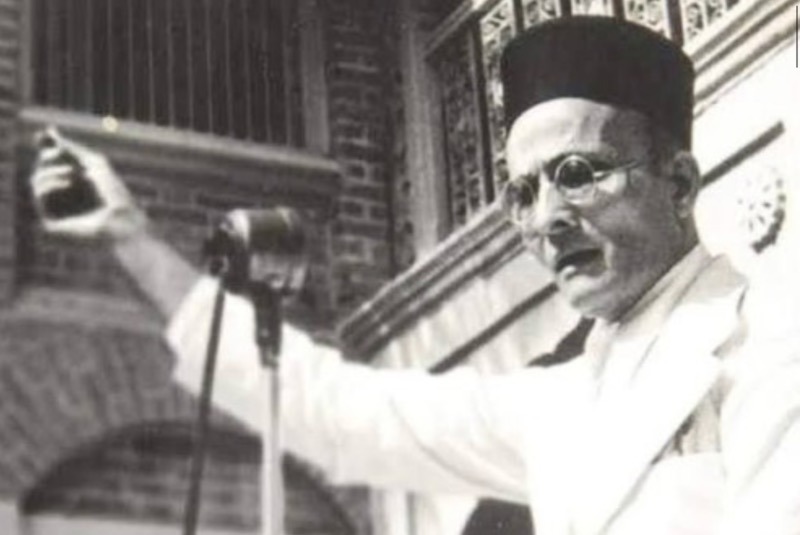
Contrary to some claims, Savark did not argue against untouchability. To insist that he did so is a miscarriage of truth. Let me substantiate with the facts available in the Hindu Mahasabha [HM] archives.
Vinayak Damodar Savarkar (1883-1966) led HM from 1937 onward and was the most prominent ideologue of the organisation. He was a prolific polemical writer who left a large volume of documents on Casteism and Untouchability.
Savarkar, as a prophet of Hindutva and author of the book with the same title, published in 1923, defended Casteism in Hindu society as a natural component essential to the making of a nation. He declared that the institution of Casteism was the peculiar mark of identifying a Hindu Nation.
The system of four varnas which could not be wiped away even under the Buddhistic sway, grew in popularity to such an extent that kings and emperors felt it a distinction to be called one who established the system of four varnas…Reaction in favour of this institution grew so strong that our nationality was almost getting identified with it. [Savarkar, VD., Hindutva, VV Kelkar, Nagpur, 1923, p. 24.]
Defending Casteism as an inalienable constituent of a Hindu Nation, Savarkar declared that “the land where the system of four Varnas does not exist should be known as the Mlechcha country: Aryawarta lies away from it.” [Ibid., p. 24.]
Savarkar’s defence of Casteism was, in fact, a corollary of his Racial approach to understanding the Hindu nation. While refuting the criticism that Casteism checked the free flow of blood in Hindu society, he presented an interesting logic by making them complementary. He argued that it was, in fact, due to Casteism that the purity of the Hindu Race was maintained. He stated:
All that the caste system has done is to regulate its noble blood on lines believed—and on the whole rightly believed—by our saintly and patriotic law-givers and kings to contribute most to fertilize and enrich all that was barren and poor, without famishing and debasing all that was flourishing and nobly endowed. [Savarkar, VD., Hindutva, VV Kelkar, Nagpur, 1923, p. 27.]
Interestingly, Savarkar, who stood steadfast in defence of Casteism throughout life, showed interest for a brief period in the elevation of the status of the Untouchables in the Hindu society, conducted programmes against Untouchability, entry of Untouchables into Hindu temples, organised community lunches and went out to visit their quarters.
This was not due to an egalitarian outlook. Instead, it was mainly because he was alarmed at the numerical loss which the Hindu community had been experiencing due to the steady conversion of the Untouchables to Islam and Christianity, which guaranteed them social equality normatively.
Savarkar admitted that, as the Sudras were treated as Outcastes, then around 7 crore people, “Hindu people-power” did not stand in ‘Our’ (High caste Hindus) favour. Savarkar knew that Hindu nationalists would greatly need the physical power of these Untouchables as foot-soldiers for settling scores with Muslims and Christians.
So, he warned his cadres that if the Untouchables did not remain in their fold, they would bring a terrible crisis for high-caste Hindus. Savarkar lamented the fact that “they will not only cease to be beneficial for us but also become an easy means of dividing our house, thus proving to be responsible for our boundless loss.” [Savarkar, VD., Hindutva ke Paanch Pran, Hindi Sahitya Sadan, Delhi, 1996, p. 45. ]
The most authentic record of Savarkar’s beliefs and actions on this issue is available in a compilation by Savarkar’s secretary, A. S. Bhide, titled ‘Vinayak Damodar Savarkar’s Whirlwind Propaganda: Extracts from the President’s Diary of his Propagandist Tours Interviews from December 1937 to October 1941’ — an official dos and don’ts guide-book for Hindu Mahasabha cadres.
This HM publication shows how serious Savarkar was towards even these cosmetic reformative actions. According to the book, Savarkar soon declared that he was undertaking these reformative actions in his personal capacity “without involving the Hindu Mahasabha organization into social and religions [sic] activities not guaranteed by its constitutional limits…” [Bold as in the original text] [Bhide, AS (ed), Vinayak Damodar Savarkar’s Whirlwind Propaganda: Extracts from the President’s Diary of his Propagandist Tours Interviews from December 1937 to October 1941, HM, Bombay, 1941, p. xi.]
Savarkar assured Sanatani Hindus, who were opposed to the entry of untouchables into Hindu temples in 1939, that the Hindu Mahasabha, “will not introduce or support compulsory Legislature [sic] regarding Temple Entry by the untouchables etc. in old temples beyond the limit to which the non-Hindus are allowed by custom as in force today.” [Ibid., p. 128.]
On June 20, 1941, he once again gave a personal assurance that he would not hurt the sentiments of SanataniHindus so far as the issue of entry of Untouchables in temples was concerned. This time, he even promised not to touch anti-women and anti-Dalit Hindu personal laws:
I guarantee that the Hindu Maha Sabha shall never force any legislations regarding the entry of untouchables in the ancient temples or compel by law any sacred ancient and moral usage or custom prevailing in those temples. In general, the Mahasabha will not back up any Legislation to thrust the reforming views on our Sanatani brothers so far as personal law is concerned… [Ibid., p. 425.]
Savarkar remained a staunch proponent of Casteism and a worshipper of the Manusmriti throughout his life. The institutions of Casteism and Untouchability were, indeed, the outcome of Manu’s Codes, which Savarkar greatly revered, as we will see in his statement:
Manusmriti is that scripture which is most worshippable [sic] after Vedas for our Hindu Nation and which from ancient times has become the basis of our culture-customs, thought and practice. This book for centuries has codified the spiritual and divine march of our nation. Even today the rules which are followed by crores of Hindus in their lives and practice are based on Manusmriti. Today Manusmriti is Hindu Law. That is fundamental. [Savarkar, VD., ‘Women in Manusmriti’, in Savarkar Samagr (collection of Savarkar’s writings in Hindi), Prabhat, Delhi, vol. 4, p. 415.]
Sadly, people bent on establishing Savarkar as a champion of anti-Untouchability have no hesitation in playing mischief with a letter Dr Ambedkar wrote to Savarkar on February 18, 1933. They produce it as a testimonial to establish Savarkar as a crusader against Untouchability, which, according to the adherents of Savarkar’s philosophy, reads:
I wish to take this opportunity of conveying to you my appreciation of the work you are doing in the field of social reform. If the Untouchables are to be part of the Hindu society, then it is not enough to remove untouchability; for that matter you should destroy ‘Chaturvarna’. I am glad that you are one of the very few leaders who have realised this.
Unfortunately, sentences have been taken from Dr Ambedkar’s letter, deleting all critical comments on Savarkar’s love for the Sanatani regime of Chaturvarna. The letter is produced in full so that such intellectual dishonesty is known to readers. It reads:
Many thanks for your letter inviting me to Ratnagiri to open the Temple on the fort to the Untouchables. I am extremely sorry that owing to previous engagements, I am unable to accept your invitation. I, however, wish to take this opportunity of conveying to you my appreciation of the work you are doing in the field of social reforms. As I look at what is called the problem of the untouchables, I feel it is intimately bound up with the question of the reorganization of Hindu society. If the untouchables are to be a part and parcel of the Hindu society, then it is not enough to remove Untouchability, for that you must destroy Chaturvarnya. If they are not to be a part and parcel, if they are only to be appendix to Hindu society then Untouchability, so far as temple is concerned, may remain. I am glad to see that you are one of the very few who have realized it. That you still use the jargon of Chaturvarnya although you qualify it by basing it on merit is rather unfortunate. However, I hope that in course of time you will have courage enough to drop this needless and mischevious jargon. [Emphasis added]
In fact, Dr. Ambedkar came to the conclusion as early as 1940 that “If Hindu Raj does become a fact, it will, no doubt, be the greatest calamity for this country… [It] is a menace to liberty, equality and fraternity. On that account, it is incompatible with democracy. Hindu Raj must be prevented at any cost.”
-30-
Copyright©Madras Courier, All Rights Reserved. You may share using our article tools. Please don't cut articles from madrascourier.com and redistribute by email, post to the web, mobile phone or social media.Please send in your feed back and comments to editor@madrascourier.com