
Is Globalisation Dying?

Globalisation-Dying-Madras-Courier
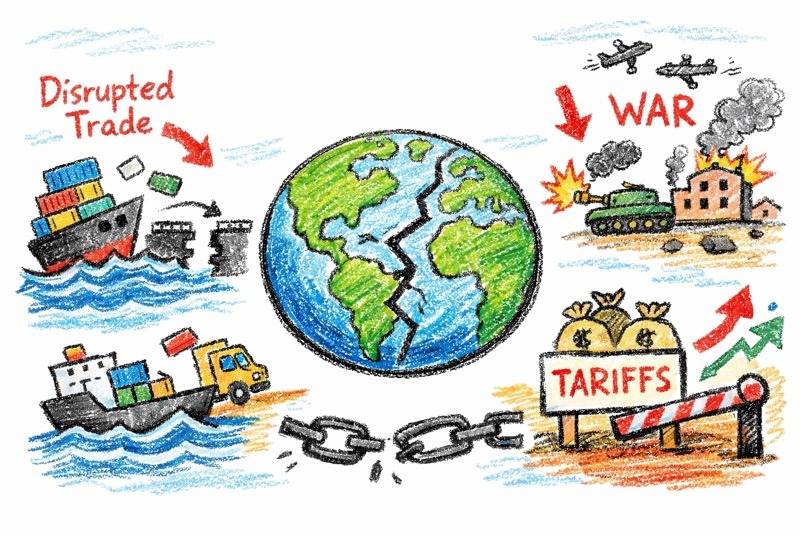
Representational Image: Digitally created illustration.
The lesson of history is not that globalisation must continually advance, but that it requires stewardship.

For most of the modern era, the world economy has behaved like a one-way ratchet. It tightens, locks, and refuses to slip backwards. Trade expands, borders soften, technologies shrink distance, and even catastrophic interruptions—revolutions, depressions, world wars—turn out to be pauses rather than reversals.

If you were standing in 1650, watching ships leave European ports with cargoes of wool, spices, silver, and human beings, you could not have imagined a global economy worth more than eighty trillion dollars. Yet that is precisely what emerged.

As the economic historian J. Bradford DeLong has shown, measured in constant prices, global output grew more than eight hundredfold between the mid-seventeenth century and the early twenty-first. The steepest climbs on that long curve coincided with moments when the world decided, collectively and often reluctantly, that integration was preferable to isolation: the long nineteenth century, and then the decades after 1945, when tariffs fell, capital flowed, and supply chains stretched across oceans.

The striking thing about this story is not just its scale but its persistence. Globalisation survived slavery, imperial plunder, financial panics, and total war. It survived the collapse of empires and the invention of nuclear weapons.

Even the Cold War, with its ideological iron curtains, did not entirely stop the movement of goods, money, and ideas. So when we say now that globalisation is retreating, that the ratchet is slipping, we should pause. This is not a trivial claim. It suggests that something unusually fundamental has changed.

The evidence is hard to ignore. Trade as a share of global output has stalled. Cross-border investment has slowed. Governments speak openly again about self-sufficiency, industrial policy, and strategic decoupling.

The election of Donald Trump, with his fondness for tariffs and suspicion of alliances, seemed to crystallise the shift. But Trump is less an originator than a symptom. He said out loud what many political systems had been edging toward for years: the era in which the United States could plausibly act as the uncontested engine and referee of the global economy is ending.

To understand why this matters, it helps to recognise a pattern that repeats itself across four centuries. Every sustained phase of globalisation has rested on a hegemon—a state powerful enough to set the rules and confident enough to insist that those rules serve everyone’s long-term interest.

Spain tried first, on the back of American silver. The Dutch refined the model, marrying trade, finance, and naval power. Britain perfected it in the nineteenth century, championing free trade once it had already built the world’s most formidable industrial base. After 1945, the United States stepped into the role Britain could no longer afford, underwriting security, opening its markets, and supplying the world with dollars.

What makes the current moment unsettling is not simply that the American hegemon is tired. There is no obvious successor. China is large, dynamic, and ambitious, but it lacks some of the invisible infrastructure of leadership: a fully convertible currency, deep and trusted financial markets, and a political system that others are willing to accept as a template.

Europe has economic weight but no unified fiscal or military voice. And emerging economies—India foremost among them—are still in the process of translating demographic scale and technological capability into sustained global influence.

History offers a cautionary tale about what happens in such interregnums. After the First World War, Britain could no longer enforce the economic order it had built, and the United States declined to assume the burden.

The result was not a gentle rebalancing but a spiral of protectionism, currency manipulation, and political extremism. Trade collapsed. Unemployment soared. The global economy became a contest of beggar-thy-neighbour policies that ultimately benefited no one.

The temptation, in moments like this, is to romanticise the alternative. Globalisation has always produced losers alongside winners. The wealth of eighteenth-century Europe was inseparable from the Atlantic slave trade. The prosperity of late-twentieth-century America came at the cost of hollowed-out manufacturing towns.

It is easy, then, to imagine that a retreat from integration might restore balance or dignity. Yet the interwar years suggest otherwise. Deglobalisation does not distribute pain evenly or justly; it concentrates it and politicises it.

To see how deeply this logic runs, we have to go back to the first attempt to theorise global economic dominance. In the mid-seventeenth century, France stood at the centre of European power. Under Louis XIV, it possessed the continent’s largest population, a formidable army, and a court that defined prestige.

What it lacked, in the eyes of its finance minister Jean-Baptiste Colbert, was enough money. Colbert’s insight was disarmingly simple: power flowed from bullion, and bullion flowed from trade surpluses. If France could ensure that more gold entered the kingdom than left it, grandeur and strength would follow.

Mercantilism, as this doctrine came to be known, treated the world economy as a zero-sum game. One nation’s gain was another’s loss. Colbert raised tariffs, subsidised favoured industries, granted monopolies, and built canals and shipyards. He lured skilled craftsmen from abroad and expanded France’s navy to protect commerce. Colonies were not partners but instruments, sources of sugar, spices, and enslaved labour. Trade was something to be controlled, not liberalised.

Other powers had experimented with similar ideas. The Dutch and the English had chartered trading companies and carved out maritime empires. Spain had grown rich on American silver. But France was the first to integrate mercantilism across the entire apparatus of the state. It was economic policy as grand strategy.

What is often forgotten is that this early globalisation coexisted with vast regions that were only marginally dependent on external trade. Empires in Asia, including Mughal India and Qing China, were largely self-financing, sustained by agriculture and internal markets. They traded extensively, but they did not yet need global integration to prosper. That would change as European power expanded and industrialisation altered the terms of exchange.

The arc from Colbert to Trump is not as long as it seems. When modern politicians speak of trade deficits as evidence of national weakness, they are echoing a seventeenth-century worldview. When they argue that tariffs will revive the domestic industry, they are reenacting an old play with new actors.

The difference is scale. Today’s supply chains run through dozens of countries. A smartphone embodies the labour and ingenuity of China, the United States, South Korea, Taiwan, and increasingly India and Vietnam. Pulling on one thread reverberates everywhere.

This interconnectedness complicates the prospects for emerging economies. For much of the Global South, globalisation was not an abstract ideal but a development strategy. Export-led growth lifted hundreds of millions out of poverty in East Asia.

India’s post-1991 liberalisation plugged its vast workforce into global services and manufacturing networks, creating a new middle class and positioning the country as a technological hub. A fragmented world economy threatens to close off these pathways just as they were beginning to widen.

At the same time, the decline of a single hegemon creates space. India, with its democratic system, growing market, and strategic non-alignment, is often described as a potential bridge between blocs. It does not yet have the capacity to set global rules, but it can shape them, particularly in areas such as digital governance, pharmaceuticals, and climate adaptation. Other emerging economies face similar choices: whether to hedge, to align, or to try, cautiously, to lead.

The lesson of history is not that globalisation must continually advance, but that it requires stewardship. Integration without legitimacy breeds backlash; retreat without coordination breeds chaos. The long ratchet of the world economy can slip, but when it does, the fall is rarely tidy.

The challenge of the coming decades is not to resurrect an idealised past of frictionless trade, nor to embrace a comforting myth of self-sufficiency, but to navigate a more plural world without forgetting what four centuries of painful experience have already taught us: that when nations turn inward, the costs have a way of multiplying, and that the benefits of connection, however unevenly distributed, are far easier to squander than to rebuild.

-30-

Copyright©Madras Courier, All Rights Reserved. You may share using our article tools. Please don't cut articles from madrascourier.com and redistribute by email, post to the web, mobile phone or social media.
Please send in your feed back and comments to [email protected]

0 replies on “Is Globalisation Dying?”