India at 78: Reflections On Freedom, Promise & Unfinished Business

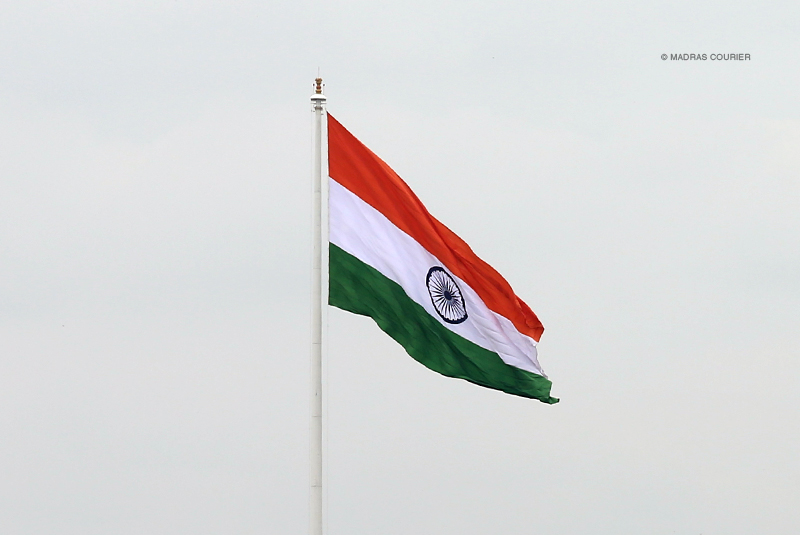
india_flag_madras_courier
Image: 7MB
As we mark the spirit of independence this August 15, let us remember: the true legacy of 1947 lies not in the freedoms we have already attained, but in the freedom we still must secure for all.

Seventy-eight years ago, on August 15, 1947, when India gained independence, the nation was not just celebrating the end of colonial rule. The founding fathers of this new republic were enacting a profound social contract—a vision for the future.

The Declaration of Independence of 1947 was not merely a statement of liberty but a pledge to a set of enduring ideals that, if adhered to, could carve out a just society. But as we stand on the cusp of 2025, amid growing anxieties over the state of our democracy, we must ask: Are we living up to the promises made on that momentous night?

India’s founding vision was built on principles that continue to resonate: freedom, liberty, equality, justice, and fraternity. These are not abstract ideals. They are a call to action, a guide for constructing a society where individuals, regardless of their caste, religion, or creed, could claim equal dignity and opportunity.

India was to be a place where institutions would protect human rights, a strong judiciary would uphold the rule of law, and a free and robust press would expose abuses of power. Yet today, it seems those ideals, the foundation of India’s democratic structure, are under siege.

The challenges facing the country are not unfamiliar. They are historical continuities. But as we reflect on the 15th of August, let us remember the promises of the past—and ask ourselves whether we are on the path to fulfilling them.

One of the most significant promises of the Indian independence movement was the establishment of a society where everyone, irrespective of their background, could enjoy equal rights. When Jawaharlal Nehru declared India’s independence, he said:

At the stroke of the midnight hour, when the world sleeps, India will awake to life and freedom.

These words were not just a declaration of liberation from colonial oppression, but a bold commitment to a new social order, an order in which the shackles of caste, poverty, and discrimination would be broken. The architects of the Indian Republic understood that true freedom could not exist without equality.

In the early years of independence, India made strides toward this vision. The Indian Constitution, one of the most remarkable documents of its time, enshrined rights for minorities, established affirmative action for the oppressed, and declared that the “untouchables” would no longer be seen as inferior but as equals.

Yet the reality has been far more complex. Poverty, a remnant of centuries, remains pervasive. As of 2023, approximately 24 per cent of India’s population still lives below the poverty line, a staggering number for a country that is one of the world’s fastest-growing economies. Most of India’s poor are the “untouchables.”

These economic disparities have not been sufficiently addressed, and the promise of equality for all remains unfinished. The persistence of caste-based discrimination is another sore point. Despite decades of affirmative action and legislative progress, the caste system remains a powerful force in rural and urban India alike.

It shapes access to education, jobs, and political power. It is, in fact, so entrenched that even the most basic rights of Dalits—the historically marginalised community—are often violated. The right to education, healthcare, and a dignified existence are still aspirations, not realities, for millions.

Nehru’s vision was also about freedom, a freedom that was not just political but also social and economic. India was to be a democracy that was accountable to its people, a democracy with institutions that would function without fear or favour, without being unduly influenced by the whims of rulers. India’s institutions were meant to be a check on power, protecting the rights of citizens and ensuring that no leader could ever rule without scrutiny.

However, in recent years, we have witnessed a disturbing erosion of these very institutions. India’s judiciary, once revered as an independent bastion of justice, now faces questions about its impartiality and its capacity to stand up to political pressures. The Press, once the backbone of democratic accountability, has been increasingly stifled. Journalists face threats, arrests, and harassment for simply doing their job of exposing corruption or government mismanagement. According to the 2023 Press Freedom Index compiled by Reporters Without Borders, India ranked 150th out of 180 countries, a stark decline from its position in the early 2000s.

This is not just a symbolic decline—it represents a real-world collapse in the ability of the press to hold those in power to account. As political leaders increasingly resort to using the media to push their own agendas, the ability of independent journalism to critically evaluate and challenge those in power has been severely diminished.

This is a problem not just for journalists, but for the very idea of democracy itself. Without a free and independent press, there is no way for citizens to hold their government accountable, no way to ensure that the public interest is protected. Without this accountability, democracy becomes little more than a veneer—a tool for those in power to consolidate their control.

Perhaps the most fundamental promise of India’s founding fathers was the promise of justice. The Indian Constitution established a system where the rule of law would prevail, where every citizen, regardless of their social status, would have access to justice. This was a monumental step forward, especially for a nation with such deep historical divisions. But the reality of justice in India today is one of backlog, delay, and inconsistency.

The country’s judiciary is plagued by delays, with millions of cases pending in courts across the country. The average wait time for a case to reach its conclusion can stretch into years, if not decades. When cases do reach a conclusion, judgments often leave much to be desired. In 2023, the backlog of cases in India’s courts stood at over 45 million, a staggering figure that represents a failure of the judicial system to deliver timely justice.

Moreover, the independence of the judiciary has been repeatedly challenged. In recent years, there has been a growing concern that political influence is creeping into judicial appointments, undermining the very premise of an impartial judiciary. This is not just a problem for India’s legal system; it is a fundamental threat to the country’s democracy. Without an independent judiciary, there can be no genuine rule of law, no protection for the rights of the individual, and no means by which abuses of power can be checked.

India’s founding fathers also promised that the country would be a secular state—a nation where religion would not define the state’s policies or shape its politics. This was a radical departure from the history of many countries, where religion and politics were often inextricably linked. India, however, was to be a pluralistic democracy, one that would embrace its diversity and provide space for all religions, cultures, and traditions.

Yet today, India finds itself grappling with an unsettling rise in religious polarisation. Leaders have sought to divide the electorate along religious lines, stoking tensions between communities that have coexisted for centuries. Political rhetoric has increasingly invoked religious symbols and language, turning religion into a tool for political mobilisation rather than a source of moral guidance. The growing influence of religious-based politics poses a threat to the secular vision of the founding fathers and undermines the inclusive democracy they envisioned.

The strength of any democracy lies in its institutions—the ability of a nation’s systems to withstand the pressures of political power and to function independently, transparently, and with integrity. The architects of the Indian republic understood that the future of India would depend on robust institutions—on a free press, an independent judiciary, and a strong civil service that would work in the public interest rather than for personal or political gain.

However, in recent years, these institutions have been under siege. Across the world, populist leaders have emerged, often with authoritarian tendencies, who seek to consolidate power by subverting the very institutions that once protected the public good. India is no different. Political leaders who understand the power of narrative often resort to manipulating public opinion, using religion and caste as tools to divide the electorate. They seek to weaken the institutions that have the potential to hold them accountable, including the judiciary and the press.

As we reflect on India’s Independence Day, it is important to remember that the promises made in 1947 were not meant to be ideals we simply look back on in nostalgia. They were commitments to ensuring that India would be a nation of equality, justice, and opportunity.

These promises are as relevant today as they were nearly eight decades ago. But to realise them, we must act with urgency. We must protect our institutions from political interference. We must ensure that the most vulnerable in society are not left behind. We must stand guard over the freedoms that so many fought for.

This is not a call for nostalgia or romanticism. It is a call for action—a reminder that India’s true strength lies not just in its economy or military power, but in the integrity of its institutions, the freedom of its press, and the unwavering commitment to justice for all. It is a call for every Indian, young and old, to remember the promises of the past and ensure they live on in the future.

As we mark the spirit of independence this August 15, let us remember: the true legacy of 1947 lies not in the freedoms we have already attained, but in the freedom we still must secure for all.

-30-

Copyright©Madras Courier, All Rights Reserved. You may share using our article tools. Please don't cut articles from madrascourier.com and redistribute by email, post to the web, mobile phone or social media.
Please send in your feed back and comments to [email protected]

0 replies on “India at 78: Reflections On Freedom, Promise & Unfinished Business”