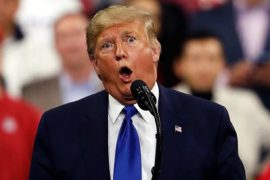
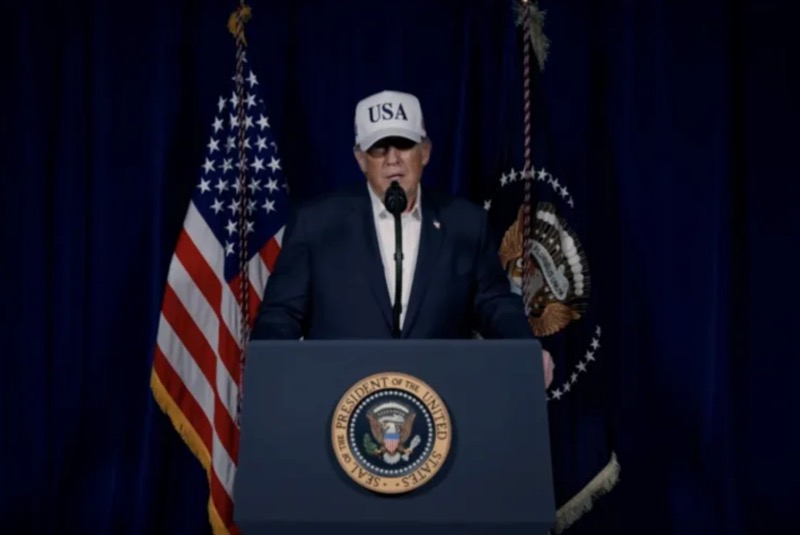
When Donald Trump announced that the United States was at war with Iran, he did so with a vulgar brashness that has long been his signature. The country, he said, was “eliminating imminent threats from the Iranian regime.” The phrase has a familiar cadence. Yet, the substance was elusive. No specific evidence was produced. No intelligence was shared. The assertion hovered—heavy with implication, lacking in detail.
It seemed as if the Trump administration was manufacturing a narrative of threats by looking in the rearview mirror. They pointed to the 1979 seizure of the American embassy in Tehran, which ended in 1981; to the 1983 bombing of U.S. Marine barracks in Beirut; and to the 2000 attack on the USS Cole. These were grievous episodes. But they are also decades old. To cite them as evidence of a present “imminent” threat is to stretch the ordinary meaning of the word beyond recognition.
At one point, Trump suggested that Tehran “knew about” and was “probably involved” in the Cole bombing—an assertion that has been debated for years but never conclusively established in a court of law. The Trump administration simultaneously maintained that it had “obliterated” Iran’s nuclear program the previous summer, a claim that undercuts the argument that required immediate war.
The episode raised a fundamental question about the architecture of the Constitution. The power “to declare War” resides in Congress. That power, embedded in Article I, was not an accident but a deliberate constraint, born of the Founders’ suspicion of concentrated executive authority.
The American President, as commander in chief, possess independent powers under Article II. Few serious observers would deny that a president may respond unilaterally to a genuine attack on America or on forces abroad. But in this instance, Iran did not attack the United States. The legal theory, therefore, could not rest on self-defence in the conventional sense. It required something more abstract: the narrative of an ‘existential threat.’
That tension becomes sharper when measured against the War Powers Resolution of 1973, enacted in the aftermath of Vietnam. The statute permits an American president to introduce U.S. forces into hostilities only pursuant to a declaration of war, specific statutory authorisation, or a national emergency created by an attack on the United States, its territories, or its armed forces.
No declaration had been issued. No new authorisation had been passed. No attack had occurred. The administration did not vigorously argue otherwise. Instead, its defenders suggested that historical practice—decades of presidents stretching the boundaries of unilateral action—had effectively rewritten the rulebook. Precedent, they implied, has a way of hardening into permission.
International law casts the matter in stark terms. The United Nations Charter, ratified by the U.S. Senate and signed in 1945 by Harry Truman, prohibits the use of force against the territorial integrity or political independence of any state, except when authorised by the Security Council. No Security Council resolution authorised the strikes.
In fact, Secretary-General António Guterres condemned the escalation, warning that the use of force by the United States and Israel against Iran, and Iran’s subsequent retaliation across the region, undermined international peace and security. He called for an immediate cessation of hostilities and a return to negotiations, emphasising that the Charter provides the foundation for maintaining international order.
Particularly fraught was the killing of Iran’s Supreme Leader, Ayatollah Ali Khamenei. International law shields heads of state from targeted killing. The strike represents a dramatic escalation beyond the 2020 killing of Qassem Soleimani, who, as a military commander, occupied a different legal category.
Domestically, successive executive orders—beginning in the 1970s—have prohibited political assassination. Yet presidents have repeatedly navigated around the ambiguity embedded in that term, arguing that targeted killings in the course of armed conflict are not “assassinations” but acts of war. The distinction is tidy on paper and contested in practice.
It is tempting to see this episode as unprecedented. In truth, American presidents of the past half-century have tested the elastic limits of war-making authority. The legal check, within the American system, is not prosecution but impeachment. Congress has never removed a president solely for unauthorised military action.
The practical consequence is cumulative boldness. Each administration cites the last; each departure becomes the next baseline. Trump’s legal defenders argue that history and prior precedent stand on his side, even if the statutory text does not. The argument is less about what the law says than about what the political system has tolerated.
Americans have seen this movie before. The 2003 invasion of Iraq, undertaken without explicit Security Council approval, is now regarded as a mistake. Yet the reasons most citizens give for that judgment are not primarily legal. They speak of the human toll, the financial burden, the regional instability, and the faulty intelligence regarding weapons of mass destruction and alleged links to the September 11 attacks. Law, in such moments, functions as a framework for argument rather than the decisive arbiter. Public opinion turns not on clauses but on consequences.
Ironically, Trump once criticised the Iraq War and promised that if he took office, he would usher in a new era of global restraint. Instead, he exacerbated tensions not only with Iran but also with Venezuela and Cuba. Relations with traditional allies have grown strained, especially after he suggested that Canada would soon be an American state and Greenland would be acquired by America.
European leaders have approached Washington with visible caution. Canada declined to participate in the military operations against Iran. Spain’s Prime Minister Pedro Sánchez rejected ‘unilateral military action’ and warned that the world cannot afford another prolonged and devastating war in the Middle East. He condemned illegal and indiscriminate attacks across the region and cautioned that violence, once unleashed, rarely confines itself to its intended targets.
The regional picture is volatile. Cross-border strikes have rippled outward, touching Gulf states and reigniting hostilities in places such as Lebanon, where the militant group Hezbollah has exchanged fire with Israel in past confrontations.
Diplomacy, meanwhile, had not been entirely dormant. Negotiations over Iran’s nuclear program were proceeding under Oman’s mediation, with recent talks held in Geneva. To launch strikes in the midst of such discussions is to signal a preference for coercion over diplomacy. That preference has spiralled into a wider conflict that would destabilise the region.
In the end, the debate over legality may prove less decisive than the unfolding reality on the ground. The architecture of the American Constitution and the UN Charter sketch out an ideal of deliberation and collective security. But practice has diverged from that ideal. Presidents act; Congress hesitates; the international community protests; events accelerate.
What distinguishes this moment is not simply the invocation of imminent threat without public evidence, but the cumulative erosion of the norms designed to slow the rush to war. Law depends on restraint, and restraint depends on a shared belief that the rules matter. When that belief frays, the vocabulary of imminence becomes dangerously elastic.
History suggests that Americans render their verdict not in laws but in narratives. If the conflict expands, casualties will mount, and alliances will weaken. But for now, it is clear that the United States is being run by a bunch of reckless cowboys and war criminals.
-30-
Copyright©Madras Courier, All Rights Reserved. You may share using our article tools. Please don't cut articles from madrascourier.com and redistribute by email, post to the web, mobile phone or social media.Please send in your feed back and comments to [email protected]