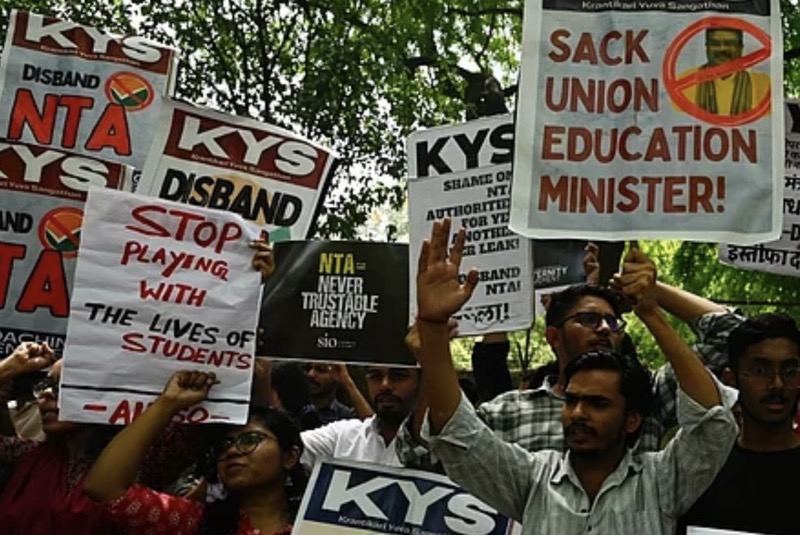
The controversy surrounding the alleged NEET-2026 paper leak has once again exposed the contradictions at the heart of India’s centralised examination system. The system, introduced in the name of ‘merit,’ transparency, and uniformity, has become associated with controversy, inequality, and institutional failure.
Between 2015 and 2026, India witnessed 148 exam-related scams; around 87 exams were cancelled due to irregularities and malpractice. In states such as Gujarat and Uttarakhand, the number of such cases rose from zero before 2015 to 13 and 9, respectively, after 2015.
In December 2025, a Parliamentary Standing Committee observed that, out of the 14 major exams conducted by the National Testing Agency (NTA) in 2024, at least five faced serious issues, including paper leaks, question errors, postponed examinations, and delayed results. These recurring failures indicate a systemic dysfunction.
However, despite repeated scams that threaten the futures of millions of students, no one has been held accountable. No senior minister or bureaucrat has accepted moral, political or administrative responsibility for the repeated failure of the exam system. The statistical anomalies surrounding NEET 2024 further intensified public suspicion. In 2022, not a single candidate secured a perfect score in NEET. In 2023, only two students achieved full marks.
However, in 2024, an unprecedented 67 candidates initially secured perfect scores, a figure later revised to 17, while some candidates reportedly obtained improbably high scores such as 718 and 719. Such extraordinary irregularities naturally triggered serious questions regarding the credibility and transparency of the examination process.
The aftermath of the 2024 NEET controversy sparked nationwide outrage, leading to the constitution of the Radhakrishnan Committee to recommend reforms and restore credibility to the examination process. However, its recommendations have been ignored.
The NTA frequently speaks of a “zero error, zero tolerance” policy. But slogans do not substitute credibility. When paper leaks recur, results are challenged, and examinations are postponed. When irregularities continue unabated, institutional claims of “zero error – zero tolerance” lose credibility.
Supporters of NEET often argue that a centralised examination system ensures uniform standards and reduces corruption. However, the reality is quite the opposite.
The recent NEET-UG 2026 paper leak further intensified these concerns. Following widespread allegations, the examination was reportedly cancelled, and a re-examination was announced, affecting more than 22 lakh aspirants across the country.
Reports of student suicides following the controversy exposed the enormous psychological burden imposed by an increasingly uncertain and crisis-ridden exam system. For millions of students, NEET represents years of sacrifice, social expectation, and the hope of upward mobility. However, uniformity without equality of preparation merely standardises inequality.
For years, Tamil Nadu has opposed the National Eligibility cum Entrance Test (NEET), arguing that it would disproportionately affect rural students, government school students, marginalised communities, and aspirants from economically and socially deprived backgrounds. Those apprehensions, dismissed for years as exaggerated or politically motivated, today appear alarmingly prophetic.
The crisis surrounding NEET must be viewed not simply as an administrative failure, but as a constitutional and social justice issue. As the political philosopher Michael J. Sandel observed, “The problem with meritocracy is not only that the practice falls short of the ideal, but that even a perfect meritocracy may not be morally or politically satisfying.”
“Meritocracy” rarely exists in isolation from privilege. It is shaped by access to elite schools, expensive coaching centres, financial resources, language proficiency, digital access, and social capital. When these inequalities are ignored, meritocracy ceases to function as a level playing field. Instead, it becomes a mechanism for reproducing existing hierarchies.
In practice, meritocracy often resembles a modern form of hereditary aristocracy.
A student studying in an elite urban institution with access to expensive coaching centres, digital infrastructure, English-language proficiency, and years of specialised preparation cannot be compared to a first-generation learner from a rural government school lacking basic educational resources. Treating these unequal social realities as equivalent in the name of ‘merit’ transforms formal equality into substantive injustice.
What happens to the daughter of an Adivasi family who dreams of becoming a doctor to serve her community? What happens to a rural Dalit student studying in an underfunded government school with limited access to coaching infrastructure, digital resources, hostel facilities, and institutional support?
For such students, exclusion begins long before the exam is even conducted. In practice, the commercial ecosystem surrounding NEET is determined not by talent or aspiration, but by social privilege and economic capacity. Consequently, NEET ceases to be an exam. Instead, it becomes an entrenched institutional barrier.
That is why opposition to NEET from several states and social justice movements must be understood within the broader constitutional framework of equality and social democracy. The Constitution of India does not merely promise formal equality under Article 14; it recognises the need for substantive equality through affirmative measures under Article 15(4) and the broader vision of social justice envisioned by Dr B. R. Ambedkar.
Education in a democracy cannot be viewed solely through the lens of market efficiency or competitive filtering. It must instead be understood as an instrument of empowerment and the greatest tool for social and economic mobility.
Various industry estimates suggest that India’s coaching-centre economy may now be worth nearly ₹55,000-₹60,000 crore. The rise of paper-leak mafias worsens this inequality further. A paper leak is not simply an act of corruption; it is an organised assault on fairness. It creates side-door opportunities for those who can afford to spend lakhs of rupees on purchasing question papers, while simultaneously reinforcing existing financial privilege.
The consequences are profound. Every student, including those from an affluent background, is subjected to enormous psychological stress, repeated uncertainty, disrupted academic calendars, and recurring institutional failures.
Most importantly, the burden of these failures falls disproportionately upon rural students, Dalits, Adivasis, backward classes, socially and economically deprived communities — reinforcing the inequalities that education in a democracy is expected to reduce.
A nation cannot build an equitable healthcare system while systematically excluding large sections of society from medical education.
The medical profession, by its very nature, demands a commitment to service, empathy, and universal care that transcends caste, class, language, religion, and region. Doctors continue to occupy a uniquely respected moral position in Indian society.
A healthcare system that systematically excludes marginalised communities from medical education risks producing not merely inequality in opportunity, but inequality in representation within the medical profession. Such exclusion distances healthcare institutions from the lived realities of large sections of Indian society.
In a constitutional democracy committed to social justice, medical education cannot become the preserve of privilege alone. The systematic exclusion of marginalised communities from the medical profession is not only socially harmful; it stands in opposition to the constitutional vision of equality, inclusivity, and democratic empowerment.
The NEET crisis, therefore, extends far beyond examination malpractice. It reflects widening inequality, the commercialisation of education, institutional decay, and the erosion of public trust.
-30-
Copyright©Madras Courier, All Rights Reserved. You may share using our article tools. Please don't cut articles from madrascourier.com and redistribute by email, post to the web, mobile phone or social media.Please send in your feed back and comments to editor@madrascourier.com